


Artificial intelligence (AI) holds immense potential to reshape industries, from automating tasks to generating new insights. Yet, despite this promise, only a handful of companies have turned AI deployments into substantial profits, though most are chipmakers like Nvidia (NASDAQ:NVDA | NVDA Price Prediction) that supply advanced accelerators to fuel AI expansion.
However, many customers investing in these tools struggle to realize meaningful returns. As questions mount about whether the technology justifies its costs, Meta Platforms (NASDAQ:META) may have cracked the code and emerged as the standout example of profitable AI integration.
Doubts Mount on AI’s Financial Payoff
In recent weeks, scrutiny has intensified over whether companies can achieve solid returns on the hundreds of billions — potentially trillions — poured into AI infrastructure. Big Tech’s combined capital expenditures for 2026 are projected at around $650 billion, rivaling the GDP of some nations, yet investor unease is growing as spending outpaces clear revenue gains.
Data infrastructure challenges alone lead to an estimated $108 billion in wasted AI investments annually, with only 43% of U.S. leaders reporting predictive operations. This has triggered market volatility, including a $1 trillion wipeout in software stocks amid fears of AI disruption.
The Uncertainty of the AI Push to Lift Profits
Microsoft (NASDAQ:MSFT) has integrated AI across its products, with capital expenditures hitting $37.5 billion in its latest quarter — up 65% year-over-year — to build “AI factories.” Revenue reached $81.3 billion, up 17%, and profits surged 60% to $38.5 billion. Azure cloud grew 39%, but this marked a slight slowdown from prior quarters, raising concerns about monetization gaps.
The company’s annualized spending run rate of $150 billion has sparked investor backlash, with shares dropping 11% after earnings as power constraints and unclear ROI timelines weigh in.
Google parent Alphabet (NASDAQ:GOOG)(NASDAQ:GOOGL), reported cloud revenue up 48% to $17.7 billion, achieving a 30% operating margin and highlighting AI infrastructure as profitable. Gemini has reached 750 million monthly users, while Project Genie — an AI for creating immersive worlds — stirred markets by demonstrating potential to disrupt sectors like gaming. This contributed to the “SaaS-pocalypse,” a $300 billion evaporation in software values as AI agents threaten traditional models.
However, Alphabet’s 2026 capex forecast of $175 billion to $185 billion — nearly double last year’s spend — has fueled doubts about when platforms like Gemini and Genie will deliver sustained profits.
Highlighting Meta’s AI Edge
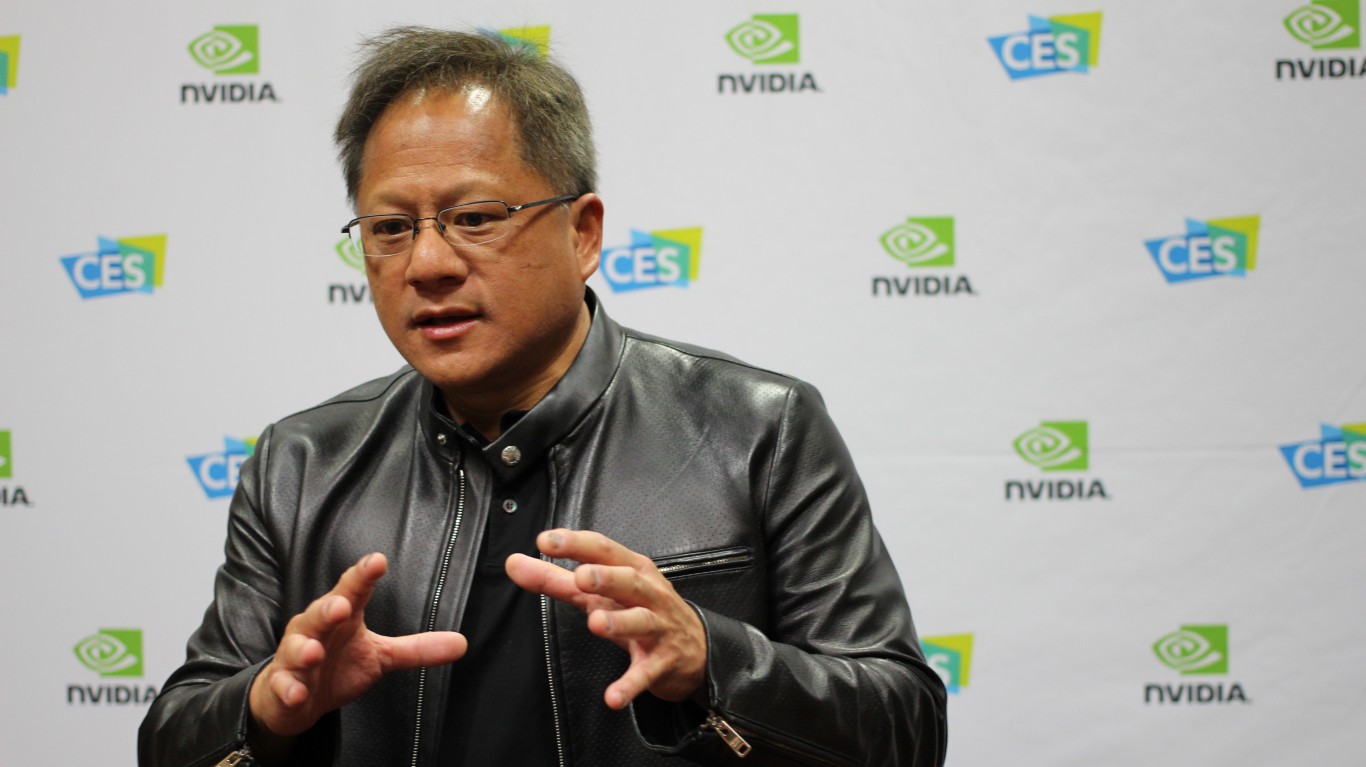
Nvidia CEO Jensen Huang recently praised Meta as the top AI deployer, stating in a CNBC interview that its approach yields real rewards from massive investments. Huang noted Meta’s shift to generative AI has transformed its business, driving earnings growth and justifying continued spending. This comes amid broader AI optimism from Huang, who views the $660 billion capex buildout as sustainable due to rising cash flows.
In the interview, Huang explained that Meta upgraded from classical CPU-based recommenders to generative AI agentic systems for recommendations. This change has altered social media operations and advertiser content creation, with earnings reflecting the impact. He emphasized Meta’s AI use drives a greater future potential, fueling heavy investments.
Meta’s AI-driven ad ranking, for example, has delivered about four times more revenue impact than simply increasing ad load, with both ad prices and impressions accelerating.
For Meta, Huang’s endorsement underscores its lead in monetizing AI through ads. The company reported fourth-quarter ad revenue of $58.14 billion, up 24%, with AI powering a 3.5% lift in Facebook ad clicks and over 1% in Instagram conversions. Video generation tools hit a $10 billion run-rate, growing nearly three times faster than overall ad revenue.
Despite 2026 capex of $115 billion to $135 billion for AI infrastructure, incremental ROI remains above 20%, with cash return on invested capital over 52%. This positions Meta as a model for turning AI into compounding revenue leverage via smarter, embedded systems.
Key Takeaway
Concerns about AI are valid, from uncertain ROI on massive spending to disruptions in industries and the labor force. Yet, if other companies can replicate Meta’s success in integrating AI for tangible gains, it could broaden opportunities as initially promised, though the shift to this landscape could and likely will be painful for many.












 Top Gaining Stocks
 Top Losing Stocks