



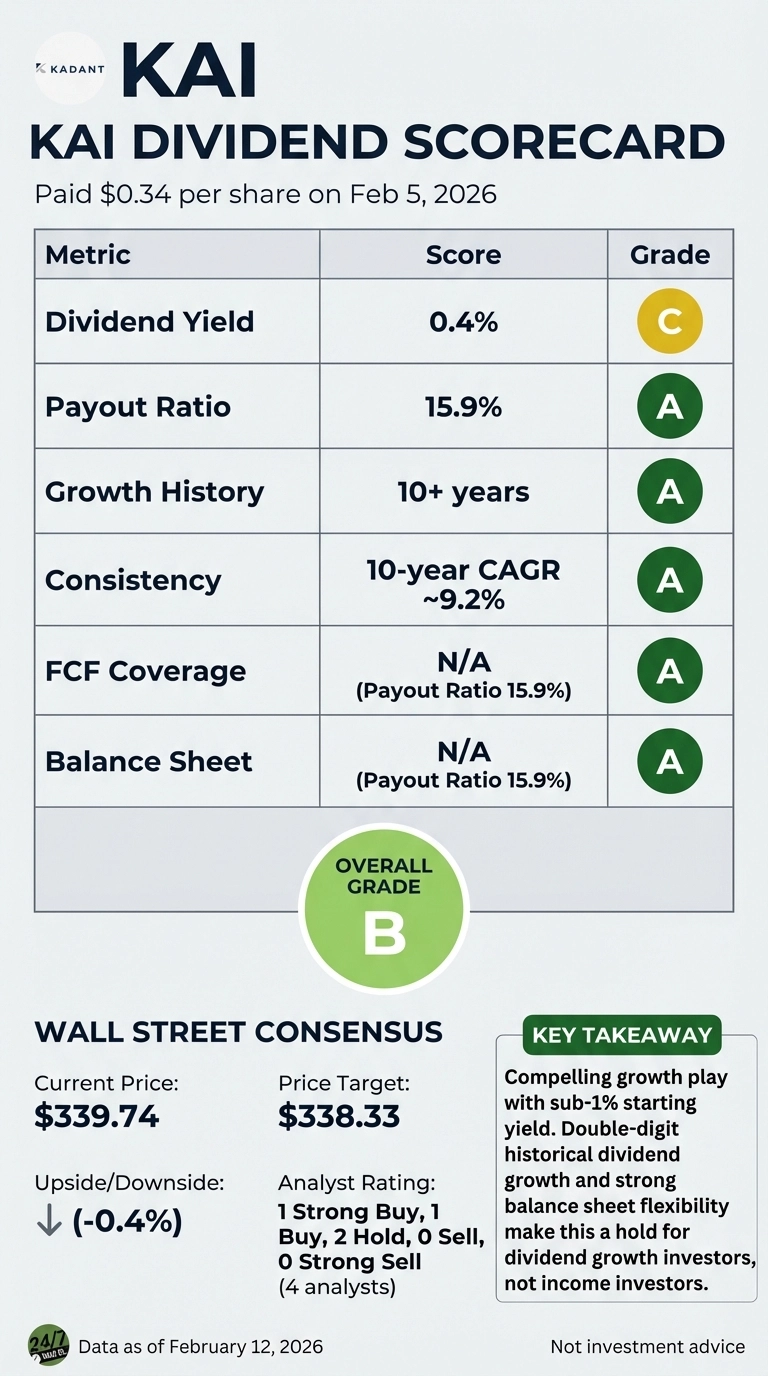
Kadant Inc. (KAI) delivered its latest quarterly dividend of $0.34 per share on February 5, 2026, marking another consistent payment in the industrial machinery supplier’s decade-long dividend growth streak. With shares currently trading at $339.74, the modest 0.4% yield might raise eyebrows among income-focused investors—but this dividend scorecard reveals a more nuanced story about capital allocation in a high-growth industrial.
The Dividend Profile: Steady Growth, Low Yield
Kadant’s annual dividend stands at $1.36 per share, based on four consecutive quarterly payments of $0.34 throughout 2025. That represents a 6.25% increase from 2024’s $1.28 annual total, continuing a pattern of mid-single-digit annual raises that has persisted for more than a decade.
The payout ratio sits at a conservative 15.9%, calculated from the $1.36 annual dividend against trailing twelve-month earnings of $8.54 per share. This leaves substantial room for future increases while allowing the company to reinvest heavily in growth initiatives—a strategic choice reflected in Kadant’s 11.3% return on equity and expanding market position in specialty industrial machinery.
Growth Trajectory: Consistency Over Acceleration
Kadant has increased its dividend for 10+ consecutive years, with the quarterly payment climbing from $0.125 in 2013 to today’s $0.34—a 172% total increase over that span. The 10-year compound annual growth rate of approximately 9.2% significantly outpaces inflation and demonstrates management’s commitment to returning value even as the company pursues acquisitions and capacity expansion.
Recent growth rates have moderated slightly, with the 2025 increase of 6.25% following 2024’s 10.34% jump. This pattern aligns with the company’s operational reality: quarterly earnings declined 12.3% year-over-year in the most recent quarter, reflecting cyclical pressures in certain end markets despite flat revenue growth.
Valuation Context: Premium Pricing for Quality
The stock’s 39.2x trailing P/E ratio and 33.3x forward P/E reflect investor confidence in Kadant’s long-term positioning rather than current dividend income. The company trades at 3.85 times trailing sales and 4.2 times book value, premiums justified by its 16.8% operating margin and specialized product portfolio serving paper, packaging, and industrial processing markets.
Price performance tells the growth story: shares have gained 132.63% over five years and an exceptional 859.34% over ten years. Even after a 4% decline over the past year, the stock has surged 19.8% year-to-date as investors anticipate recovery in industrial capital spending.
The Dividend Scorecard: Grade B
Strengths: Kadant earns high marks for dividend growth consistency and financial sustainability. The 10-year streak of annual increases with no cuts demonstrates management discipline, while the 15.9% payout ratio provides exceptional coverage and flexibility. The company’s $3.94 billion market capitalization and $1.02 billion in trailing revenue offer scale advantages in niche industrial markets.
Weaknesses: The 0.4% yield ranks in the bottom quartile among dividend-paying industrials, limiting appeal for income investors. Recent earnings volatility—with quarterly earnings down 12.3%—raises questions about near-term dividend growth acceleration, even if the low payout ratio provides cushion. The 39.2x P/E ratio leaves little room for disappointment.
Peer Context: Kadant’s dividend profile reflects a growth-oriented industrial rather than a mature income play. The 0.4% yield is lower than many established industrials but aligns with specialty machinery peers prioritizing reinvestment. The 9.2% historical dividend growth rate exceeds most large-cap industrials, offering a different value proposition: modest current income with strong growth potential.
What Investors Should Watch
The next dividend declaration, expected in early May 2026 based on historical patterns, will signal management’s confidence following Q1 2026 results. With analyst target prices averaging $338.33 essentially at current levels, dividend growth may become an increasingly important component of total return.
The payment schedule remains predictable: quarterly dividends typically go ex-dividend in early January, April, July, and October, with payments following 3-4 weeks later. This consistency, combined with the company’s 84.6% insider ownership, suggests alignment between management and long-term shareholders focused on compounding value rather than maximizing current yield.
For dividend growth investors willing to accept a sub-1% starting yield, Kadant offers a compelling combination: double-digit historical dividend growth, strong balance sheet flexibility with a 15.9% payout ratio, and exposure to secular trends in sustainable manufacturing and industrial efficiency. The recent payment maintains a streak that has quietly built wealth through consistent raises rather than headline-grabbing yields.











 Top Gaining Stocks
 Top Losing Stocks