


Consumer sentiment has been sitting in recessionary territory for months, with the University of Michigan’s index at 56.4 as of January 2026 and the S&P 500 up just 0.81% year-to-date. That combination is exactly the environment where defensive funds like KXI have historically demonstrated their characteristics.
What KXI Is Actually Built to Do
KXI tracks a global index of companies selling things people buy regardless of economic conditions: food, beverages, household products, and tobacco. The fund holds roughly 55% of its identifiable holdings in international names, including Nestlé, Unilever, and Diageo, giving it exposure outside the US that its domestic counterpart Consumer Staples Select Sector SPDR Fund (NYSEARCA:XLP | XLP Price Prediction) doesn’t offer.
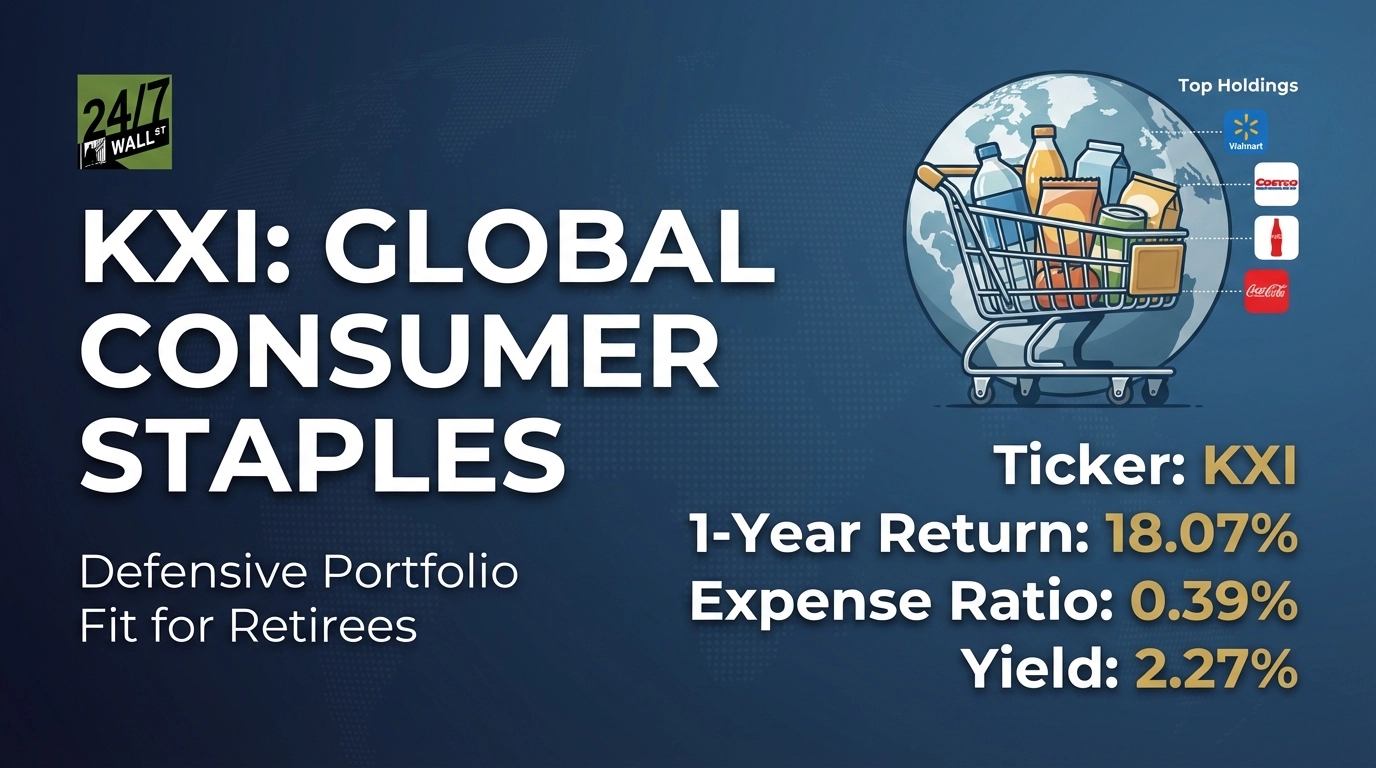
The two largest positions — Walmart (NYSE:WMT) at 9.94% and Costco (NASDAQ:COST) at 9.22% — are retailers that have consistently grown earnings through economic cycles, anchoring the portfolio in businesses with demonstrated resilience. KXI yields 2.27% with a 0.39% expense ratio, with distributions paid semi-annually.
Does the Defense Actually Hold?
iShares Global Consumer Staples ETF (NYSEARCA:KXI) has meaningfully outpaced the S&P 500 over the past year — returning 18.07% versus the index’s 15.11% — while taking on less volatility, a pattern consistent with how defensive funds behave when consumer sentiment is depressed.
That outperformance reflects the earnings durability of KXI’s largest holdings. Walmart has been gaining grocery market share and expanding internationally, with Q4 FY26 revenue up 5.6% year-over-year. Costco’s 89.7% membership renewal rate signals the kind of sticky consumer loyalty that holds up in downturns. Coca-Cola’s 63-year dividend growth streak reflects the pricing power that makes consumer staples a historically consistent income source.
Three Tradeoffs Worth Understanding
The international exposure that differentiates KXI from XLP also introduces currency risk. Coca-Cola, PepsiCo, Procter & Gamble, and Philip Morris all flagged foreign exchange headwinds in their most recent earnings, and a strengthening dollar can quietly erode returns even when underlying businesses perform well.
KXI carries roughly 12.5% in tobacco stocks, including Philip Morris, Altria, British American Tobacco, and Japan Tobacco. These positions pay high dividends and have been strong performers, but ESG-focused investors will find KXI incompatible with ethical screens. Altria and Philip Morris both carry high dividend yields, reflecting their classification as income-oriented holdings rather than growth positions.
The fund’s 0.39% expense ratio is nearly five times XLP’s 0.08%. Over a long time horizon, that difference compounds meaningfully. The tobacco holdings, higher expense ratio, and international diversification are key structural differences between KXI and XLP that investors and their advisors may consider when evaluating which fund aligns with their portfolio goals.












 Top Gaining Stocks
 Top Losing Stocks