



When markets crack, consumer staples tend not to. During the 2008 financial crisis, the S&P 500 fell approximately 38% peak to trough, and consumer staples, as a sector, declined roughly half of that. In the 2020 pandemic selloff, the S&P lost about 34% in five weeks while staples fell closer to 20%.
In the 2022 bear market, the broad index declined roughly 25% while staples held to single-digit losses. The pattern is consistent enough that retirees and near-retirees have increasingly treated the sector not as an opportunity but as insurance.
Three funds make that insurance accessible and low-cost: the State Street Consumer Staples Select Sector SPDR ETF (NYSE:XLP | XLP Price Prediction), the Vanguard Consumer Staples Index Fund ETF Shares (NYSE:VDC), and the Fidelity MSCI Consumer Staples Index ETF (NYSE:FSTA). They hold nearly identical portfolios, charge almost nothing, and behave in ways that protect capital precisely when it most needs protecting.
Why Staples Hold Up When Nothing Else Does
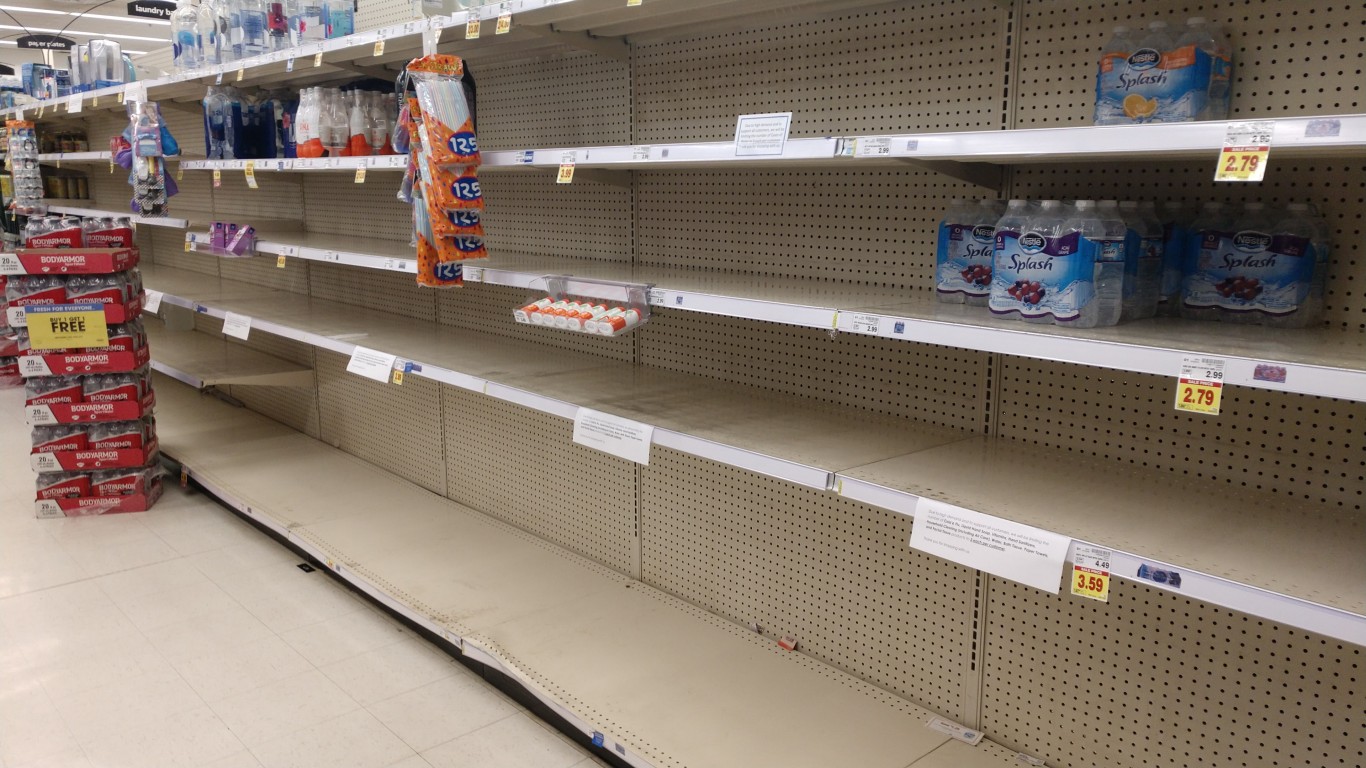
The mechanism is straightforward: consumer staples companies sell products that people buy regardless of economic conditions, such as food, beverages, household goods, and tobacco. Demand does not evaporate in a recession. Neither does pricing power for brands with decades of consumer loyalty. Procter & Gamble, Coca-Cola, and Walmart do not stop collecting revenue when unemployment rises. That inelastic demand floor supports earnings and, by extension, dividends, and even when growth stocks are repricing dramatically lower.
Beta confirms what the drawdown history already tells us as the State Street Consumer Staples Select Sector SPDR ETF carries a beta of 0.66. The Vanguard Consumer Staples Index Fund ETF Shares run at 0.69, while the Fidelity MSCI Consumer Staples Index ETF sits at 0.68.
All three move at roughly two-thirds the volatility of the broader market, which in a sharp selloff translates into a meaningful preservation of capital.
The Three Funds Side by Side
The State Street Consumer Staples Select Sector SPDR ETF has returned 6.06% year-to-date, yields 2.65%, and charges 0.08%. It is the largest of the three with $15.4 billion in net assets and the most widely traded. Its top holdings are Walmart, Costco, Procter & Gamble, Coca-Cola, and Philip Morris.
The Vanguard Consumer Staples Index Fund ETF Shares has returned 7.30% year-to-date, yields 2.15%, and charges 0.09%. With $9.2 billion in assets, it tracks the MSCI US Investable Market Consumer Staples Index and holds the same top names with slightly higher weightings in Walmart and Costco than the State Street fund.
The Fidelity MSCI Consumer Staples Index ETF has returned 6.71% year-to-date, yields 2.22%, and charges 0.08%. At $1.4 billion, it’s the smallest of the three but tracks essentially the same index as the Vanguard Consumer Staples Index Fund ETF Shares, producing nearly identical performance. The difference between owning either is marginal for most investors.
Where They Overlap and Where They Differ
All three funds hold Walmart, Costco, Procter & Gamble, Coca-Cola, and Pepsi in their top positions. The divergence is in concentration, where the State Street Consumer Staples Select Sector SPDR ETF gives Walmart and 11.85% weight versus 15.71% in the Vanguard fund. Costco sits at 9.62% in the State Street fund and 12.44% in the Vanguard fund. Investors who want slightly less concentration in the top two names will find the State Street Consumer Staples Select Sector SPDR ETF more balanced.
Approximate Max Drawdown During the Last Three Selloffs
| Selloff | S&P 500 | XLP | VDC | FSTA |
| 2008 Financial Crisis | -38% | ~-16% | ~-14% | N/A (inception 2013) |
| 2020 COVID Crash | -34% | ~-19% | ~-18% | ~-18% |
| 2022 Bear Market | -25% | ~-4% | ~-5% | ~-5% |
The Risk Worth Naming
Staples underperform significantly in growth-led rallies, so when the S&P surged in 2023 and 2024, all three funds trailed the index by wide margins. Retirees who hold too much in staples during a bull run sacrifice meaningful compounding. These are not core equity positions, they are a defensive ballast.
A reasonable allocation for a retiree with a moderate risk profile is 10% to 20% of equity exposure in consumer staples ETFs. Trimming toward the lower end makes sense when yield curves normalize, credit conditions ease, and earnings growth broadens beyond defensive sectors. That rotation signal, not a calendar event, is the right trigger to reduce the position.











 Top Gaining Stocks
 Top Losing Stocks