


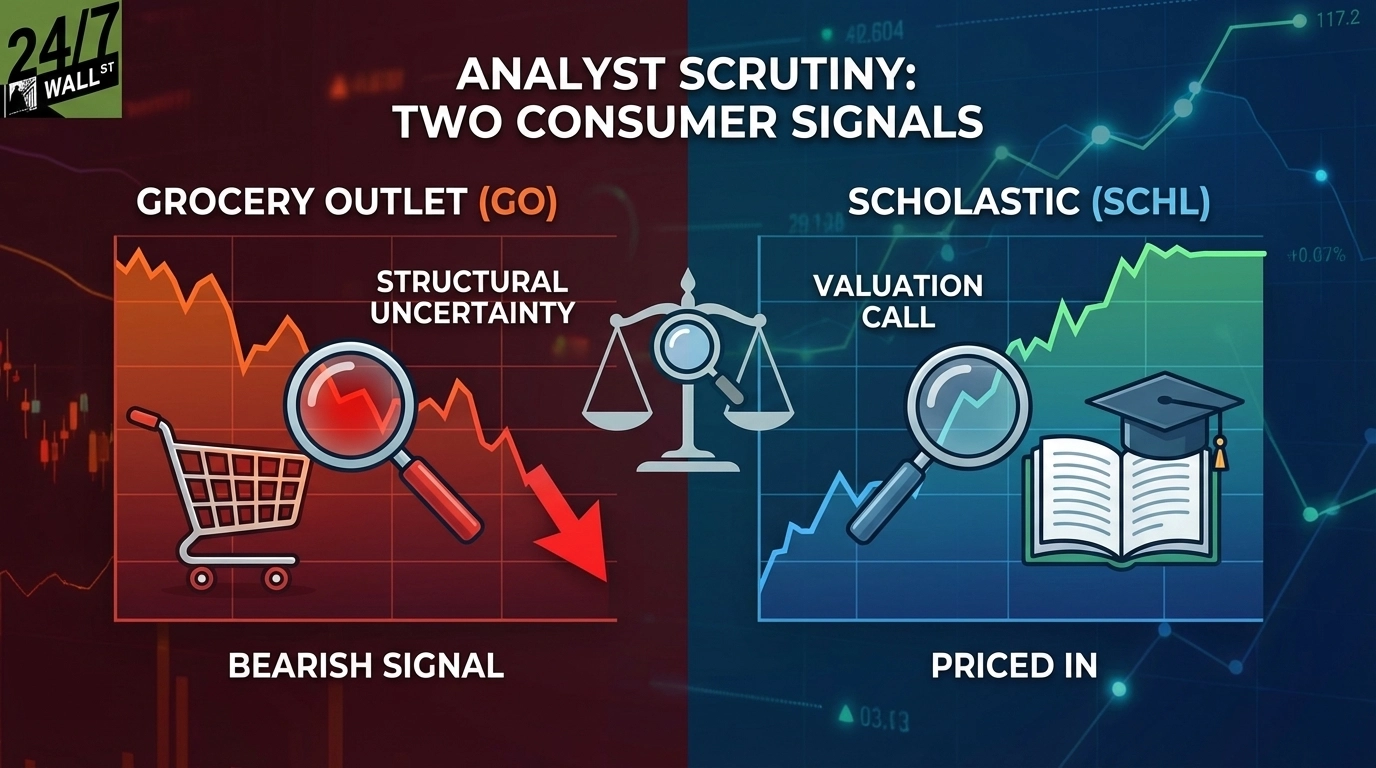
Wall Street is sending two distinct signals on consumer-facing stocks this week. Grocery Outlet is firmly in the bearish camp, with analysts cutting targets and flagging structural recovery uncertainty. Scholastic, by contrast, is being downgraded not because the story has soured, but because the market has already priced in the good news.
Grocery Outlet: Neutral, With Deteriorating Conviction
Bank of America lowered its price target on Grocery Outlet to $10.50 from $13, maintaining a Neutral rating. The firm points to ongoing supply chain pressure and affordability challenges among core consumers, with uncertain timing on comp sales and basket size recovery. That assessment is well-supported by the numbers.
Grocery Outlet (NASDAQ:GO) reported Q4 FY2025 adjusted EPS of $0.19 against a consensus estimate of $0.21, missing by 10.59%. Comparable store sales swung to -0.8% after posting +1.2% in Q3, and average transaction size fell -1.7%. The company recorded $259.2 million in combined goodwill and long-lived asset impairment charges, driving a GAAP net loss of $218.16 million.
FY2026 guidance compounds the concern. Management guided for comparable store sales of -2.0% to flat and diluted adjusted EPS of $0.45 to $0.55, well below the $0.76 delivered in FY2025. The company is also closing 36 underperforming stores under a board-approved Optimization Plan. CEO Jason Potter acknowledged the quarter directly: “Consumer pressure intensified, federally funded benefits were delayed, and competition grew more promotional in the fourth quarter.”
The stock has collapsed -42.92% year-to-date to $5.72 as of today, sitting well below BofA’s already-reduced $10.50 target. The consensus across 14 analysts shows 10 holds and 1 sell, with an average price target of $8.31. Even the average target implies meaningful upside from current levels, but the analyst community is not rushing to upgrade. An unresolved material weakness in internal controls adds another layer of institutional hesitation. The macro backdrop reinforces the caution: University of Michigan Consumer Sentiment stood at 56.4 in January 2026, a recessionary-level reading that directly pressures the value-oriented shopper Grocery Outlet depends on.
Scholastic: A Valuation Call, Not a Fundamental One
B. Riley’s move on Scholastic tells a different story. The firm downgraded Scholastic to Neutral from Buy, keeping its price target unchanged at $37. The rationale: the stock returned 50% inclusive of dividends since B. Riley’s early-September initiation, shares are at a 52-week high, and the stock is within 3% of the price target. B. Riley states the shares largely reflect its growth expectations.
Scholastic (NASDAQ:SCHL) trades at $34.49 today, up 66.44% over the past year. The Q2 FY2026 earnings beat was substantial: adjusted EPS of $2.57 versus the $2.07 consensus, a 24.15% beat. Operating income grew 11.57% year-over-year, and the company closed a sale-leaseback generating approximately $401 million in net proceeds, funding a $150 million share repurchase program. Coverage is thin, with only one analyst rating on record, a Buy, with a $36 price target.
The risks worth watching: Education Solutions revenue fell 13% in Q2 after dropping 28% in Q1, reflecting persistent federal and state funding headwinds. Book Clubs revenue also slid 14% in Q2. These structural pressures have not derailed the transformation narrative, but they limit how much further upside analysts see from here.
Analyst Takeaways
On Grocery Outlet, the analyst consensus is overwhelmingly Hold despite the stock trading below every price target on record. The gap between current price and targets reflects uncertainty about the timing of comp sales and basket size recovery, not a consensus view of near-term upside. On Scholastic, the downgrade follows a strong run since B. Riley’s initiation. With shares near the price target and limited analyst coverage, analysts see the growth thesis as largely reflected in the current price.








 Top Gaining Stocks
 Top Losing Stocks