


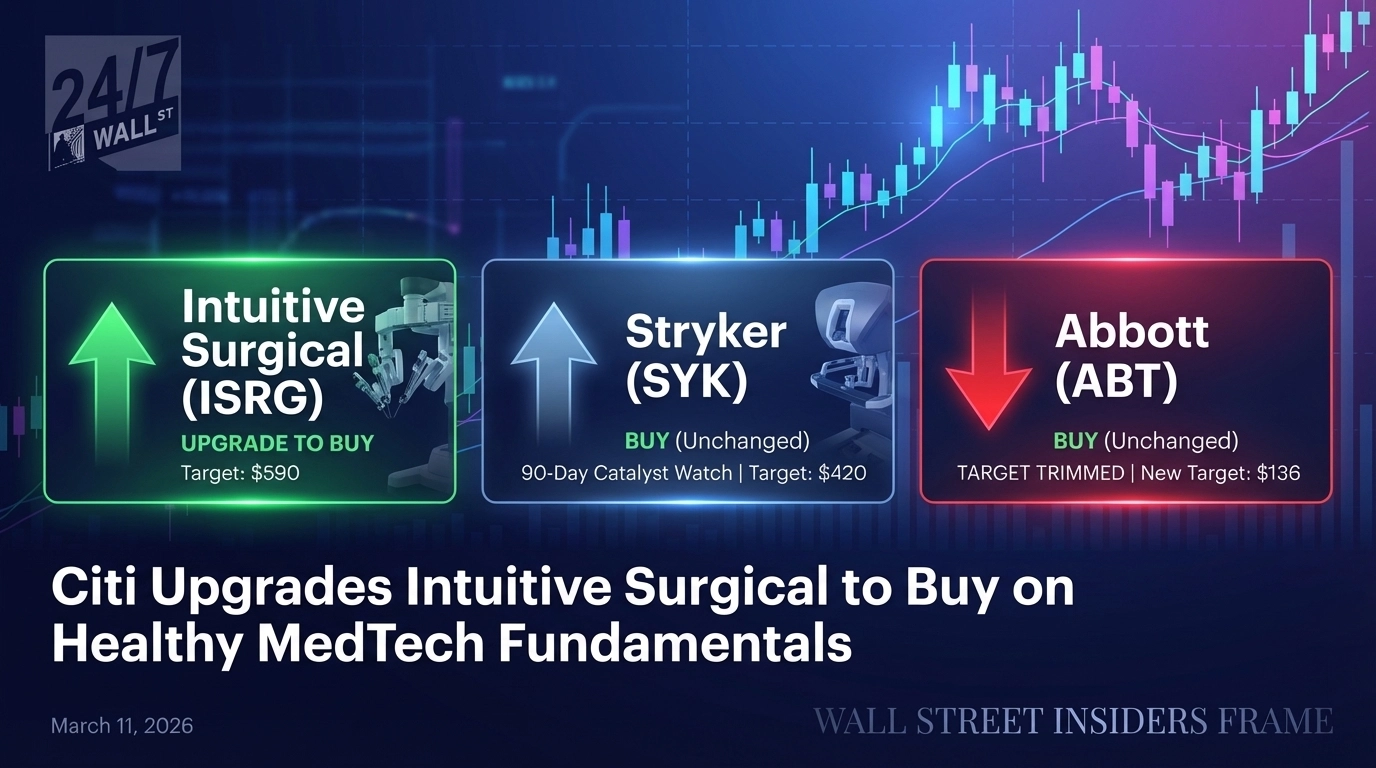
Citi is making a clear statement about the health of U.S. medical technology heading into the spring: the sector’s fundamentals remain intact, even as broader market volatility has dragged down some of the industry’s strongest names. On Wednesday, the firm upgraded Intuitive Surgical (NASDAQ:ISRG | ISRG Price Prediction) to Buy from Neutral, opened a 90-day catalyst watch on Stryker (NYSE:SYK), and trimmed its price target on Abbott (NYSE:ABT) while maintaining its Buy rating. Across all three names, Citi analyst Joanne Wuensch characterized sector fundamentals as “healthy” despite recent turbulence — a conviction call at a moment when the VIX has climbed sharply.
| Ticker | Company Name | Firm | Old → New Rating | New Price Target | One-Line Takeaway |
|---|---|---|---|---|---|
| ISRG | Intuitive Surgical | Citi | Neutral → Buy | $590 | Upgrade follows pullback despite continued double-digit growth trajectory |
| SYK | Stryker | Citi | Buy (unchanged); 90-day catalyst watch added | $420 | Consistent execution and Mako robotics expansion warrant close monitoring |
| ABT | Abbott | Citi | Buy (unchanged); target lowered | $136 (from $140) | Post-Q4 target trim; dividend stalwart with device growth intact |
The Analyst’s Case
The Intuitive Surgical upgrade is the headline move. Citi argues that the stock has sold off alongside the broader market despite no deterioration in the underlying business, and that the company remains well positioned to grow sales at a double-digit pace while leveraging earnings. That assessment is grounded in a track record that is hard to dismiss: Intuitive beat EPS and revenue estimates in all four quarters of 2025, and its da Vinci 5 platform is still in the early stages of a multi-year adoption cycle.
For Stryker, Citi is not changing its Buy rating, but the addition of a 90-day catalyst watch signals the firm is watching for a specific near-term inflection. The note points to consistent double-digit revenue and earnings growth as the foundation for the existing Buy, while the catalyst watch likely reflects early data from the Mako RPS handheld robotic system, which entered limited market release heading into 2026.
The Abbott target cut is a post-earnings housekeeping move rather than a change in conviction. Citi adjusted targets across the medical technology group following Q4 reports, and the $4 reduction to Abbott’s target reflects the more modest growth profile of a diversified healthcare giant rather than any structural concern. Notably, Citi’s top picks in the sector are iRhythm and Medtronic — Abbott and the other names here represent solid but secondary positioning within the firm’s MedTech framework.
Company Snapshot and Recent Performance
Intuitive Surgical has pulled back sharply from its highs despite delivering one of the strongest fundamental years in its history. The stock is trading around $485.85, down 14.2% year-to-date after closing 2025 near a 52-week high of $603.88. That gap between operational momentum and price action is precisely what Citi is flagging. In Q4 2025, the company posted revenue of $2.87 billion, up 18.76% year-over-year, with non-GAAP EPS of $2.53 against a consensus estimate of $2.26. The da Vinci 5 placed 303 systems in Q4 alone, compared to 174 in the same quarter a year earlier, and the total installed base reached 11,106 systems, up 12%.
Stryker is holding up better on a relative basis, trading at $358.65, up 2% year-to-date, though it slipped 6.7% over the past week. The company crossed a significant milestone in 2025, surpassing $25 billion in annual revenue for the first time, with full-year revenue of $25.12 billion, up 11.16%. Adjusted operating margins expanded at least 100 basis points for the second consecutive year.
Abbott is the laggard in the group, with shares at $110.55, down 11.3% year-to-date and 18% over the past year. Q4 revenue came in at $11.46 billion, a modest 4.42% year-over-year gain, with the medical devices segment — including $2.0 billion in CGM sales, up 15% — providing the clearest growth signal. The company’s pending $21 billion acquisition of Exact Sciences, expected to close in Q2 2026, adds a cancer diagnostics dimension that could reshape Abbott’s long-term growth profile.
Why the Move Matters Now
The market backdrop is doing a lot of the work here. The VIX has surged to 25.50 as of early March, sitting at the 92.6th percentile of its 12-month range and up 43.6% from just a month ago. That kind of broad-market fear tends to compress valuations indiscriminately, and Citi is arguing that Intuitive Surgical in particular has been caught in that downdraft without justification from its fundamentals.
At $485.85, Intuitive trades at roughly 49x forward earnings, a premium that reflects the company’s growth rate and competitive moat in robotic-assisted surgery. Citi’s $590 price target implies upside from current levels based on analyst price targets vs. current prices, and the broader analyst consensus sits even higher at $609.82. The company’s 2026 guidance calls for da Vinci procedure growth of 13% to 15%, a deceleration from 2025’s pace but still firmly double-digit, with a tariff headwind of approximately 1.2% of revenue already baked into management’s outlook.
Stryker’s implied upside to Citi’s $420 target is based on analyst price targets vs. current prices, and the broader analyst consensus of $424.89 is closely aligned. The forward P/E of roughly 24x is meaningfully more modest than Intuitive’s, reflecting Stryker’s more diversified and mature business mix. For Abbott, the $136 revised target implies upside based on analyst price targets vs. current prices, and with a forward P/E near 20x and a 54-year dividend growth streak, the valuation case is more straightforward for income-oriented investors.
Breaking Down the Three Names
Citi’s cluster of moves sends a coherent message: MedTech is not broken, it has just been repriced by macro fear. All three names offer meaningful upside to current analyst targets, but Citi’s notes reflect distinct business profiles and risk characteristics across the group.
Citi’s upgrade of Intuitive Surgical centers on the da Vinci 5 adoption curve, which remains in its early stages — 303 placements in Q4 2025 versus just 8 in Q1 2024 illustrates the pace of acceleration — and a recent FDA clearance for certain cardiac procedures opens a potential new procedure category. The firm’s note acknowledges valuation risk: even after the year-to-date pullback, the stock carries a premium multiple, and tariff exposure from manufacturing in Mexico and Germany is a real, if manageable, headwind. The company’s $9.03 billion cash position provides meaningful buffer.
Citi’s note highlights Stryker’s more modest forward P/E of roughly 24x relative to Intuitive, reflecting its more diversified and mature business mix. Its 2026 guidance of $14.90 to $15.10 in adjusted EPS and 8% to 9.5% organic growth represent a durable compounding story. The 90-day catalyst watch is worth noting: if the Mako RPS robotic system shows early commercial traction, it could be the signal Citi needs to add further conviction.
Abbott is characterized in Citi’s coverage as the most defensive of the three names. Its $0.63 quarterly dividend and unbroken dividend growth record are highlighted alongside the Exact Sciences deal, which, if it closes as expected, could reinvigorate the growth narrative. The near-term caution reflected in the target trim is that management’s guidance of 6.5% to 7.5% organic sales growth in 2026 does not leave much room for upside surprise.










 Top Gaining Stocks
 Top Losing Stocks