


Ten years ago, Oracle (NYSE: ORCL | ORCL Price Prediction) and Salesforce (NYSE: CRM) were both navigating a pivotal shift: legacy software companies racing to reinvent themselves as cloud businesses. Both made it, but the paths diverged sharply, and so did the returns.
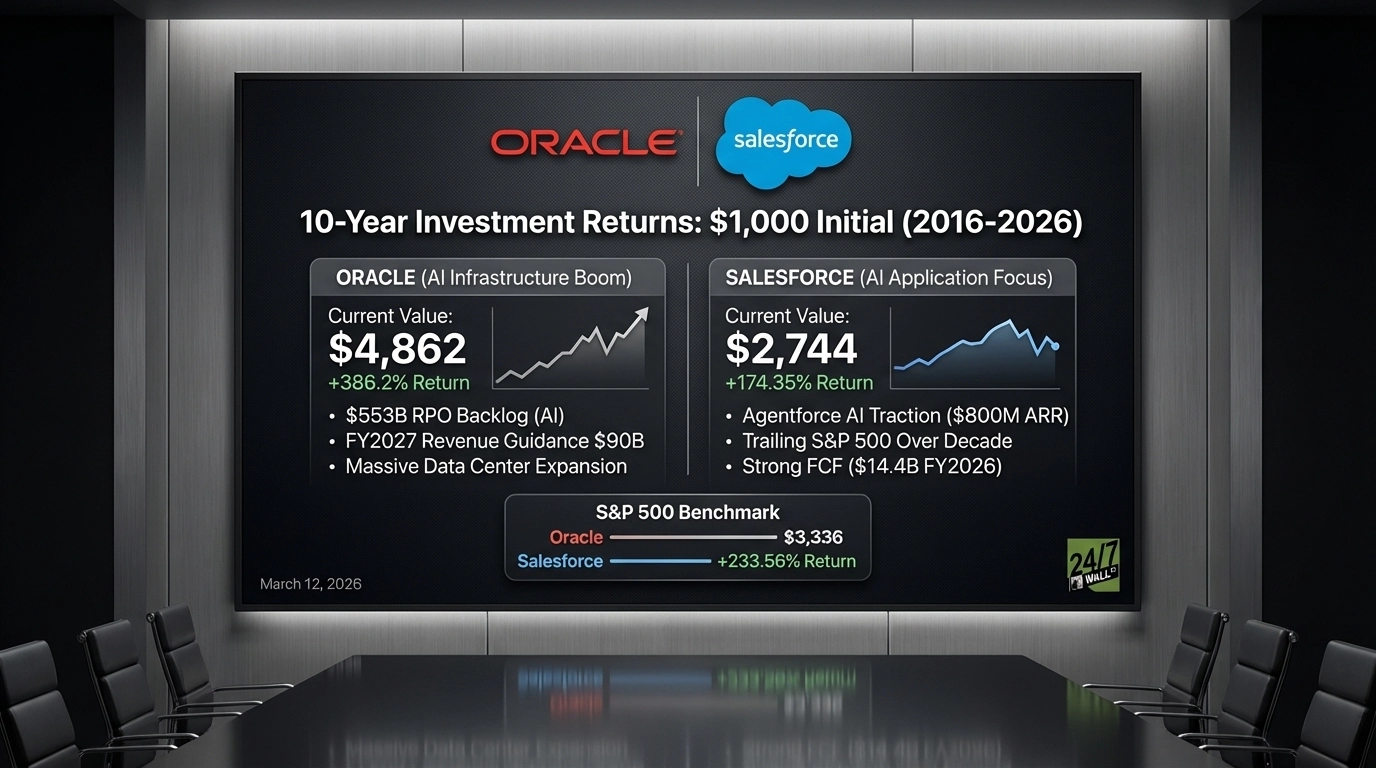
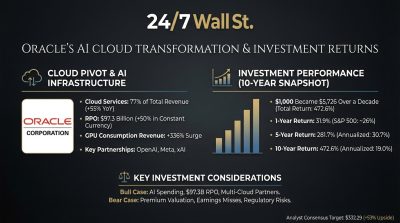
Oracle spent much of the late 2010s migrating its massive installed base to the cloud. The real acceleration came later, when artificial intelligence (AI) infrastructure demand exploded. Oracle’s cloud data centers became critical real estate for AI training workloads, and the company locked in an extraordinary pipeline. Remaining performance obligations reached $553 billion in Q3 FY2026, up 325% year-over-year, signaling years of contracted revenue already on the books.
Salesforce dominated customer relationship management (CRM) and expanded aggressively into marketing, analytics, and collaboration. Growth was real, but the stock ran far ahead of fundamentals during the 2020-2021 boom and has been correcting since. Salesforce is down roughly 24.5% year-to-date and about 29.7% over the past year as of March 2026. Its Agentforce AI platform is gaining traction, with 29,000 deals closed since launch and $800 million in annual recurring revenue (ARR), up 169% year-over-year, but investor patience has worn thin waiting for that to show up in top-line growth.
Oracle Wins the Decade. Salesforce Still Beats the Market.
Oracle 10-Year Return
- Initial Investment: $1,000
- Current Value: $4,862
- Total Return: +386.2%
- S&P 500 (same period): $3,336 (+233.56%)
Salesforce 10-Year Return
- Initial Investment: $1,000
- Current Value: $2,744
- Total Return: +174.35%
- S&P 500 (same period): $3,336 (+233.56%)
Oracle’s transformation into an AI cloud infrastructure provider rewarded patient holders with returns that more than doubled the S&P 500. Salesforce beat the index for most of the period but has given back significant ground, now trailing the benchmark over 10 years. Neither was a smooth ride, as both stocks endured painful drawdowns.
Where the Case Stands Today
Oracle is compelling for those who believe the AI infrastructure buildout has years left to run. The $553 billion RPO backlog and FY2027 revenue guidance raised to $90 billion suggest the growth cycle is still early. The risk is real, though: non-current debt stands at $124.7 billion and free cash flow is deeply negative as the company spends aggressively on data centers. If AI spending slows or a major customer walks, that debt load becomes a serious problem.
Salesforce is worth considering if Agentforce converts early commercial traction into durable revenue acceleration. The valuation has compressed meaningfully, and with a forward P/E near 15 and $14.4 billion in free cash flow for FY2026, the financial foundation is solid. But if Agentforce stalls or enterprise AI budgets shift toward infrastructure over applications, the thesis breaks. The stock has been a value trap for two years, and the burden of proof is on management to show the AI pivot is accelerating top-line growth, not just margins.
For retirement-focused investors evaluating these two stocks, Oracle’s locked-in revenue backlog and improving dividend (now $0.50 per quarter) represent characteristics often associated with long-term income investing. Salesforce carries a different risk profile: higher potential reward if the Agentforce story plays out, but also greater uncertainty around near-term revenue acceleration.







 Top Gaining Stocks
 Top Losing Stocks