


Super Micro Computer (NASDAQ:SMCI | SMCI Price Prediction) just posted one of the most striking revenue beats in recent memory, and CEO Charles Liang is not shy about what it means for the company’s future.
The numbers first: Q2 FY2026 revenue came in at $12.68 billion, against an estimate of $10.34 billion. Non-GAAP EPS of $0.69 came in above the $0.49 estimate estimate, while revenue compared to $5.68 billion in the prior year period.
Liang framed the moment this way:
“With our leading AI server and storage technology foundation, strong customer engagements, and expanding global manufacturing footprint, we are scaling rapidly to support large AI and enterprise deployments while continuing to strengthen our operational and financial execution.”
The more revealing signal came a quarter earlier, when Liang disclosed that Supermicro had already accumulated more than $13 billion in Blackwell Ultra orders. That backlog gave him confidence to raise full-year FY2026 revenue guidance from $36 billion to $40 billion after this quarter’s results, up from an original target of $33 billion set just two quarters ago.
The DCBBS Play
Liang’s second key quote centers on what Supermicro is actually selling beyond individual servers:
“Our DCBBS, Data Center Building Block Solutions, enable customers to scale faster, greener, and at lower cost. Supermicro is well positioned to capture the next wave of AI and IT infrastructure demand.”
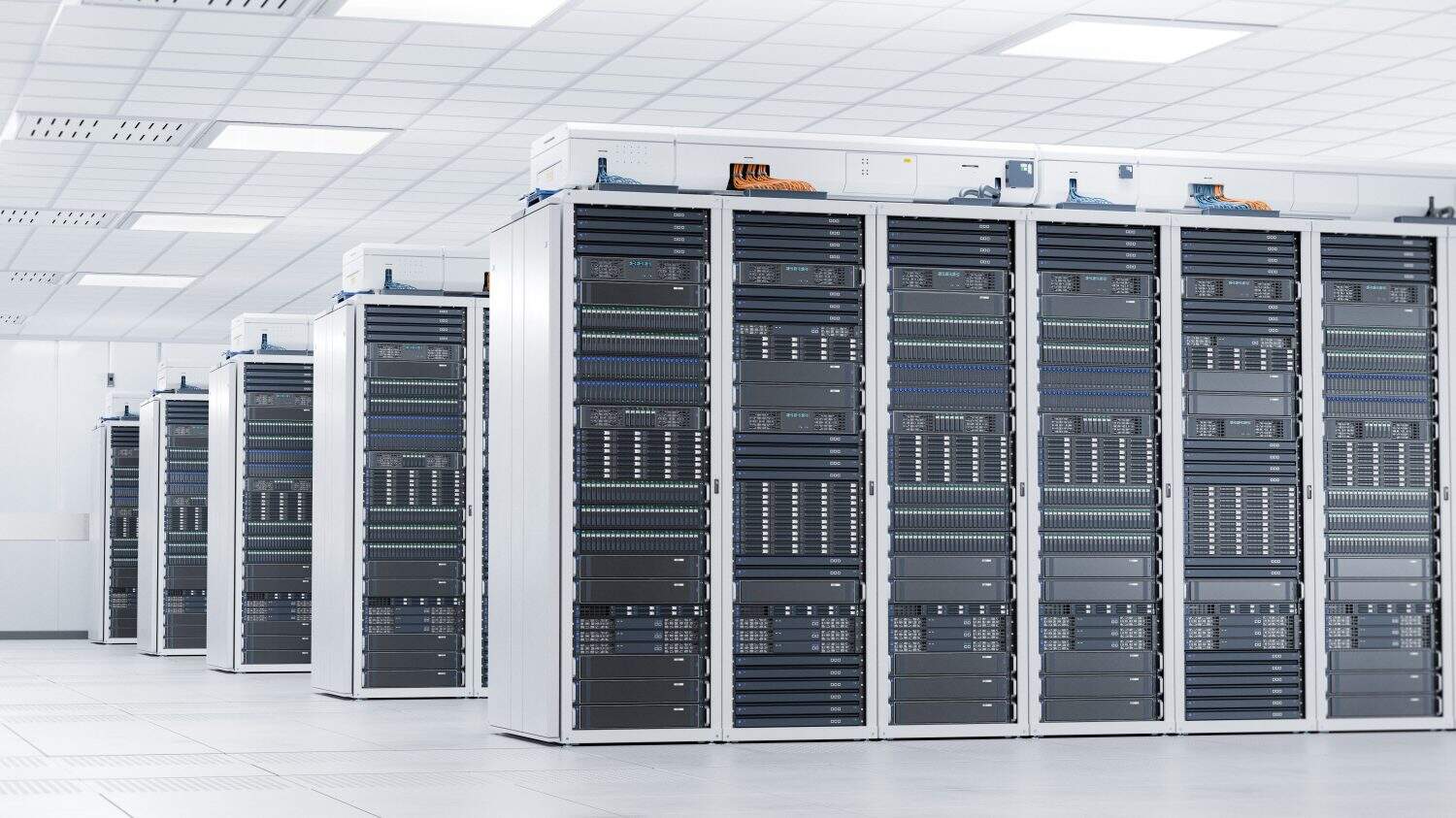
Think of DCBBS as a prefabricated data center in a box. Instead of selling individual servers, Supermicro packages compute, cooling, power, and networking into a deployable unit that hyperscalers or enterprises can stand up quickly. Liang said in Q4 FY2025 that he expected to grow large-scale datacenter customers from four in FY2025 to six to eight in FY2026. That customer expansion is the engine behind the revenue trajectory.
Recent partnerships reinforce the strategy. Supermicro partnered with SK Telecom and Schneider Electric to develop modular AI data center solutions, and separately introduced three new systems targeting sovereign AI platforms and Radio Access Networks, diversifying beyond traditional hyperscaler customers.
The Margin Problem
While revenue is exploding, GAAP gross margin fell to 6.3% this quarter, down from 11.8% year-over-year. Large AI deployments come with aggressive pricing and elevated component costs. The company is trading margin for market share at the most critical moment in the AI infrastructure buildout. Operating cash flow was negative in the first half of fiscal 2026, and liabilities grew to $21 billion year-over-year.
The analyst community reflects this tension. The consensus target sits at $41.31 against a current price of $30.75, but the rating is split between eight buys and eight holds. Liang’s bet is that winning the infrastructure land grab now justifies the margin compression later. Whether margins recover as product mix shifts toward higher-value DCBBS solutions will be the defining question for SMCI shareholders through the rest of FY2026.














 Top Gaining Stocks
 Top Losing Stocks