


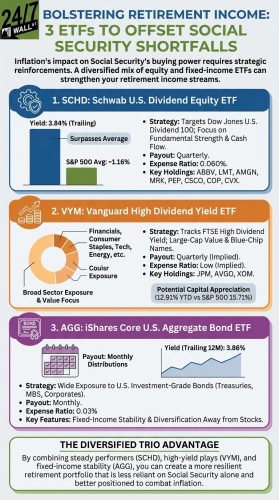
Schwab U.S. Dividend Equity ETF (NYSEARCA:SCHD | SCHD Price Prediction) costs $6 a year on a $10,000 investment, holds 100 dividend stocks, and currently yields 3.39%. With the Fed funds rate sitting at 3.75% and most high-yield savings accounts paying in that same neighborhood, the yield gap is narrow. But SCHD adds something a savings account never will: price appreciation. The fund is up 12.29% year to date and 17.28% over the past year. Over ten years, shares have returned 225.89%.
For context, the average mutual fund charges 0.44%, or $44 per year on $10,000. An advisor-managed portfolio typically runs 1%, or $100 per year. SCHD’s 0.06% expense ratio leaves almost every dollar working in the portfolio rather than covering fees.
What the Fund Actually Owns
The top ten holdings account for roughly 40% of the portfolio, and they read like a dividend investor’s wish list. Lockheed Martin (NYSE:LMT) leads at 4.9% of assets. The defense contractor posted FY2025 revenue of $75.05 billion and carries a $194 billion backlog. Its quarterly dividend now stands at $3.45 per share, up from $3.30 throughout 2025.
Verizon (NYSE:VZ) at 4.49% yields 5.4% on its own, paying $0.69 per quarter. ConocoPhillips (NYSE:COP) at 4.48% raised its ordinary dividend to $0.84 per quarter in early 2026 and plans to return 45% of cash from operations to shareholders this year. Chevron (NYSE:CVX) at 4.42% just marked its 39th consecutive annual dividend increase, now paying $1.78 per quarter.
The healthcare names add stability. Bristol Myers Squibb (NYSE:BMY) has paid dividends for 94 consecutive years. Merck (NYSE:MRK) pays $0.85 per quarter. Coca-Cola (NYSE:KO) just raised its quarterly payout to $0.53, extending a streak of 63 consecutive years of dividend increases.
Sector allocation tilts toward income. Energy represents 22.7% of the fund, consumer staples 18.6%, and healthcare 15.7%. Utilities and real estate, the two sectors most sensitive to rising rates, have zero weight.
The Total Return Case
SCHD’s 10-year dividend growth rate runs roughly 12% annually. That compounding matters: a dollar of income today becomes meaningfully larger over a decade without the investor doing anything. Add a 3.39% starting yield to that growth rate and the total return proposition pulls well ahead of a savings account that pays a fixed rate and offers no appreciation. The S&P 500, by comparison, is down 2.88% year to date while SCHD has gained over 12% in the same stretch.
The fund launched in October 2011 and now holds $85.9 billion in net assets. Portfolio turnover runs at just 30%, reflecting a genuine buy-and-hold approach to dividend quality rather than active rotation.












 Top Gaining Stocks
 Top Losing Stocks