


Editor’s note: a prior version of this article incorrectly stated that Crowdstrike’s recent earnings were their first ever positive GAAP net income print. This has been corrected.
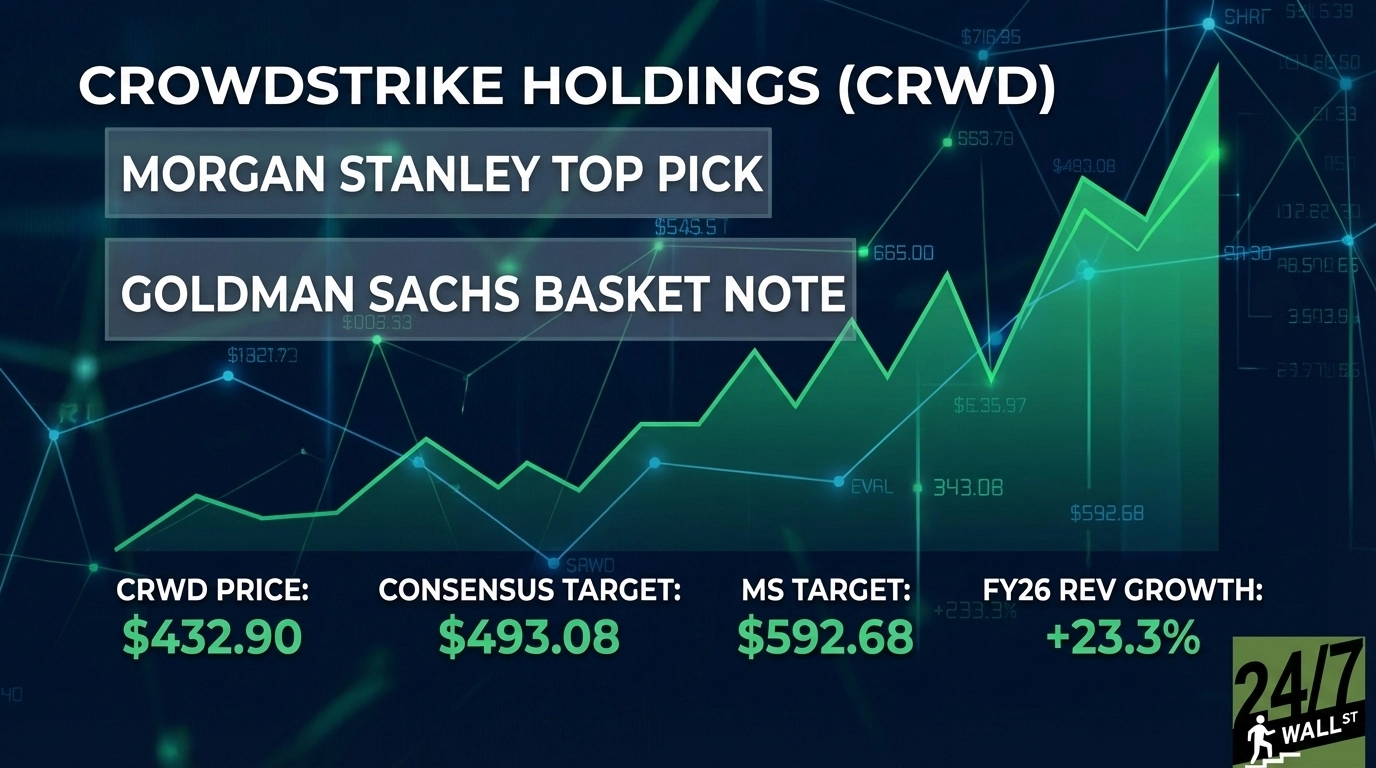
Morgan Stanley has upgraded CrowdStrike (NASDAQ: CRWD | CRWD Price Prediction) to Overweight and named it a Top Pick following Q4 fiscal 2026 earnings, and Goldman Sachs packaged it into $1,635,000 in Autocallable Basket-Linked Notes due 2028 alongside other high-conviction growth names. These two very different institutional moves have one shared data point: both firms acted on CrowdStrike at current price levels.
CrowdStrike trades below $440, down more than 6% year-to-date despite delivering what CEO George Kurtz called the company’s best fiscal year on record. The divergence between institutional conviction and market price has drawn attention from both institutional and retail investors.
Three Data Points Anchoring the Bullish Case
Analyst consensus is decisively skewed toward buying. The Street carries 38 Buy-equivalent ratings against 15 Holds and zero Sells, with a consensus price target of $493.08. Morgan Stanley’s AI-derived price target sits at $592.68, implying 39.8% upside from current levels. The firm specifically cited AI positioning, accelerating module adoption, and the potential for sustained double-digit revenue growth as its rationale.
Goldman’s structured product signals multi-year conviction. The Goldman basket note pairs CrowdStrike with Cloudflare, Reddit, Vertiv Holdings, and others in an equally weighted structure maturing in 2028. Structured notes of this type require Goldman’s desk to underwrite exposure to the underlying basket through the note’s duration. Inclusion alongside names selected for growth trajectory is a form of institutional endorsement that doesn’t show up in traditional ratings counts.
The fundamentals justify the attention. Q4 FY26 revenue came in at $1.305 billion, up 23.3% year-over-year, and the company posted positive GAAP net income of $38.69 million, compared to an $86.29 million loss a year earlier. Ending ARR reached $5.25 billion, up 24% year-over-year, with net new ARR of $330.7 million marking a record and growing 47% year-over-year. The Falcon Flex model, which allows customers to access the full platform under a single flexible contract, ended the year with $1.69 billion in ARR, growing more than 120% year-over-year.
The Gap Between Wall Street and the Market
The stock closed at $500.93 the day Q3 earnings were reported in December 2025 and has since pulled back significantly. That decline happened despite sequential improvement in every major operating metric. The 200-day moving average sits at $468.72, well above current price, which means the stock is in technically extended territory to the downside relative to its own trend.
The institutional picture is not unanimous. Franklin Resources trimmed its position by 21%, selling 265,953 shares, a meaningful reduction that reflects legitimate valuation concerns. At roughly 87x forward earnings, CrowdStrike is priced for continued execution with no margin for error. Meanwhile, AllianceBernstein raised its stake by 1.7% to 329,818 shares valued at $161.74 million, illustrating that even within institutional money, the debate is live.
Retail sentiment, for what it’s worth, has recovered alongside the institutional moves. A composite sentiment score of 63.86 out of 100, up 5.5 points over 30 days, with Reddit scores in the 68 to 74 range across communities including r/wallstreetbets and r/stocks, suggests retail investors are not fleeing despite the price weakness.
What Investors Should Watch
The core question is whether CrowdStrike can sustain the ARR growth rate that justifies its valuation. FY27 guidance calls for revenue of $5.868 billion to $5.928 billion and ending ARR of $6.466 billion to $6.516 billion, with a long-term target of $20 billion in ending ARR by FY36. Morgan Stanley and Goldman are betting the platform consolidation thesis holds. Franklin’s trim is a reminder that at these multiples, the margin for execution risk is thin. The smart money is bullish, but it is not unanimous. The divergence between institutional conviction and market price remains an open question heading into FY27.







 Top Gaining Stocks
 Top Losing Stocks