


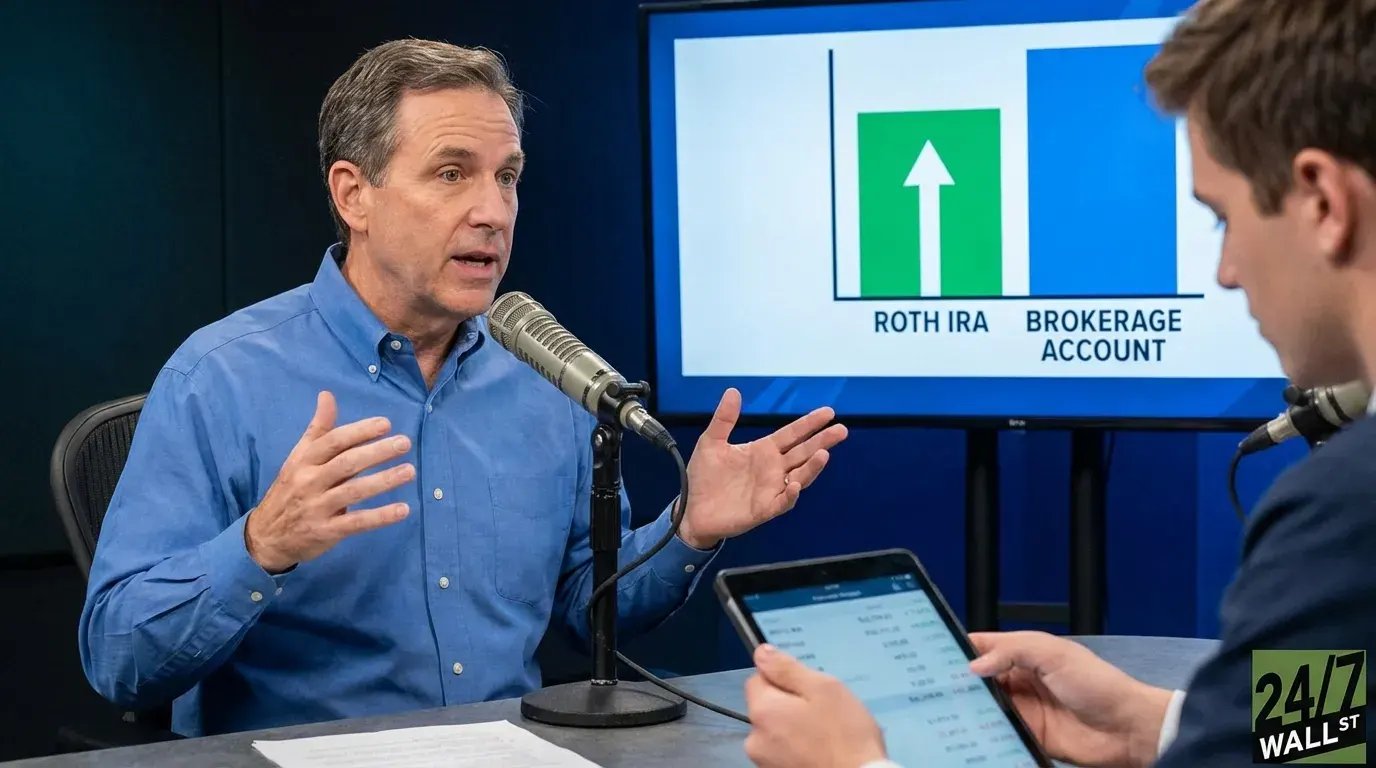
Anthony from Georgia is 25 years old, has $18,000 sitting in a high-yield savings account earning 3.3% annually, and wants to know whether a Roth IRA or a taxable brokerage account should come first. Clark Howard gave him a clear answer on the March 18 episode of the Clark Howard Podcast: the Roth IRA wins, and it is not particularly close.
Howard’s guidance points to the Roth IRA as the first move for someone in Anthony’s position. The tax mechanics point in one direction, and understanding why will help Anthony, and anyone in a similar situation, make this decision with confidence.
Why the Roth IRA Has Such a Durable Edge
A Roth IRA is funded with money you have already paid income tax on. Every dollar of growth inside the account compounds without annual tax drag. When you withdraw in retirement, you owe nothing to the IRS. A taxable brokerage account generates a tax bill every year you realize gains or receive dividends, and again when you sell. Over decades, that repeated friction meaningfully reduces what you actually keep.
Clark Howard described it plainly: “You can put huge amounts into it, and that money grows tax-free, ultimately spent tax-free for retirement. It is the best deal for retirement savings that exists.” The 2026 Roth IRA contribution limit is $7,500 for individuals under 50, with income eligibility phasing out for single filers above $153,000 in modified adjusted gross income. At 25, Anthony almost certainly qualifies to contribute the full annual Roth IRA limit with room to spare — check IRS.gov for the current year’s figures.
His HYSA is earning 3.3% annually, which sounds reasonable until you consider the inflation backdrop. The Core PCE index, the Federal Reserve’s preferred inflation gauge, rose 0.4% in just the most recent month in just the most recent month. That means the real purchasing power gain from his savings account is razor thin. That is a holding pattern, not a wealth-building strategy.
Staying in cash is not a neutral decision. It is a choice to accept a known ceiling on returns. Even risk-free government bonds currently yield 4.3%, already outpacing Anthony’s HYSA. The more significant gap opens up over decades: the S&P 500 is up 222% over the past decade over the past decade, illustrating how much compounding power a 25-year-old sacrifices by staying on the sidelines. For someone with a multi-decade runway, the biggest risk may not be market volatility. It is missing those compounding years entirely.
How to Actually Split the $18,000
Howard’s specific guidance was practical: “Let’s say you keep 90 days’ expenses in the savings. You go with that as an initial target, and your big push needs to be getting money every month into a Roth IRA.” An emergency fund covering roughly three months of expenses stays liquid and untouched. Everything above that threshold becomes the seed for long-term investing.
For a 25-year-old, three months of expenses serves as the emergency reserve target. That leaves the remainder that could move into a Roth IRA immediately, nearly enough to max out the full annual Roth IRA contribution limit for 2026 in a single transfer — visit IRS.gov to confirm the current limit. The remainder stays in the HYSA as a buffer while he builds the habit of contributing monthly.
One detail worth knowing: Roth IRA contributions (not earnings) can be withdrawn at any time without penalty. This partially addresses Anthony’s concern about staying financially safe. The money he puts in is always accessible if a genuine emergency arises, though the goal is to leave it alone for decades.
When a Brokerage Account Makes Sense Too
The Roth IRA should come first, but a taxable brokerage account has a legitimate role once Anthony is consistently maxing out his Roth contributions. Brokerage accounts have no contribution limits, no income restrictions, and no restrictions on when you can withdraw. They are the right vehicle for goals before retirement age, like buying a home in 10 years or building a bridge fund for early financial independence.
Someone already maximizing a Roth IRA and a workplace 401(k) who wants to invest additional savings has no other tax-advantaged option. That is when a brokerage account moves from second choice to only choice. For Anthony right now, that is not the situation. Howard’s guidance suggests filling unused Roth capacity before turning to a brokerage account.
The One Step to Take This Week
Howard’s recommendation is to open a Roth IRA at a low-cost brokerage, fund it above the three-month emergency reserve threshold, and invest in a broad index fund tracking the U.S. or total world stock market. He also suggests setting up automatic monthly contributions so the decision becomes a system rather than a recurring debate. The national personal savings rate has been declining, sitting at just 4% as of late 2025, which means Anthony is already ahead of most peers simply by having $18,000 saved at 25. The Roth IRA is how he turns that head start into something durable.














 Top Gaining Stocks
 Top Losing Stocks