


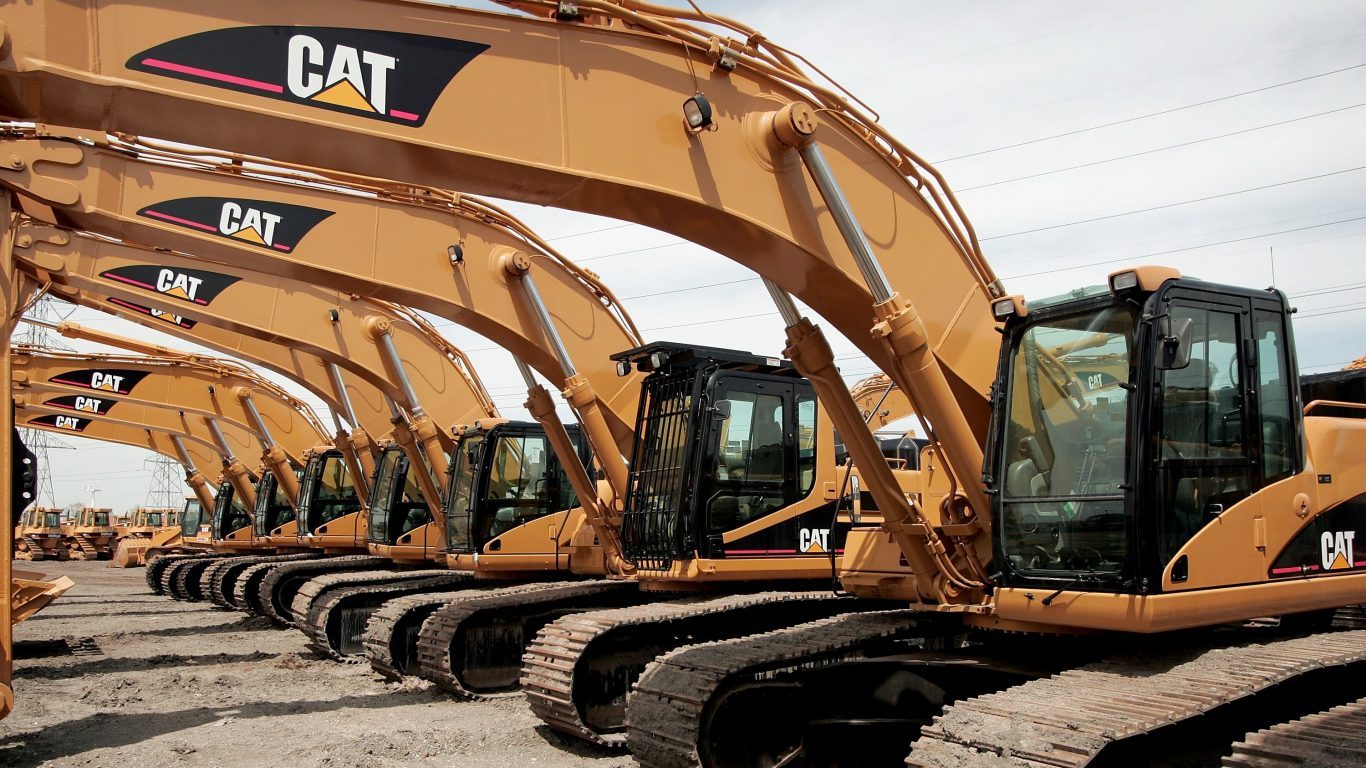
Caterpillar (NYSE: CAT | CAT Price Prediction) is the world’s largest manufacturer of construction and mining equipment, with growing exposure to data center power generation through its large reciprocating engines. The company posted record full-year revenues of $67.6 billion in FY2025 and so far in 2026 has had a record backlog. For income investors, the core question is whether the dividend keeps growing or faces pressure from tariff headwinds and rising debt costs.
| Metric | Value |
|---|---|
| Annual Dividend | $6.04 per share (TTM) |
| Dividend Yield | 0.77% |
| Consecutive Years of Increases | 32 years |
| Most Recent Increase | $1.41 to $1.51 per quarter (Q3 2025) |
| Dividend Aristocrat Status | Yes |
Payout Ratios Leave Plenty of Room
Caterpillar paid $2.70 billion in dividends in FY2025 against $9.5 billion in free cash flow, yielding an FCF payout ratio that is remarkably conservative for an industrial giant. On the earnings side, diluted EPS came in at $18.81, leaving the earnings payout ratio well below the 60% threshold most analysts consider healthy.
| Metric | TTM Value | Assessment |
|---|---|---|
| Earnings Payout Ratio | 32% | Healthy |
| FCF Payout Ratio | 26.8% | Healthy |
| Operating Cash Flow Coverage | 3.74x FCF/Dividend | Strong |
The FCF coverage ratio improved year over year, rising from 3.33x in FY2024 to 3.74x in FY2025, as capital expenditures increased from $3.215 billion to $4.286 billion. Management has guided for capex of approximately $3.5 billion in 2026, though compression of FCF will likely be driven more by $2.6 billion in projected tariff costs rather than the capex itself.
Debt Is Manageable but Worth Watching
Caterpillar carries significant debt, much tied to its financial products segment. Total debt rose to $43.33 billion at year-end 2025, up from $38.41 billion in 2024. Against shareholders equity of $21.32 billion, the debt-to-equity ratio stands at 2.03x, elevated in isolation but typical for a company with a captive finance arm.
| Metric | Value | Assessment |
|---|---|---|
| Debt-to-Equity | 2.03x | Elevated (finance segment driven) |
| Net Debt-to-EBITDA | Net debt: $33.35B vs EBITDA: $14.86B | Manageable |
| Interest Coverage | ~10.9x (Operating Income / Interest Expense) | Strong |
| Cash on Hand | $9.98B | Solid Buffer |
Interest expense doubled year over year, from $512 million in FY2024 to $1.03 billion in FY2025. Interest coverage remains strong at roughly 10.9x, and the company holds nearly $10 billion in enterprise cash plus $1.2 billion in liquid marketable securities.
32 Years of Increases and Still Growing
| Year | Annual Dividend | YoY Change |
|---|---|---|
| 2025 | $5.84 | +7.8% |
| 2024 | $5.42 | +8.4% |
| 2023 | $5.00 | +8.2% |
| 2022 | $4.62 | +7.9% |
| 2021 | $4.28 | +4.9% |
The dividend has never been cut or suspended since at least 1999, surviving the 2008 financial crisis, the 2016 downturn when net income turned negative, and the 2020 pandemic. That is a remarkable track record for a cyclical industrial company.
Management Calls the Dividend a Core Commitment
CEO Joe Creed stated on the Q4 2025 earnings call: “We’re proud of our continued dividend aristocrat status, paying higher dividends for thirty-two consecutive years, and remain committed to returning substantially all MP and E free cash flow over time.” CFO Andrew Bonfield reinforced the point: “We continue to expect to return substantially all MP&E free cash flow to shareholders over time.” That language is unambiguous: management’s commitment is explicit and unconditional.
This Dividend Is Rock Solid
Dividend Safety Rating: Very Safe
The FCF payout ratio of 26.8% is among the most conservative of Dividend Aristocrats. The earnings payout ratio of roughly 32% leaves room for increases even if earnings compress. Interest coverage at 10.9x is comfortable, and the company holds nearly $10 billion in cash.
Caterpillar’s dividend is well-covered, growing, and backed by management that has demonstrated commitment. Growth depends on continued data center power generation buildout and manageable tariff impacts within guided ranges. The record $51 billion backlog provides earnings visibility. Caution would be warranted if tariff costs escalate beyond the $2.6 billion 2026 estimate, compressing margins below target, or if the construction cycle turns sharply negative.







 Top Gaining Stocks
 Top Losing Stocks