


Nvidia (NASDAQ:NVDA | NVDA Price Prediction) remains the undisputed heavyweight champ of AI chips, and CEO Jensen Huang seems to be ready to keep rising above the competition. It’s hard to tell just how much of a lead that Nvidia holds, as some of its rivals in the Magnificent Seven spend hundreds of billions of dollars on efforts, which include advancing their very own AI chips.
While some folks, including Andrew Left of Citron Research, highlight Amazon (NASDAQ:AMZN) as a credible challenger to Nvidia in AI chips, I’d also not sleep Alphabet (NASDAQ:GOOG) and the Google TPUs (tensor processing units), which, I think, could take quite a bit of market share, especially as the red-hot Google Cloud Platform (GCP) looks to hit the gas pedal when it comes to AI-driven growth. Any way you look at it, there’s a big silicon showdown happening, and it’s starting to look like Nvidia will need to keep flooring it if it’s to stay comfortably ahead of its many friends and rivals in mega-cap tech.
In a prior piece, I highlighted Alphabet as having what it took to hit the $5 trillion market cap level, perhaps before Nvidia has a chance to hit that high watermark again. Undoubtedly, Google seems to be a master at monetizing new tech, but it’s the parent company, Alphabet, which seems to have potential cash cows in the making.
Most notably, Waymo is the needle-mover that might be the big AI monetizer that the market and much of Wall Street have yet to price in. Beyond that, though, I think that the many billions that Google is pouring into capital expenditures will give its TPUs more share-taking power.
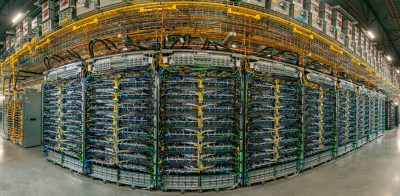
Google is moving fast in AI. TPUs are coming in hot
Just how much of the AI chip market TPUs can grab over the next five years remains the five-trillion-dollar question. In the meantime, Nvidia is going to continue cashing in on the AI boom, with $1 trillion in sales of Blackwell and Rubin expected by the end of next year. What does that leave for the other players who entered the custom silicon chat?
It’s hard to say, but if the silicon spenders continue investing heavily in the initiative, I do think that the race could become a whole lot more interesting as time goes on. Going into 2028 and into the 2030s, my guess is that it’ll be a closer AI chip race.
In any case, Google delivered a major breakthrough with memory efficiency with its TurboQuant algorithm just a few weeks ago. It was big enough to move the memory chip makers in a pretty big way. As it turns out, such a breakthrough works in favor of many boats in the AI waters, including the memory chip makers themselves.
Google’s innovation edge is worth a fat premium
For a firm that can deliver that kind of efficiency shock, I think it’d be a mistake to discount the kind of innovative leaps it can make in the world of AI chips. As agents drive an inference boom of sorts, I think efficiency and low costs will begin to accelerate in the AI chip race. And in that regard, I think Google deserves to trade at a much richer premium since it’s already demonstrated it can make things unfathomably more efficient.
With the Ironwood TPU generation already impressing with efficiency gains for the “age of inference” and various other big spenders, including Anthropic, giving Google’s silicon a big vote of confidence, I think Google might evolve to become one of Nvidia’s largest rivals in the future. Nvidia has been making all the right moves to enhance its positioning in inference.
With smart acquisitions, huge gains to be had in the Vera Rubin era, and, of course, the software moat with CUDA, Nvidia has built quite the moat for itself. Is it impossible to get through? Probably not. But if Nvidia keeps playing its cards well, it can certainly play some very solid defense. As such, I wouldn’t count it out, even as Google’s latest impresses on the efficiency front.





 Top Gaining Stocks
 Top Losing Stocks