


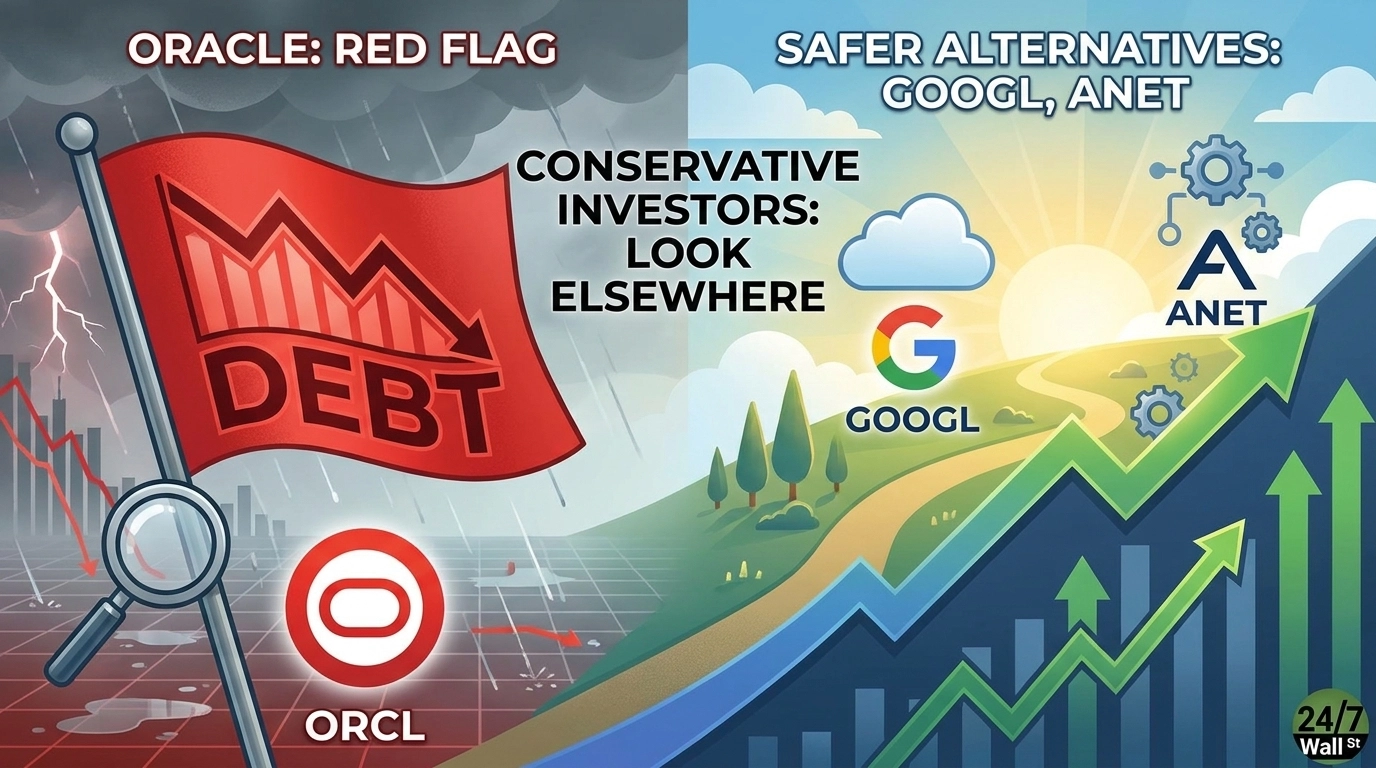
Oracle (NASDAQ: ORCL | ORCL Price Prediction) surged 29.4% in a single week, fueled by AI infrastructure announcements and a massive remaining performance obligation backlog. But the weekly pop masks structural risks that should concern conservative investors.
The stock sits well below its 52-week high of $345.72 and closed most recently at $178.34. That context matters for retirement-focused investors who cannot afford to buy momentum spikes and wait years for recoveries that may never come.
Three Reasons to Step Back From Oracle
1. The Debt Load Is Structural, Not Temporary
Oracle’s AI infrastructure transformation is funded almost entirely by borrowed money. Non-current debt stands at $124.7 billion, up from $85.3 billion at fiscal year-end. Total liabilities have reached $206.189 billion against shareholders equity of just $39.051 billion. Interest expense grew 32% year-over-year to $1.18 billion. Free cash flow is negative $24.736 billion on a trailing four-quarter basis. The company is spending $48.25 billion in capital expenditures while generating no free cash flow. Conservative investors who bought Oracle for its historically asset-light software model now hold a highly leveraged infrastructure bet with a fundamentally different risk profile.
2. The OpenAI Concentration Risk Is a Single Point of Failure
Oracle’s remaining performance obligation surging to $553 billion sounds extraordinary. Oracle’s infrastructure bet is heavily concentrated on a single customer relationship: OpenAI. A $50 billion annual capex cycle built around one counterparty is a concentrated wager on a single relationship. If that relationship deteriorates or OpenAI’s capital access changes, Oracle’s revenue visibility collapses. The company also laid off up to 30,000 employees to fund this buildout, signaling that the transformation is consuming the entire organization. Restructuring expenses more than doubled to $153 million from $63 million, and software license revenue fell 21% year-over-year in Q2, the legacy business that funded Oracle’s prior decade of growth.
3. Retail Has Already Turned Skeptical
One Reddit post in r/stocks captured the moment: “Personally not chasing this at current levels. Watching to see if it holds and builds a base above the breakout, or if it retraces and offers a cleaner entry. Feels like one of those setups where chasing late either works quickly or gets punished just as fast.” That instinct is well-grounded. Insider activity at Oracle shows a net selling direction, and the composite sentiment score is just 42.92, with social sentiment at 25 out of 100. The analyst community is bullish, but retail conviction has evaporated. This kind of divergence often signals sharp reversals in momentum-driven rallies.
Where Conservative Investors Should Look Instead
Alphabet (NASDAQ: GOOGL) offers everything Oracle promises to become, at a fraction of the financial risk. Google Cloud grew 48% year-over-year in Q4 to $17.664 billion, with operating income that more than doubled. Free cash flow for fiscal year 2025 reached $73.266 billion, funding a $175 to $185 billion capex plan for 2026 without a debt binge. Shareholders equity stands at $415.265 billion. Alphabet pays a $0.21 quarterly dividend and has risen 5.5% over the past week, a steady move built on real cash generation rather than borrowed momentum.
Arista Networks (NYSE: ANET) is the pure-play AI networking alternative with the financial discipline Oracle abandoned. Capital expenditures for fiscal year 2025 were just $119.5 million, against $9.0057 billion in full-year revenue. Operating cash flow grew 17.9% year-over-year to $4.3719 billion. Non-GAAP operating margins run 46 to 47%. Arista delivered a 28.9% revenue increase in Q4 and beat EPS estimates by 18.84%, the kind of profitable growth sustained entirely from operating cash flow. The stock has gained 10.2% over the past week and has 28 analyst Buy ratings and zero Sell ratings.
Oracle may eventually succeed with its AI infrastructure vision. However, the company as it stands today carries $206 billion in total liabilities, negative free cash flow, and a capex model dependent on a single hyperscale relationship. Savvy retirement investors will know that story and will redirect their attention to companies funding AI growth from cash flow.








 Top Gaining Stocks
 Top Losing Stocks