


Coca-Cola (NYSE:KO | KO Price Prediction) closed full-year 2025 with steady organic growth and a Zero Sugar brand accelerating. PepsiCo (NASDAQ:PEP) followed with a Q1 2026 beat showing international momentum and North America foods stabilizing. Willing to invest $5,000? Let’s see which has built the stronger decade-long case for investors.
Zero Sugar Carries Coke. International Rescues Pepsi.
Coca-Cola’s growth engine lives in Zero Sugar, Coca-Cola Zero Sugar posted unit case volume growth of 13% in Q4 2025 and 14% for the full year, making it the clearest growth driver in the portfolio.
The broader business delivered 5% organic revenue growth for both Q4 and the full year, powered by consistent price/mix gains across geographies. The asset-light model kept comparable operating margins at 34.7% in Q3 2025, a level PepsiCo cannot match structurally.
| Business Driver | Coca-Cola (KO) | PepsiCo (PEP) |
|---|---|---|
| Primary Growth Engine | Zero Sugar + price/mix | International segments + foods recovery |
| Most Recent Organic Revenue Growth | 5% (Q4 2025) | 2.6% (Q1 2026) |
| Operating Margin | ~34.7% | 16.5% |
| FY2026 Organic Rev Guidance | 4-5% | 2-4% |
PepsiCo’s Q1 2026 report showed mixed results. Revenue came in at $19.44 billion, exceeding the $18.92 billion consensus, and core EPS of $1.61 topped the $1.54 estimate, beating expectations. Real momentum came from outside North America. EMEA revenue rose 18% with core operating profit up 29%, and Asia Pacific Foods surged 11% with operating profit up 35%.
Pure Beverage Franchise vs. Diversified Food-and-Drink Empire
Coca-Cola runs a beverage-only, asset-light franchise generating enormous margins and predictable cash flows. Free cash flow for FY2025 came in at approximately $5.3 billion, with guidance calling for approximately $12.2 billion in free cash flow for FY2026 as the African bottling divestiture closes. This asset-shedding strategy is deliberate.
PepsiCo operates across chips, crackers, oats, energy drinks, and sodas. That breadth creates volume resilience but compresses margins. The $1.99 billion Rockstar impairment in FY2025 reflects how portfolio diversity creates both resilience and impairment risk. Laguarta’s affordability push, including sharper price-pack architecture and the poppi acquisition integration, signals active portfolio reshaping.
| Lens | Coca-Cola (KO) | PepsiCo (PEP) |
|---|---|---|
| Business Model | Beverage-only, asset-light franchise | Diversified food and beverage |
| Dividend Streak | 63 consecutive years | 54 consecutive years |
| Key Vulnerability | Currency headwinds, BODYARMOR pressure | North America volume recovery, commodity costs |
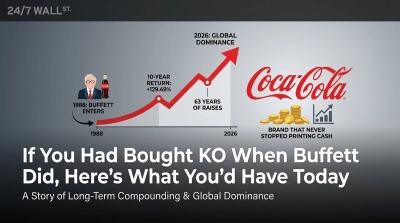
| 10-Year Price Return | +129.49% | +105.67% |
The Next Test Is Pricing Power and Volume Recovery
Coca-Cola projects 7-8% comparable EPS growth in FY2026 against a $3 base, supported by roughly 3% currency tailwind. Watch whether Zero Sugar sustains double-digit volume growth globally and whether BODYARMOR impairment signals broader sports drink fatigue. Volume declines in Mexico, India, and Thailand warrant monitoring.
For PepsiCo, the critical question is whether North America foods recovery is durable. PFNA grew only 2% in Q1 2026, but management noted “notable improvement in convenient foods organic volume.” Watch whether Lay’s, Doritos, and Cheetos regain shelf velocity as affordability initiatives take hold. Tariff and commodity cost volatility affect both companies, but PepsiCo’s broader input exposure makes it more sensitive.

Why Coca-Cola Edges Out for Compounding Investors
The 10-year price return data is clear: KO returned 129.49% over the decade ending April 21, 2026, while PEP returned 105.67% over the same period. Coca-Cola’s 63 consecutive years of dividend increases and structurally superior margins provide durability. Zero Sugar has posted back-to-back double-digit volume growth, establishing it as a long-cycle growth driver.
PepsiCo suits a different profile. If international momentum continues and North America foods stabilizes, the 54-year dividend streak and $8.9 billion in planned cash returns for FY2026 make it a credible income holding.
The turnaround narrative carries more upside variance but also execution risk. For patient, income-focused investors, Coca-Cola’s cleaner model and stronger decade of compounding present a stronger historical case.






 Top Gaining Stocks
 Top Losing Stocks