


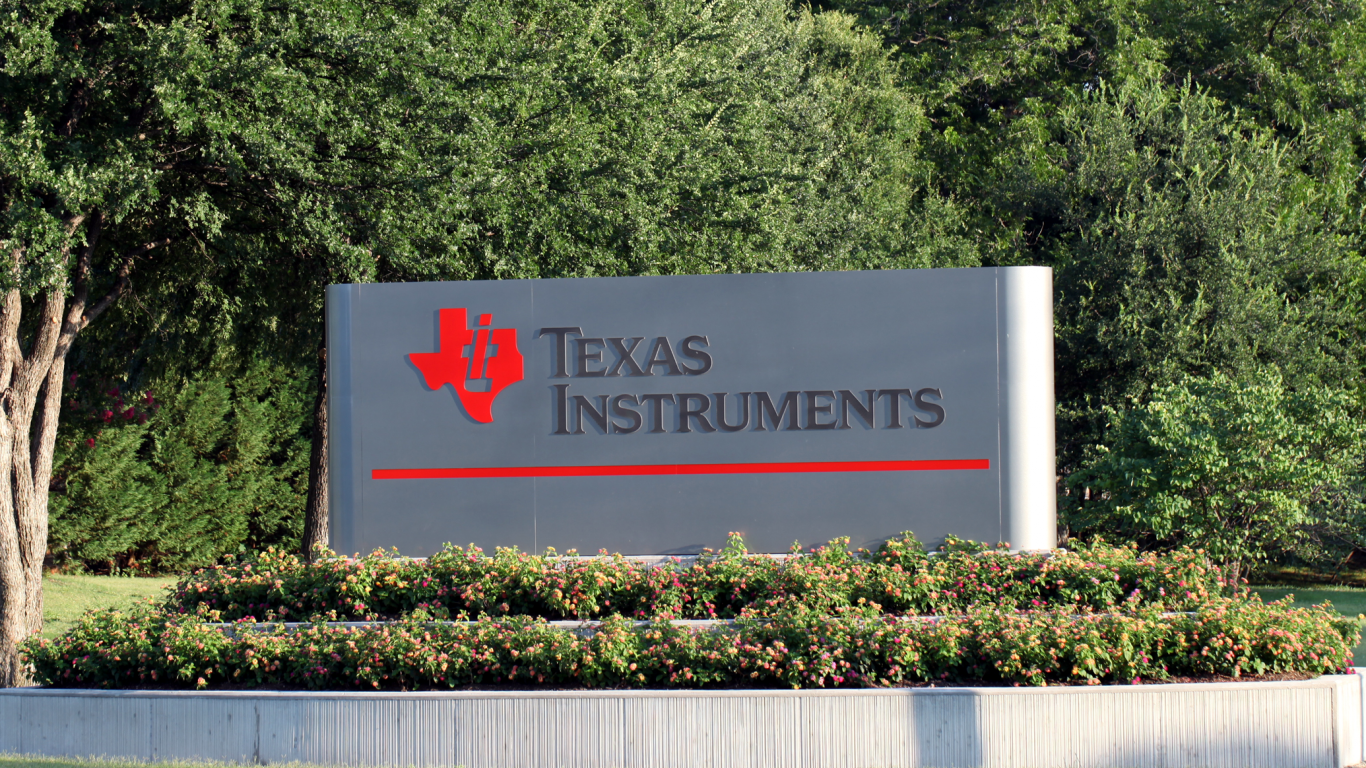
Texas Instruments (NASDAQ:TXN | TXN Price Prediction) has gone vertical, climbing more than 44% over the past month and over 51% year to date. The move reflects a five-year manufacturing investment finally hitting the income statement, and the fundamentals make this trajectory difficult to derail.
Texas Instruments is now sitting at $271.26 with a $241 billion market cap, and the recent breakout is supported by three reinforcing pillars rather than a single catalyst.
Pillar One: A Q1 Report That Reset the Earnings Power
Q1 2026, reported April 22, 2026, was the inflection. Revenue hit $4.83 billion, up 19% year over year, beating consensus by roughly $298 million. EPS of $1.68 blew past the $1.36 estimate by 23%. The operating leverage was the headline number: operating profit jumped 37% on 19% revenue growth, and free cash flow exploded 611% to $1.4 billion. Capex moderated 40% year over year, meaning every incremental dollar of revenue is now flowing to cash, not back into the fabs.
Pillar Two: Forward Guidance That Confirms the Acceleration
Management is guiding for continued acceleration. CEO Haviv Ilan set Q2 revenue at $5.00 billion to $5.40 billion with EPS between $1.77 and $2.05, sequential acceleration on top of an already-hot Q1. Industrial revenue grew more than 30% year over year, marking the eighth quarter of sequential growth, and data center revenue grew about 90% year over year. Crucially, industrial is still 15% lower than the 2022 peak, which means the recovery has runway. Lizardi flagged that $8 free cash flow per share is highly probable for 2026 if revenue grows mid- to high-single digits, and H1 is tracking 15% to 20%.
Pillar Three: A Manufacturing Moat That Compounds
This is where the breakout earns its “five years in the making” framing. The 300mm wafer buildout is now phase three. Ilan said it plainly: “We are in phase three on the fab and can modulate wafer starts there. We have the capacity… If the market wants to grow at the same rate as Q1, 19% year over year, we are ready. If it wants to accelerate, we are ready as well.” Layer in $555 million in CHIPS Act incentive proceeds in Q1 alone, with more milestone funding ahead, and Texas Instruments has a domestic supply position that competitors cannot replicate quickly. The company returned $6.0 billion to shareholders over the trailing 12 months while still funding all of this.
The Risk, and Why Momentum Wins
The honest concern is cyclicality. Ilan himself flagged that 2025 started strong and then took a breather, and shares trade at a 45 trailing P/E with insiders net selling on 39 recent transactions. That is real. The counter is that this cycle has breadth the last one lacked: all sectors and all geographies grew sequentially in industrial, gross margin expanded 210 basis points sequentially to 58%, and management expects 75% to 85% fall-through on incremental revenue. A cyclical pause from these levels still leaves a structurally higher earnings base than the prior peak.
The Signal
The setup is rare: a 0.99 beta compounder running 68% over one year on accelerating cash flow and capacity that is finally paid for. Wall Street’s $272.75 consensus target is essentially today’s price, which means the analyst community has not yet caught up to the operating leverage. With capex moderating, free cash flow inflecting, and Q2 guidance pointing higher, the momentum will continue until something breaks the demand curve, and nothing in the Q1 data suggests that is imminent. The setup is worth respecting.











 Top Gaining Stocks
 Top Losing Stocks