



Passive income separates a paycheck from a portfolio. Earned income stops when you stop working, but dividends landing quarterly do not. With layoffs rippling through tech and consumer staples in 2026 and housing and grocery costs rising, more investors seek cash flow regardless of macro headlines.
High-yield names get attention, but durable passive income comes from blue-chip dividend payers that have raised payouts through every recession of the past half-century. Dividend Kings and Aristocrats trade at modest yields because the market trusts the cash flow. Unlike rental real estate, you can sell these positions in seconds, reinvest dividends with one click, and avoid tenants, repairs, and property taxes.
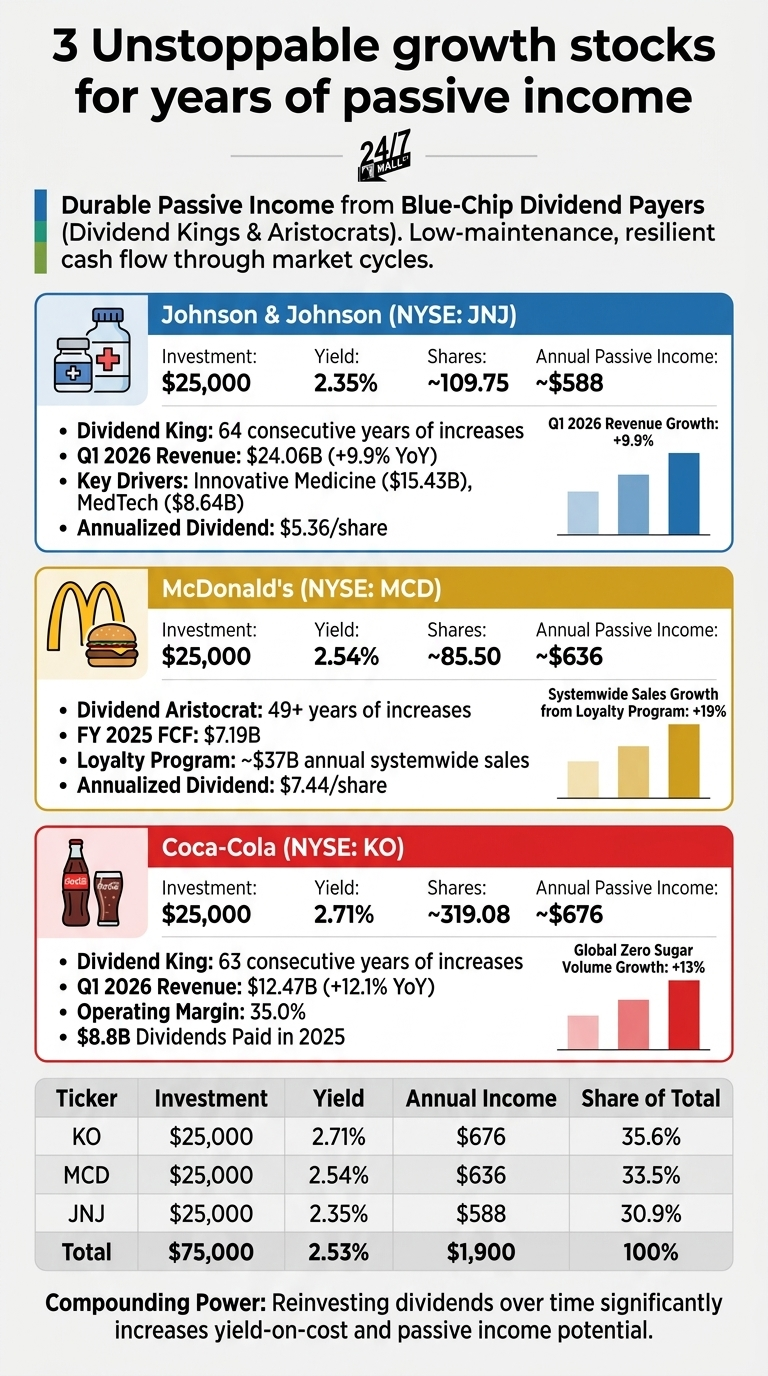
We screened our 24/7 Wall St. dividend equity research database and found three companies that combined can generate over $1,900 a year in passive annual income on a $25,000 investment in each stock.
Johnson & Johnson
- Yield: 2.35%
- Shares for $25,000: 109.75
- Annual Passive Income: $588
Johnson & Johnson (NYSE:JNJ | JNJ Price Prediction) is the world’s largest diversified healthcare company. Its Innovative Medicine pharmaceutical arm posted $15.43 billion in Q1 2026 revenue and MedTech surgical and orthopedics business added $8.64 billion. Q1 revenue of $24.06 billion grew 9.9% year over year beat consensus, and management raised full-year guidance to $100.30 billion to $101.30 billion.
JNJ just declared a $1.34 quarterly payout, a 3.1% raise extending the streak to 64 consecutive years of increases, putting it firmly in Dividend King territory. The annualized rate sits at $5.36 per share, covered by trailing EPS of $8.63. The planned spin-off of the Orthopaedics business should sharpen growth around oncology blockbusters DARZALEX and TREMFYA.
McDonald’s
- Yield: 2.54%
- Shares for $25,000: 85.50
- Annual Passive Income: $636
McDonald’s (NYSE:MCD) runs roughly 95% of its 2,600 planned new locations through franchisees, keeping operating margins at mid-to-high 40% range and free cash flow at $7.19 billion in fiscal 2025. Q4 2025 system sales lifted from a loyalty program now generating $37 billion in annual systemwide sales across 210 million 90-day active users, up 19%.
The quarterly dividend of $1.86 reflects a 5% increase declared in October 2025, taking the annualized payout to $7.44. MCD is a Dividend Aristocrat with 49+ years of consecutive increases. Management returned $2.06 billion to shareholders via buybacks in 2025, retiring 6.7 million shares.
Coca-Cola
- Yield: 2.71%
- Shares for $25,000: 319.08
- Annual Passive Income: $676
Coca-Cola (NYSE:KO) operates an asset-light concentrate model, selling syrup and brand rights to a global bottler network. Q1 2026 revenue of $12.47 billion grew 12.1% year over year on 10% organic growth, with Coca-Cola Zero Sugar volumes up 13% globally and operating margin expanding to 35.0% from 32.9%.
KO returned $8.8 billion in dividends in 2025 and another $477 million in buybacks during Q1 2026. The quarterly dividend stepped to $0.53 in Q1 2026, extending the streak to 63 consecutive years of increases. Berkshire Hathaway remains the most recognized institutional holder, with Vanguard and BlackRock in the top three. The pending sale of Coca-Cola Beverages Africa in H2 2026 will pivot the portfolio toward higher-margin concentrate revenue.
The Bottom Line
Combined, these three positions generate $1,900 in annual passive income on a $75,000 investment, a blended yield of 2.53%. Coca-Cola contributes $676, McDonald’s adds $636, and Johnson & Johnson rounds out the portfolio with $588.
| Ticker | Investment | Yield | Annual Income | Share of Total |
|---|---|---|---|---|
| KO | $25,000 | 2.71% | $676 | 35.6% |
| MCD | $25,000 | 2.54% | $636 | 33.5% |
| JNJ | $25,000 | 2.35% | $588 | 30.9% |
| Total | $75,000 | 2.53% | $1,900 | 100% |
The yield is modest, but the math improves over time. All three companies have raised payouts every year for at least 49 years, meaning a position held for a decade tends to produce a yield-on-cost well above the headline number today.










 Top Gaining Stocks
 Top Losing Stocks