


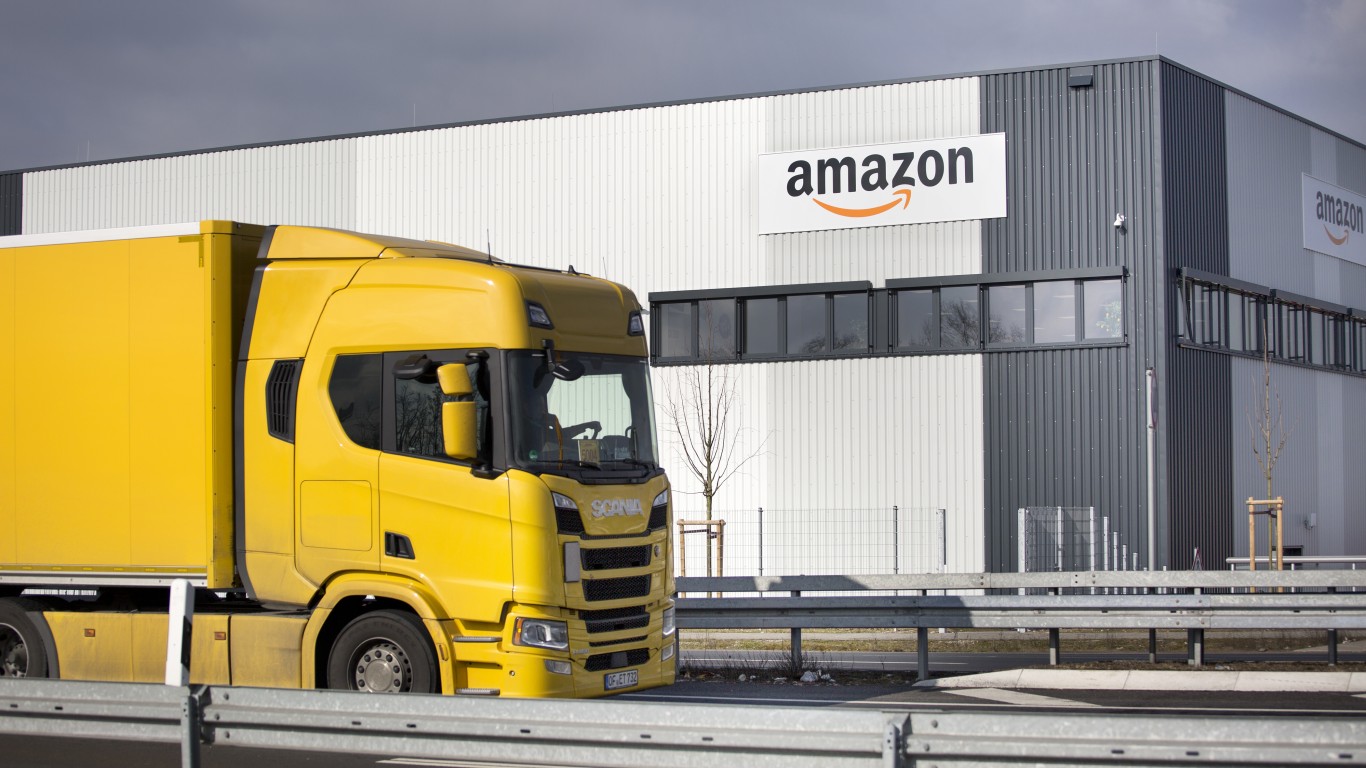
Shares of FedEx (NYSE:FDX | FDX Price Prediction) are down 9% to roughly $359 in midday trading Monday, while United Parcel Service (NYSE:UPS) stock is down 10% to about $97. The trigger: Amazon (NASDAQ:AMZN) has officially launched Supply Chain Services as a direct enterprise offering.
Amazon stock is up 1% to $271 on the news, building on a 27% April rally driven by Amazon Web Services (AWS) strength. The market is reading today’s launch as the most direct competitive escalation yet against the legacy parcel duopoly.
Both incumbents entered the session with strong momentum. FDX stock was up 37% year-to-date (YTD) and 92% over one year through May 1, while UPS stock had gained 10% YTD and 22% over twelve months. Today’s tape erases weeks of progress for both names.
The Catalyst: Amazon Supply Chain Services Goes Live
Amazon has expanded Supply Chain Services beyond fulfillment for Marketplace sellers into a unified enterprise offering. The package reportedly bundles warehousing, freight forwarding, customs brokerage, transportation, and last-mile delivery into a single solution.
The launch caps more than a decade of investment in Amazon Air, Amazon Logistics, regional sortation networks, and fulfillment centers. Retail discussion captured on r/stocks flagged a post titled “Amazon opens up its logistics network to other businesses in growth push” as the catalyst, with AMZN sentiment shifting from neutral overnight into bullish territory at a 68 score by midday.
Why the Threat Is Real
Amazon has been the largest single customer for both FedEx and UPS historically, and now it’s becoming a direct competitor. Amazon’s long-running logistics ambitions were flagged years ago, and the playbook has finally reached its enterprise phase.
UPS already telegraphed the risk. CEO Carol Tomé stated that “upon completion of the Amazon glide-down, 2026 will be an inflection point,” and the company has eliminated roughly 48,000 positions while closing 93 facilities in 2025. Q1 2026 U.S. domestic average daily volumes fell 8%, an intentional pullback from lower-margin Amazon work.
Enterprise buyers already trust AWS, and that trust may extend to Supply Chain Services. Amazon’s network density gives it room to underprice FedEx and UPS while still earning a return on assets that are already deployed.
Why the Threat May Be Overstated
FedEx and UPS bring decades of contractual relationships and customized integrations that are not trivially replicated. FedEx Express and UPS Worldport air networks require massive capital to duplicate, and international logistics involves regulatory complexity that doesn’t scale like domestic last-mile.
FedEx stock also enters this disruption story from operational strength. The company’s Q3 FY2026 revenue rose 8% to $24 billion, U.S. domestic package volume climbed 5%, and FedEx raised FY2026 adjusted EPS guidance to $16.05 to $16.85.
Many enterprise customers will hesitate to route their supply chain through a direct retail competitor. That structural friction has limited Amazon Pharmacy’s incumbent kill, and it could similarly slow the logistics grab.
The Amazon Vertical Integration Playbook
The Supply Chain Services launch continues Amazon’s pattern of moving into adjacencies. AWS reshaped enterprise computing, Amazon Pharmacy entered drug distribution, and Amazon Lending expanded into small business credit. Each prior push triggered incumbent stock pressure, with outcomes ranging from full disruption (computing) to measured share grabs (pharmacy).
Today’s reaction reflects pattern recognition. The bear case argues Amazon is the most dangerous competitor FedEx and UPS have ever faced, and that capital expenditure (CapEx) needed to defend share will pressure margins for years. The bull case counters that selloffs of this magnitude often overshoot, that air freight and international networks are durable moats, and that multi-year customer contracts provide revenue visibility.
What to Watch
The next signals will come from enterprise customers. Early adopter announcements, or visible defections from FedEx and UPS contracts, could confirm or contradict today’s panic pricing.
FedEx and UPS commentary at upcoming investor events matters, along with any Amazon Supply Chain Services revenue disclosure in future quarters. Reddit sentiment on FDX and UPS sat at a neutral 45 score at midday, suggesting retail traders are digesting rather than capitulating.
Prudent investors may want to size their share positions modestly here. Watch for whether FDX stock holds the round-number support and whether UPS stock can stabilize before the close, and look out for the first sell-side notes attempting to quantify the share-loss risk into FY2027 estimates.














 Top Gaining Stocks
 Top Losing Stocks