


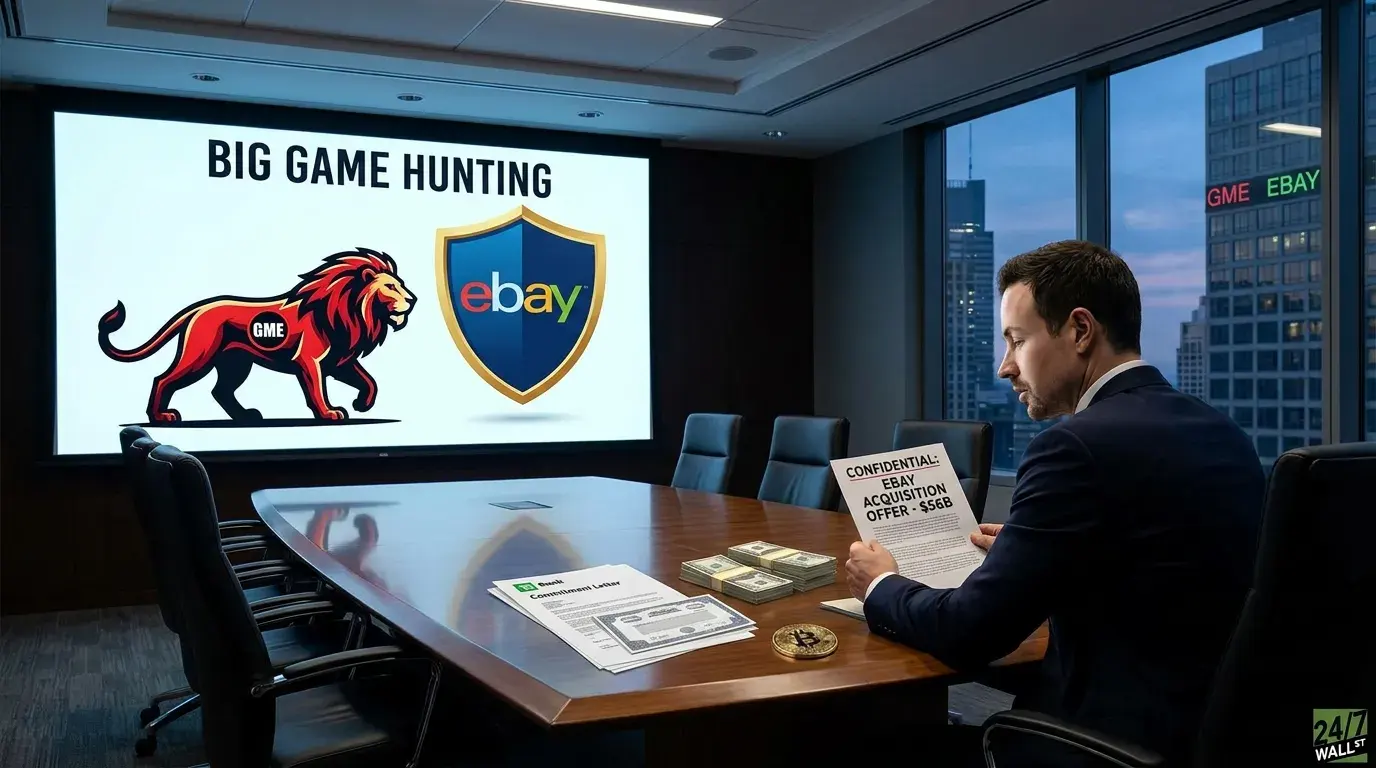
GameStop, an $11 billion company, is offering $56 billion in cash and stock for a $45 billion rival. That is the math behind GameStop‘s (NYSE:GME | GME Price Prediction) bid for eBay (NASDAQ:EBAY), unveiled by CEO Ryan Cohen this past weekend. On Friday, eBay shares jumped over 10% in extended trading, and GameStop rose around 5%.
Cohen’s “Big Game Hunting” Bid
In January, Cohen told followers he was going “big game hunting.” He has now warned the move will be “ultimately genius or totally, totally foolish.” Per a Wall Street Journal report widely cited on r/stocks, GameStop has quietly built a 5% stake in eBay and is offering $125 per share in cash and stock, a roughly 20% premium to Friday’s close. If eBay’s board resists, Cohen is prepared to run a proxy fight and take the offer directly to shareholders.
When asked how he would afford the acquisition, GameStop’s CEO, Ryan Cohen, explained they’d pay with “half cash, half stock,” without elaborating further. It’s worth noting that the combined cash, market cap, existing 5% eBay stake, and $20 billion debt financing commitment from TD Bank would not amount to the $56 billion they’d need for the acquisition, which raises questions about how they’d reach the total financing they’d need for the acquisition.
If you squint, eBay’s marketplace of collectibles, old tech, and used goods overlaps with GameStop’s customer base. eBay reported 135 million active buyers last quarter and Q1 2026 revenue guidance of $3.00 billion to $3.05 billion. Pairing that scale with GameStop’s collectibles category, now 33.1% of Q4 net sales, is the bull case Cohen is selling.
Why Cohen Gets Taken Seriously
Cohen sold Chewy for $3.5 billion in 2017 and took over as GameStop CEO in 2023. His base of retail traders has followed him through an NFT marketplace launch and, more recently, a Bitcoin treasury strategy. GameStop’s most recent annual sales were $3.6 billion. eBay did $3.1 billion in a single quarter. Cohen’s stated ambition is to forge a $100 billion retail giant from the combination. GameStop’s latest 10-K shows the firepower he is working with.
According to GameStop’s website, the plan is to essentially dramatically cut costs while giving eBay a national physical store footprint. eBay spent $2.4 billion on Sales & Marketing in fiscal 2025 while adding just one million net active buyers, moving from 134 million to 135 million users. Cohen’s plan calls for roughly $2 billion in annualized cost reductions within twelve months of closing. That includes about $1.2 billion from Sales & Marketing, $300 million from Product Development, where costs grew faster than revenue, and $500 million from General & Administrative, by consolidating functions across the combined company.
On cost alone, that would lift eBay’s diluted GAAP EPS from $4.26 to $7.79 in year one. Beyond expenses, GameStop’s roughly 1,600 U.S. retail locations could give eBay a physical layer for authentication, intake, fulfillment, and live commerce.
The Takeaway
If Cohen can execute, the upside comes from a simpler playbook than most turnarounds. Cut excess costs, stabilize the core marketplace, and layer in physical infrastructure to improve trust and logistics. That path could materially re-rate eBay’s earnings power in a short period of time. Either way, this is not a marginal move. A successful acquisition would reshape the U.S. secondary-market landscape by combining two of the most recognized brands in resale commerce under a single operator willing to take aggressive, unconventional bets.











 Top Gaining Stocks
 Top Losing Stocks