



Earned income demands your time. Dividend income does not. The appeal of a check that arrives every 90 days, regardless of market conditions, is the foundation of every serious passive-income strategy. Real estate offers similar cash flow but locks up capital, charges friction on every transaction, and cannot be liquidated in an afternoon.
Dividend stocks solve that problem. The trade-off is yield discipline: chasing the highest payout often means sacrificing longevity. Portfolios that compound for 20 or 30 years are built on companies whose cash flow can survive every cycle. Mature technology franchises with multi-decade dividend records have quietly become some of the most reliable income-producing assets available to retail investors.
We screened our 24/7 Wall St. dividend equity research database for tech stocks with decades-long records of paying and raising distributions. Combined, these companies can generate over $2,300 a year in passive annual income if you invest just $50,000 in each stock at the time of this writing.
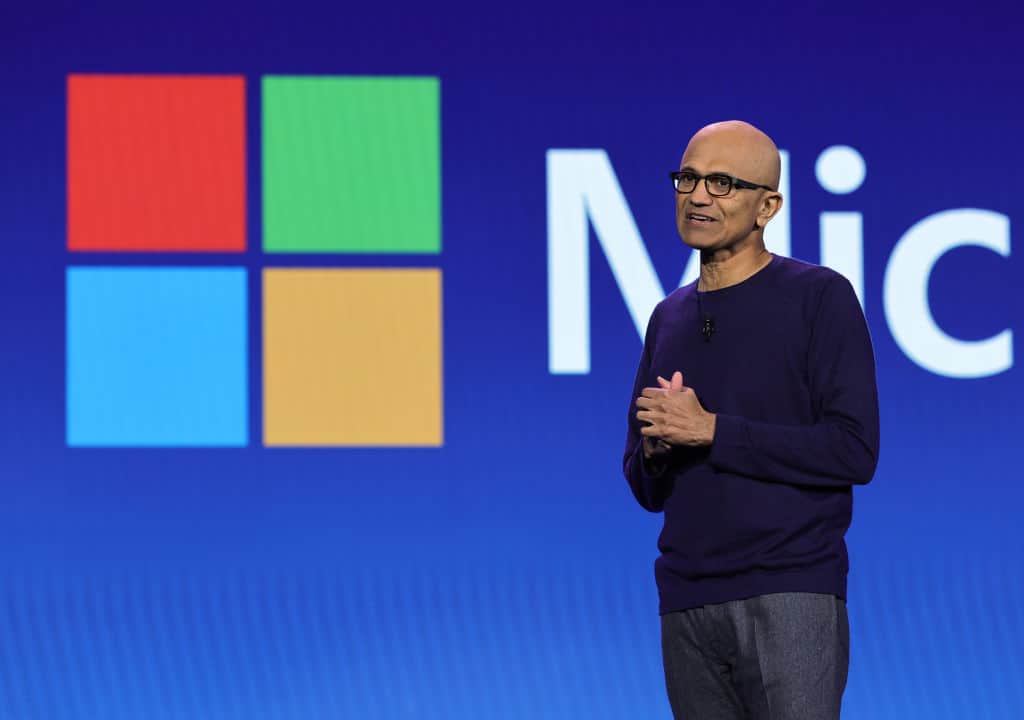
Microsoft
- Yield: 0.88%
- Shares for $50,000: 120
- Annual Passive Income: $439
Microsoft (NASDAQ:MSFT | MSFT Price Prediction) is the lowest-yielding name in this group, and that is precisely the point. The dividend currently runs at $0.91 per share quarterly, lifted from $0.83 the prior year and $0.75 the year before that. Three consecutive annual raises sit on top of an uninterrupted growth record stretching back to 2003.
Fiscal Q3 2026 revenue reached $82.89 billion, up 18.3% year over year, with Azure growing 40% and an AI run-rate of $37 billion. Operating margins of 46.3% and a return on equity of 34% mean the dividend consumes a small fraction of free cash flow. Microsoft returned $12.7 billion to shareholders in the most recent quarter, up 32% year over year.
Cisco Systems
- Yield: 1.79%
- Shares for $50,000: 544
- Annual Passive Income: $914
Cisco Systems (NASDAQ:CSCO) initiated its dividend in 2011 and has raised it every year since, taking the quarterly payout from $0.06 to the current $0.42. The most recent bump, declared February 11, 2026, was a 2% increase from $0.41.
Q2 FY26 revenue of $15.349 billion rose 9.7% year over year, with the Networking segment up 21%. AI infrastructure orders from hyperscalers reached $2.1 billion in the first half of fiscal 2026, and management raised full-year guidance to $61.2 billion to $61.7 billion. Cisco repurchased $1.4 billion of stock in Q2 with $10.8 billion remaining authorized.
Qualcomm
- Yield: 2.08%
- Shares for $50,000: 282
- Annual Passive Income: $1,039
Qualcomm (NASDAQ:QCOM) is the highest yielder in the group and the most diversified beyond its origins. The licensing-and-chips model is now flanked by a record $1.33 billion Automotive quarter, up 38% year over year, and $1.73 billion in IoT revenue. The company just declared a $0.92 quarterly dividend, raised from $0.89, continuing a record that traces back to 2003.
Capital return is aggressive. Qualcomm authorized a new $20 billion buyback and repurchased $5.4 billion in the first half of fiscal 2026 alone. CEO Cristiano Amon told investors the company is “equally excited by our entry into the data center, where a leading hyperscaler custom silicon engagement is on track for initial shipments later this calendar year.”
The Bottom Line
Combined, these three positions generate $2,393 in annual passive income on a $150,000 investment, a blended yield of 1.60%. Qualcomm contributes $1,039, Cisco adds $914, and Microsoft rounds out the portfolio with $439. Besides the dividends, these stocks have impressive capital appreciation potential.
| Ticker | Annual Income | Share of Total |
|---|---|---|
| QCOM | $1,039 | 43.4% |
| CSCO | $914 | 38.2% |
| MSFT | $439 | 18.4% |
The headline yield understates what these holdings deliver. Each company has raised its payout every year for more than a decade, meaning the income figure above is a starting line that should rise over time. Reinvested through a brokerage DRIP, the share count compounds while the per-share dividend climbs. That double engine is what separates a tech dividend portfolio held for 20 years from one harvested for the current quarter.















 Top Gaining Stocks
 Top Losing Stocks