



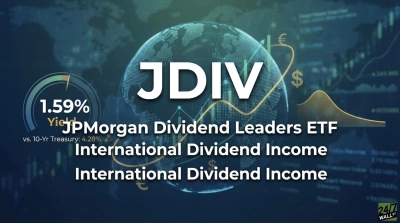
Most dividend ETFs make you pick a lane. You can chase yield with funds packed full of utilities, telecoms, and tobacco names that throw off cash but barely grow, or you can buy dividend growth funds that pay you almost nothing today on the promise of bigger checks a decade out. JPMorgan Dividend Leaders ETF (NYSEARCA:JDIV) is JPMorgan’s attempt to refuse the choice. Launched in September 2024, it invests globally in stocks with both higher dividend yield and faster dividend growth than the MSCI ACWI benchmark. The pitch is appealing. The execution is more complicated.
What JDIV Is Actually Trying to Do
JDIV is an actively managed ETF run by Sam Witherow, Helge Skibeli, and Michael Rossi at J.P. Morgan Asset Management, benchmarked against the MSCI ACWI Index. The fund commits at least 80% of assets to companies leading in dividend payouts relative to the benchmark, with ESG factors layered into selection. The return engine is twofold. You collect a current dividend stream, and you get capital appreciation as the underlying businesses grow earnings and raise their payouts over time. Active management is meant to find names where both pieces are accelerating.
The portfolio looks the part of a global quality fund. Taiwan Semiconductor sits at the top at 6.3% of net assets, followed by both Microsoft and Broadcom at ~4% each. Other industrials round out the top ten. Thus, JDIV is a tech-and-industrials tilt with healthcare ballast, the kind of mix that suggests quality screening rather than payout-chasing.
Does the Math Work for an Income Investor?
This is where the strategy meets reality. JDIV’s current yield sits around 2.73%, which trails both the 10-year Treasury and most established dividend ETFs. Quarterly distributions have also been bumpy, ranging from $0.117 in March 2025 to $0.360 in June 2025 to $0.133 in March 2026, which makes budgeting off the income stream genuinely difficult.
Total return tells a friendlier story. JDIV is up roughly 21% over the past year and 18% since its September 2024 launch, with shares near $56. That is a respectable result for a global mandate. The problem is the obvious benchmark you would actually buy instead. Schwab US Dividend Equity ETF (NYSEARCA:SCHD | SCHD Price Prediction) is up roughly 26% over the same one-year window and 16% year to date, with a higher yield and a much lower fee.
JDIV charges a 0.47% net expense ratio, compared with 0.06% for SCHD. You are paying nearly eight times as much for active stock picking, and so far the active overlay has not produced an active premium.
The Real Tradeoffs
Three constraints deserve weight before this fund earns a portfolio slot.
- Closure risk from a tiny asset base. Assets under management sits at $11 million. Funds that small can be liquidated by the sponsor, which would force a taxable event on holders at an inconvenient moment.
- An identity that fits neither box cleanly. Income-first investors will find the 2.73% yield insufficient. Growth-first investors usually do not pay a 0.47% fee for a dividend mandate when broad market or quality ETFs cost a fraction of that. The dual mandate cuts the addressable audience.
- Distribution variability and tax friction. Active turnover and uneven quarterly payouts mean you cannot reliably model income, and short-term capital gains can leak through in taxable accounts.
JDIV makes sense as a small global dividend-growth sleeve for investors who already own SCHD or a domestic dividend fund and want active international exposure to names like Taiwan Semiconductor and Safran. Anyone buying it as a primary income vehicle is paying premium fees for a yield the Treasury market currently beats.














 Top Gaining Stocks
 Top Losing Stocks