


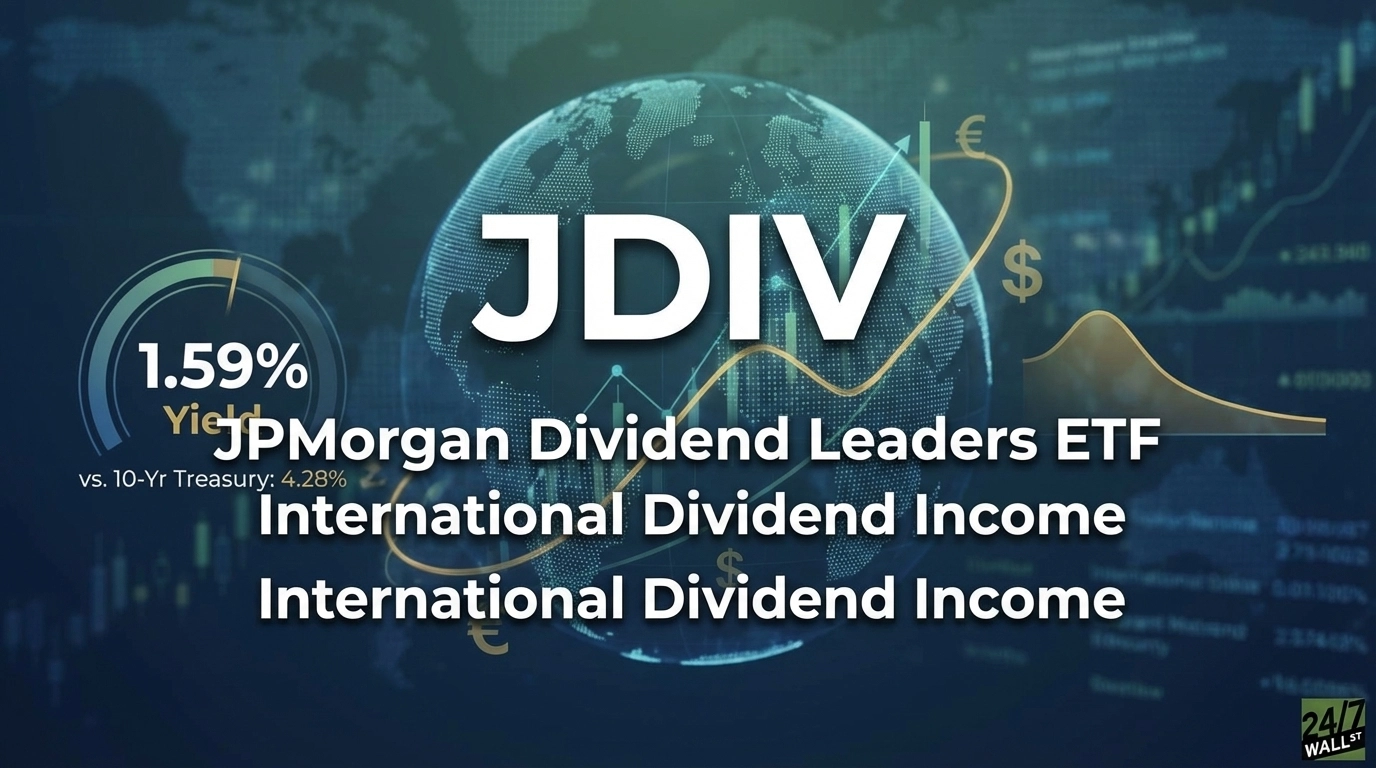
JPMorgan Dividend Leaders ETF (NYSEARCA:JDIV) JPMorgan Dividend Leaders ETF (JDIV) launched in September 2024 with a straightforward promise: give investors access to dividend-paying companies from around the world in a single, low-cost fund. With a 47 basis point expense ratio and holdings spanning the US, Europe, Asia, and emerging markets, it targets investors who want income without limiting themselves to domestic stocks. But a 1.59% yield in a market where the 10-year Treasury sits at 4.28% raises an immediate question: is this income stream worth the equity risk?
How JDIV Generates Its Income
JPMorgan Dividend Leaders ETF is a straightforward equity dividend ETF. It holds shares in companies that pay dividends, and those dividends flow through to shareholders on a quarterly basis. The fund benchmarks against the MSCI ACWI Index and selects holdings based on dividend growth and sustainability criteria. Income is not manufactured through options or leverage. What the underlying companies pay, the fund passes along.
The top holdings skew toward quality compounders rather than traditional high-yield names. Taiwan Semiconductor Manufacturing leads at 6.3% of the portfolio, followed by Microsoft at 4.4% and Broadcom at 3.5%. Taiwan Semiconductor Manufacturing (NYSE:TSM | TSM Price Prediction), Microsoft (NASDAQ:MSFT), Broadcom (NASDAQ:AVGO), NextEra Energy (NYSE:NEE) and Trane Technologies (NYSE:TT) round out the top five. These are not high-yield names by nature. They are quality compounders that also pay dividends, which explains why the fund’s overall yield is modest.
The Yield Gap Is a Real Concern
At 1.59%, JDIV’s dividend yield falls well below the current Fed funds rate of 3.75% and the 10-year Treasury yield. For income-focused investors, this gap matters. You are taking on equity volatility, currency risk, and geopolitical exposure across multiple countries in exchange for a yield that a money market fund currently beats without breaking a sweat.
The distribution history reflects the irregular nature of international dividend schedules. Payments have swung from $0.12 in lean quarters to $0.36 at the high end, and December sometimes produces multiple distributions as foreign companies settle annual payouts. This lumpiness is a structural feature of international dividend investing — not a sign of portfolio weakness — but it does mean income-dependent investors cannot count on consistent quarterly checks the way they might with a domestic dividend fund.
What the Track Record Actually Shows
The honest structural concern here is that JDIV is a very young, very small fund. With only $9.9 million in assets, it sits far below the scale most institutional investors consider viable for long-term sustainability. Small funds face higher closure risk, and the ticker JDIV was previously used by a JPMorgan US-focused dividend ETF that was liquidated in September 2022. That history is not a prediction, but it is context investors should have.
On the return side, the picture is more encouraging. Shares have gained 15.1% over the past year, which means total return has meaningfully outpaced the income yield alone. Year-to-date performance is essentially flat at 0.3%.
A Quality Fund With a Yield Problem
JDIV’s dividend is not structurally at risk. The underlying holdings are quality businesses with real earnings and genuine dividend histories. The income stream is inconsistent in timing but not in origin. The more pressing question is whether this fund makes sense as an income vehicle at all given the yield on offer.
JDIV’s global diversification and quality-focused construction make it worth examining for investors researching dividend growth strategies. Analysts at 24/7 Wall St. have flagged the short 18-month track record as insufficient for retirees, and that concern is particularly relevant for income-dependent investors. The fund’s limited history and small AUM are factors worth monitoring as the fund continues to develop.










 Top Gaining Stocks
 Top Losing Stocks