


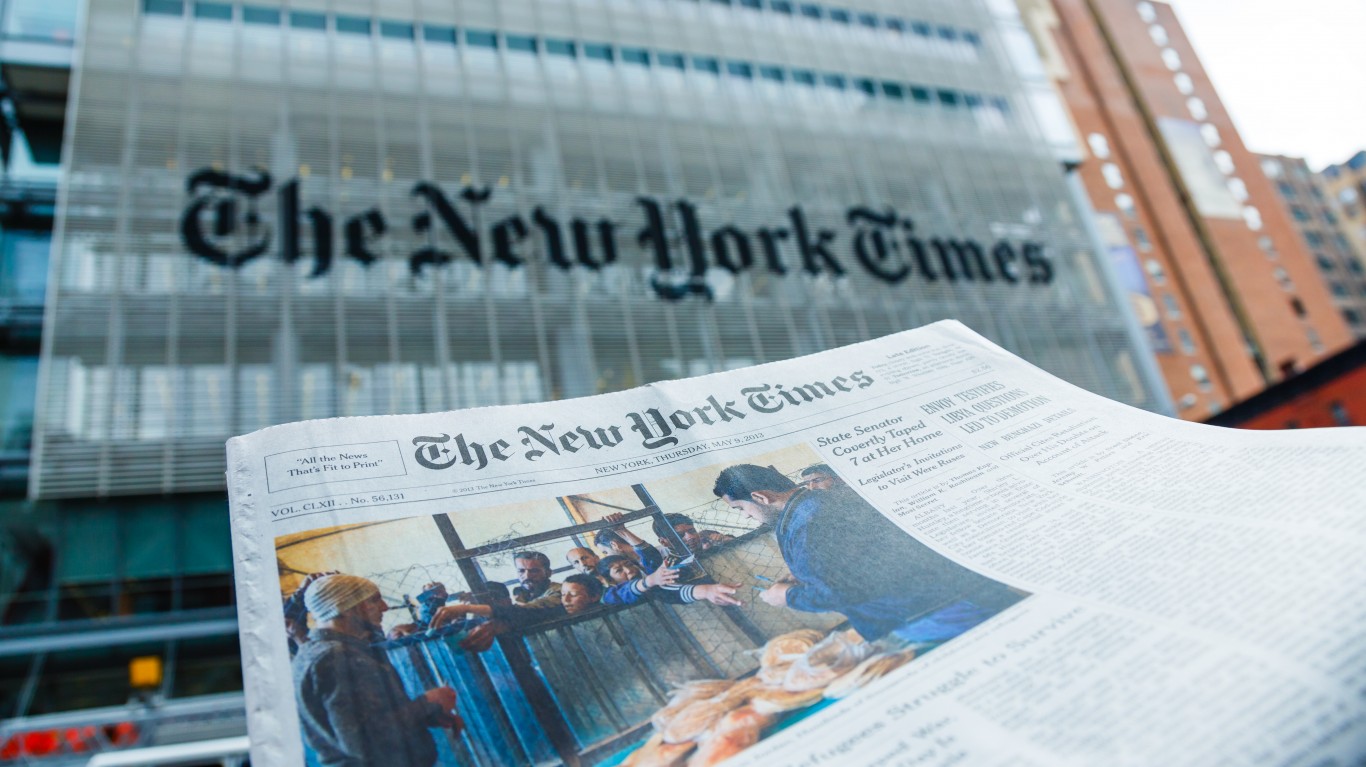
In the past few days, two important things of note happened in the newspaper industry. The New York Times Co. (NYSE: NYT | NYT Price Prediction) chief executive officer said the paper had reached a paid subscriber base of an unimaginable 5 million. Also, the second-largest newspaper chain in America, McClatchy Co. (NYSE: MNI), failed to make a scheduled debt payment. A number of people in the industry believe McClatchy will declare bankruptcy soon. One would think the wider newspaper industry could take a page from The New York Times playbook to salvage what is left of it. Unfortunately, it can’t.
The New York Times has at least two significant advantages. The first is that it has maintained a newsroom with well above 1,000 editors, writers and producers. This allows it to produce a paper unrivaled in the United States, when measured by quality, depth of reporting and the broad number of subjects it can cover. That breadth and quality allow it to charge large amounts for subscriptions. That, in turn, allows it to maintain its mammoth editorial staff.
Another advantage is that it operates in the largest American city, which gives it a large target for subscribers. While true, that does not mean it is the largest paper in New York City proper. That distinction, based on most measurements, belongs to either the New York Post or New York Daily News. The New York Times draws subscribers from across the country and from overseas.
McClatchy’s newsrooms have been gutted in an attempt to keep the company profitable. That has nearly sunk the number of stories that its papers can produce and the breadth of subjects covered. McClatchy has almost 30 properties, including the Miami Herald, Charlotte Observer, Sacramento Bee and Kansas City Star. Among them, they have about 199,200 digital-only subscribers. That is not a fair comparison to The New York Times figure. The Times has 900,000 print subscribers, which leaves it with about 4 million digital-only subscribers, which still dwarfs the McClatchy figure.
McClatchy’s major problem is that it cannot produce papers most people in its markets will pay for. The Times can, and the contrast between the subscription counts and the financials of the two companies is almost that simple and will continue to be.
[nativounit]
To draw a further contrast, McClatchy’s stock has fallen 95% in the past two years. It has a market capitalization of $3.3 million. The New York Times stock is up 17% over the same period. It has a market capitalization of $5.5 billion. In the last quarter, the Times had revenue of $428 million and net income of $16 million. McClatchy had revenue of $167 million. Its net loss was $23 million.
Experts who follow the newspaper industry have said the industry is doomed. While that may be true, it certainly will continue to be badly injured. No other paper can approach the success of the New York Times. The quality of all other major city dailies has fallen too far for them to be attractive to most possible subscribers. At the same time, the quality of the New York Times has gotten better.
[recirclink id=636319]
[wallst_email_signup]










 Top Gaining Stocks
 Top Losing Stocks