


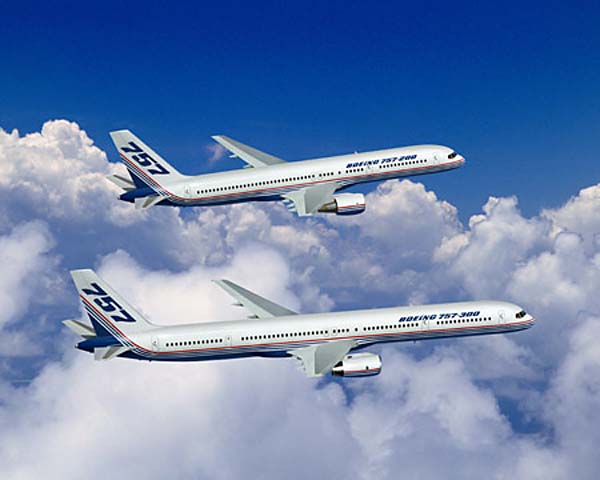
So what will Boeing do? According to Randy Tinseth, Boeing’s vice-president for marketing in its commercial planes division, the company is working on its plans for a replacement for the 757, but that reaching a decision will take some time.
Tinseth said that there are still about 950 757s in use, of which about 750 are passenger planes and the rest are freighters. According to a report from industry consulting firm Leeham, Tinseth gave a “very firm ‘No’” to putting a new engine on the 757 frame.
The 757 fills a niche in the airlines business that is not as large as that of the single-aisle 737 and the Airbus A320, but Boeing now trails Airbus in orders for the smaller planes, and Boeing wins in the dual-aisle, wide-body space. The 757 fits between these two larger spaces and has the capability to fly into and out of smaller airports with shorter runways and to serve high-altitude airports. The plane is also capable of flying so-called long-thin routes — long distances with around 200 passengers.
ALSO READ: Boeing to Build the Next Air Force One
Airbus has announced an A321LR (long range) to fill this niche. The plane is essentially an A321neo (new engine option) with a standard configuration of 16 business class seats and 190 economy class seats. Added fuel tanks give the plane a claimed range of 4,000 nautical miles. The longest commercial flight currently flown by the 757 connects New York non-stop with Berlin, which is slightly more than 4,000 nautical miles. The 757 can only fly this far with fewer passengers.
Boeing will do something in this niche because it must. In Thursday’s conference sessions, industry analyst Richard Aboulafia — who brought up the 757 issue — also said that Airbus would hold 60% of the market for single-aisle planes through 2024. The market is currently almost equally divided between Boeing and Airbus, and Boeing’s Tinseth said he does not agree that Airbus will dominate that market.
But Airbus could, and that is why Boeing needs to do something to counter the A321LR and keep a Boeing plane as at least an equal player in the 757’s niche. It doesn’t look like it can be done cheaply, though, and that is what bothers Boeing.
Boeing’s stock traded down fractionally at $147.87 Thursday morning, in a 52-week range of $116.32 to $148.89.







 Top Gaining Stocks
 Top Losing Stocks