



Stop me if you’ve heard this story before. China controls virtually 100% of the world’s supply of rare earth minerals and the United States needs to do something to redress the balance particularly to fill the needs of the Department of Defense for these militarily critical substances. There’s a source just waiting for development right here in the USA, and all it needs is some financing to get going.
If you are remembering the buzz around Molycorp in 2010 and 2011, that was then. Just last month the Government Accountability Office (GAO) scolded the Defense Department because it “has not taken a comprehensive, department-wide approach to identifying which rare earths, if any, are critical to national security.” The GAO notes that the Pentagon has been “generally directed by law since at least 2011 to take actions concerning supply chain vulnerabilities for materials, such as rare earths.”
A Pentagon spokesman told Breaking Defense, “DoD disagrees with the GAO characterization that DoD has no department-wide approach for critical materials, but in the spirit of continuous improvement, the Department agrees with the recommendations in the GAO report.”
Certain of the rare earth elements have been used to manufacture lasers, among other things, but there appears to be no demand for more rare earth minerals than China can already meet, and that means private corporations are not clamoring for the minerals. Apparently the military isn’t either.
[recirclink id=312232]
In fact, lack of demand is partly the reason that Molycorp went from a $70 stock in 2012 to a four-cent stock today. Many industrial firms that used rare earths developed substitutes for the minerals, driving prices down for the materials. Molycorp’s other big problem is that it did not have significant supplies of the really scarce ones like scandium, which still carries a price tag of $15,000 per kilogram.
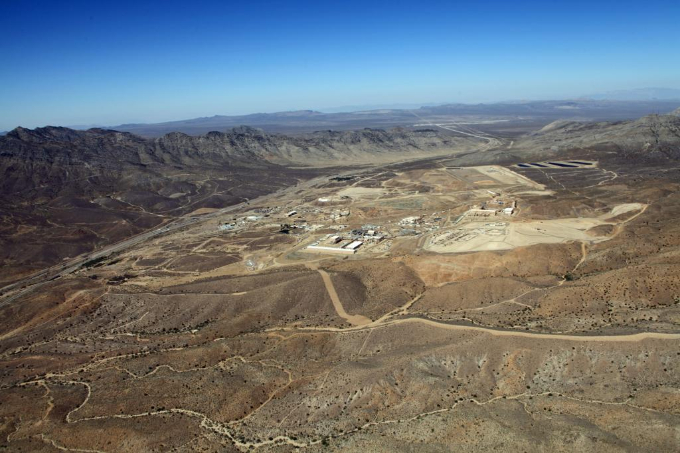
A company called Texas Rare Earth Resources, which trades over-the-counter as TRER, has located a source of rare earth minerals in Hudspeth County, Texas, about 85 miles southeast of El Paso. According to a company presentation, the proposed mine site holds more than 525 million kilos of total resource (134 million kilos of measured resource), 72% of which are the more costly heavy rare earths. Dysprosium, which the company says will account for 5.9% of production and 26.5% of revenues, currently sells for $350 per kilo as a metal and $230 per kilo as an oxide. Yttrium, which sells for $35 per kilo as a metal and just $6 per kilo as an oxide, is expected to account for nearly half of production and 9.2% of revenues. Nearly a quarter of production will be light rare earths, primarily neodymium, which currently sells for $60 per kilo as a metal and $42 per kilo as an oxide.






 Top Gaining Stocks
 Top Losing Stocks