



When baby boomers start to think about retiring, they undoubtedly have more questions than answers, like how much income they will need to maintain their lifestyle or what debt they have right now that they need to pay off before retiring.
The good news is that there are plenty of answers to these questions, some more transparent than others. The hope is that by the time the answers to these questions present themselves, they will make the transition to retirement much easier.
How Much Income?
The biggest question anyone looking to transition from full-time or even part-time work to retirement asks is, “How much income will I need to maintain my desired lifestyle?” This question is undoubtedly on the minds of baby boomers, but it’s also something millennials should start thinking about.
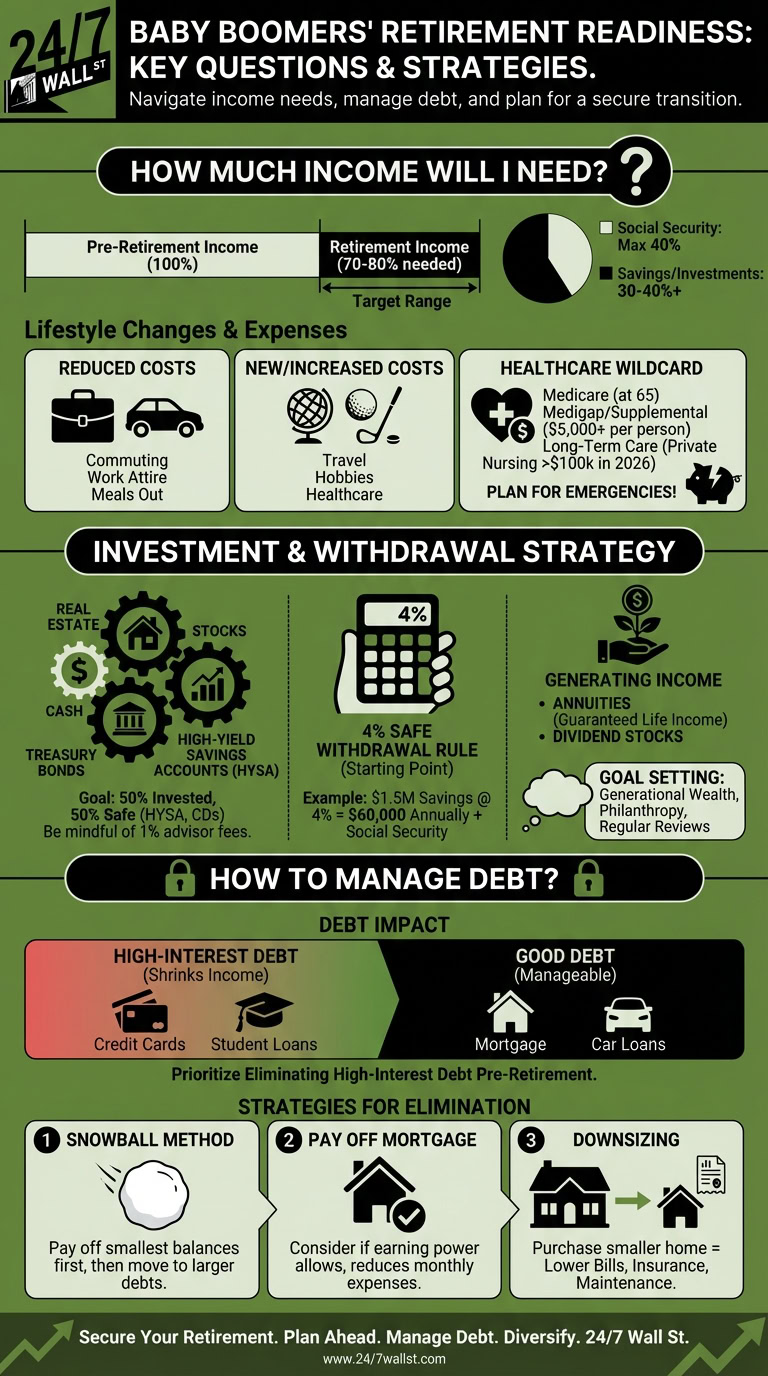
First and foremost, baby boomers must look at their pre-retirement income and decide how much of those monthly expenses will stick around. This includes groceries, travel, hobbies, dining out, entertainment, insurance, and even cell phone bills. All of these things add up, and it will be essential to look at these items one-by-one to see if and where you might be able to cut down on some of your expenses, which in turn helps answer how much income is necessary long-term.
The prevailing theory is that you will need as much as 70-80% of your full-time pre-retirement income to maintain your lifestyle. As a caveat, it’s important to remember that Social Security payments will make up no more than 40% of this percentage, depending on how much you earned during your lifetime.
Changing Lifestyles
When you think about what retirement might mean, it will mean a lifestyle change. This could be something as significant as relocating to somewhere with a lower cost-of-living or downsizing to a smaller home.
However, it could also mean that you want to allocate more money to hobbies and travel, so this money must come from another part of the budget. Some expenses will drop, like commuting expenses, lunch out, or even work attire, which you can add back to your budget. This may be the offset you need to start looking at things like a golf membership or a gym fee, which will now take on more importance in your life.
Healthcare Costs
The biggest wildcard in any retirement planning will be healthcare, which can be a surprise when you least expect it. With Medicare not starting until 65, this could impact the first few years of retirement, however, it’s what Medicare doesn’t cover that can really be the surprise.
This is where Medigap and a supplemental plan come into the picture, which can cost upward of $5,000 per person, depending on the insurance agency. Of course, you must also factor in long-term care that Medicare won’t cover, with private nursing homes estimated to exceed the six-figure mark in 2026.
Rest assured that unexpected financial emergencies can and will happen, so you must set aside money to cover any potential issues.
How Much Income Exactly?
This number is hard to pinpoint, but let’s assume a 65-year-old retiring in 2026 will have a $1.5 million savings account. Assuming a 4% safe withdrawal rate, this gives them $60,000 annually plus any additional money that might come from Social Security.
Investment and Withdrawal Strategy
The most important thing any baby boomer can do in today’s world is diversify, diversify, and diversify. This means having assets allocated among real estate, cash, stocks, treasury bonds, and even high-yield savings accounts will be a consideration. Ask yourself, “Are my investment and withdrawal strategies aligned with my retirement goals?”
When you’re looking to retire, ensuring the asset allocation isn’t too risky is vital, so 50% invested and 50% HYSAs, CDs, and other safe investments are ideal. Also of note is that if you’re working with a financial advisor, and you should, you could be spending 1% on fees to help manage all of your assets.
Safe Withdrawal Rate
As it stands in 2026 and has for any number of years previously, there is the 4% rule, which indicates that you should withdraw 4% of your assets every year to live on while retired. Unfortunately, inflation and market volatility can challenge this number, but according to financial advisors, it’s definitely a starting point worth considering as it applies well to people of all different retirement levels.
Generating Income
Another consideration to help boost income during retirement is to look at income-generating investments, like annuities. You can also have money invested in dividend stocks, but an annuity might be worthwhile if you want guaranteed income for life that you can depend on to help cover your bills. Annuities need to be researched carefully, and this is another area in which a financial advisor should be of help.
Goal Setting
Ultimately, goals will vary at this stage in your life, so you must ask yourself if you are trying to set the stage for generational wealth? What about philanthropy? The best case is to have quarterly, if not bi-yearly, reviews, which will help you understand where things stand and account for big financial expenses that pop up, like medical emergencies.
How To Manage Debt
A big question you don’t want lingering over your head is, what will you do with any existing debt you might have? Ask yourself “What debt do I have, and how will I manage or eliminate it before retiring?
The answer to this question will arguably determine how much money you bring into retirement. It’s also important to remember all your debts, including “good” debt like mortgages and cars but also debt you might not want to carry over, like credit card debt, student loan debt, and other standing medical bills.
Mortgage Debt
Thankfully, mortgage debt is common, and you don’t have to worry about it impacting your lifestyle too much unless your mortgage runs you in the thousands per month on a house that is too large for an empty nester lifestyle. It’s also common to enter retirement with plenty of years left on a mortgage, so don’t let this stop you.
Debt Impact
The most important takeaway is that you want to look at what kind of debt you have that is accruing a lot of interest right now that isn’t a mortgage. This will arguably be student debt and/or credit card debt that could shrink how much disposable or discretionary income you have every month.
Having too much debt in these categories will probably stress any baby boomer out and make retirement less enjoyable until this is paid off.
Eliminate Pre-Retirement Debt
The hope is that before retiring, you can use a method like the snowball method and start paying off your smallest balances first. Using this method, you can tackle debt one-by-one and get more comfortable as you finalize your retirement debt.
There is always the option of paying off a mortgage, which many baby boomers do pre-retirement to avoid this expense, but doing so requires considerable earning power. There is also the consideration of downsizing, which allows you to purchase a smaller home, which means lower utility bills, insurance costs, and even maintenance responsibilities. All of these things are worth considering in order to make your retirement as financially stress-free as possible.













 Top Gaining Stocks
 Top Losing Stocks