


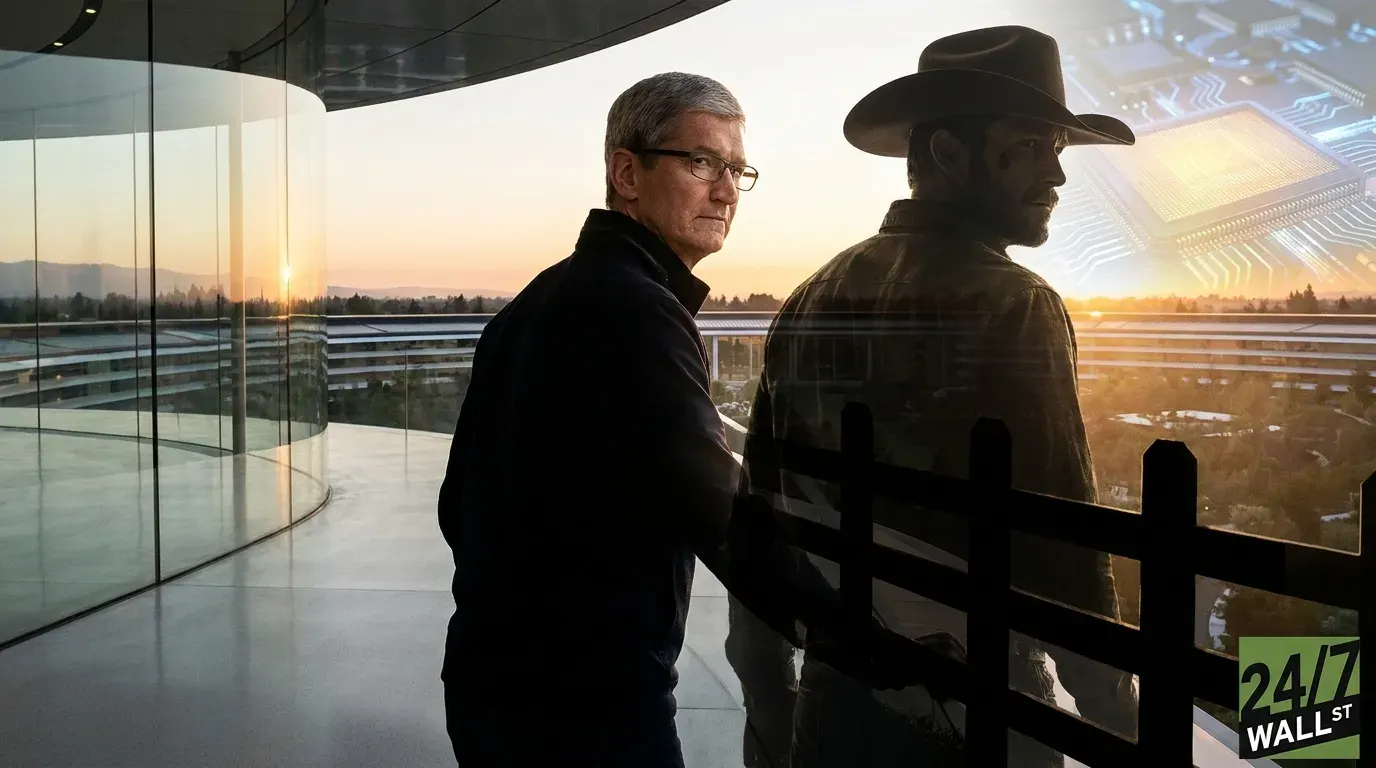
Patrick McGee’s observation that incoming Apple CEO John Ternus “has more of an opportunity to be a cowboy here, meaning to shoot from the hip and to be a lot more playful” sounds like exactly what a company at an AI crossroads needs. The problem is that cowboy instincts get fenced in fast when the previous sheriff keeps an office down the hall.
Tim Cook will transition to executive chairman on September 1, 2026. Ternus, currently Senior Vice President of Hardware Engineering and a 25-year Apple veteran, will take the CEO role. The market barely blinked. Apple shares saw a “minimal dip” following the announcement, a contrast to the more than 6% drop when Steve Jobs departed in 2011. Investor calm is understandable. Apple has beaten earnings estimates in each of the last 8 consecutive quarters. Most recently, it posted EPS of $2.84 against an estimate of $2.67 on revenue of $143.76 billion. The machine runs well. The question is whether it can evolve.
The Real Risk in This Structure
McGee’s cowboy framing is useful, but the more important observation is the one he buried: “Many companies have not been able to nail this structure where the CEO of a longtime company elevates to executive chairman and is able to really let the new CEO earn their reputation.” That is the core tension here, and it has nothing to do with Ternus’s temperament.
The executive chairman structure creates a shadow hierarchy. When the board’s most powerful voice is the person who built the prior strategy, new CEOs face a structural disadvantage on any decision that implies the old approach was wrong. China’s manufacturing is the clearest example. McGee raised the scenario directly: “If there’s a major world crisis involving China and Tim Cook has a different decision-making process… then John Ternus, who makes the call?” That is a governance question with real financial consequences for a company that has historically been heavily reliant on Chinese manufacturing.
Tripp Mickle framed the succession risk through a family business lens: Apple functions “like a family” where “the founder who starts a business, the son who takes over the business and takes it to new unprecedented business heights, and then the grandson usually comes along or the granddaughter and kind of screws it all up.” That pattern is not inevitable, but it is common enough to take seriously. The third-generation leader inherits an organization optimized for the previous era’s competitive environment.
Where Ternus’ Temperament Actually Matters
McGee noted that Ternus “plays with go-karts and engineers them in his spare time, seeing if a titanium go-kart is going to be better than the aluminum one—” the kind of tinkerer’s instinct that drove Apple’s original hardware differentiation. Ternus oversaw hardware development for the iPhone, Mac, and Apple Vision Pro, and played a key role in the Mac’s transition to Apple silicon. That track record is credible.
The gap is AI. Apple has lagged behind competitors in generative AI development. And analysts are divided on whether a hardware engineer is the right profile to close that gap. Morgan Stanley expects Apple to continue strong performance. In fact, it sees the annual developer conference and new product cycle as near-term catalysts. However, near-term execution and long-term repositioning are different challenges.
McGee believes “some of the Cook’s last 15 years need to be undone,” including expanding manufacturing in India and Mexico to reduce China’s concentration. That kind of strategic reversal requires a CEO with room to make bold calls. Whether Ternus gets that room depends entirely on how Cook interprets his executive chairman mandate.
McGee noted that Ternus “plays with go-karts and engineers them in his spare time, seeing if a titanium go-kart is going to be better than the aluminum one.”
Apple (NASDAQ: AAPL | AAPL Price Prediction) trades at roughly $272 per share with a forward P/E of about 34x and a $3.98 trillion market cap. At that valuation, investors are paying for continued execution. The cowboy can deliver it. But only if the executive chairman lets him ride.







 Top Gaining Stocks
 Top Losing Stocks