



On a recent episode of her Women & Money podcast, Suze Orman fielded a listener letter from someone named Rachel worried her portfolio was too concentrated. Orman’s response cut straight to the point: “Put 50% of your money in VOO, then buy Nvidia, AMD, Palantir, IONQ.” The advice is blunt, memorable, and worth taking seriously because the math behind it is sound, even if specific individual stock picks are debatable.
The core principle is portfolio architecture: How you split money between a broad index anchor and individual positions determines both your floor and ceiling. Orman is right about the 50% VOO foundation. The numbers back her up.
Why the Floor Matters More Than the Ceiling
The SPDR S&P 500 ETF Trust (NYSEARCA:SPY | SPY Price Prediction) and its Vanguard counterpart, VOO, both track the S&P 500 Index, which holds roughly 500 of the largest U.S. companies across all eleven sectors. The structural difference is cost. SPY carries an expense ratio of about 0.09%, while VOO’s expense ratio sits at 0.03%. Over a 30-year holding period, that gap compounds into meaningful drag on SPY relative to VOO — which is why Orman names VOO specifically.
The performance record for this index is hard to argue with. Over the past ten years, SPY has returned 237%, and over the past year alone it has returned 37%. The S&P 500 recently crossed 7,000 for the first time, a milestone that generated sentiment scores of 80 (very bullish) across retail investing communities. The long-term compounding case for holding a broad index fund is one of the most thoroughly documented arguments in personal finance.
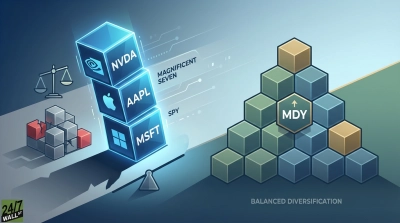
The 50% allocation creates what portfolio managers call a core-satellite structure. The core (VOO) delivers market returns with near-zero manager risk. The satellite (individual stocks) gives the investor a chance to outperform. Orman’s framing acknowledges something most retail investors resist: the majority of active stock pickers underperform the index over a decade. Anchoring half the portfolio to the index guarantees that at least half performs in line with the market, regardless of how the individual picks perform.
Running the Scenario
Consider a 45-year-old with $200,000 to invest, planning to retire at 65. Under Orman’s framework, $100,000 goes into VOO and $100,000 into individual stocks. Using the S&P 500’s historical average annual return of approximately 10% nominal, the VOO half grows without active decision-making. The individual stock half could outperform, underperform, or fail entirely — and the investor still has a substantial base from the index side.
This structure guards against concentration risk. Information Technology alone makes up nearly 33% of the S&P 500 by weight, with NVIDIA at about 8%, Apple at roughly 7% and Microsoft at about 5% as the top three holdings. An investor putting 100% into individual tech names — the exact temptation when AI excitement runs high — takes on sector concentration risk that VOO spreads across eleven GICS sectors including Financials at 13%, Health Care at 9%, and Industrials at 9%.
The timing of this advice matters. The VIX peaked above 31 recently before retreating to around 20 — a 12-month high followed by sharp normalization. Portfolios heavily concentrated in single names took the full force of that volatility. A 50% VOO allocation would have cushioned that drawdown significantly because broad diversification absorbs sector-specific shocks.
When the 50/50 Split Works and When to Tilt Toward VOO
Orman’s 50/50 split works well for investors between 35 and 55 with a long runway, risk tolerance to hold through corrections, and genuine conviction in individual names. If you put 50% into individual stocks, those picks need rigorous reasoning beyond what trends on financial social media. Orman named Nvidia, AMD, Palantir, and IONQ (all high-volatility, AI-adjacent names requiring active monitoring and tolerance for 30% or larger drawdowns in any given year).
The structure is less appropriate for investors within ten years of retirement who cannot absorb large losses in the individual stock sleeve. Consumer sentiment has remained below the 80-point neutral threshold for the entire past year, sitting around 57 in early 2026, which signals ongoing economic uncertainty. A 60-year-old with $500,000 saved may want VOO at 70% or 80%, with a smaller satellite for individual names. The 50/50 split assumes you can ride out a bad year in the individual stock sleeve without derailing your retirement timeline.
The bond side deserves mention. The 10-year Treasury yield currently sits at about 4.3%, which means fixed-income alternatives to equities are actually paying something meaningful. An investor closer to retirement might reasonably replace some or all of the individual stock sleeve with Treasuries or short-duration bond funds rather than single-name equity risk.
Size the Anchor Before Adding Satellite Bets
Before splitting your portfolio 50/50, answer one question honestly: do you have a specific, researched reason to own each individual stock in the other 50%, or are you chasing what has recently performed well? If the latter, Orman’s advice still applies — increase the VOO allocation until you have done the work on individual names. A 70% VOO and 30% individual stock split reflects a clear-eyed recognition that the index is a hard benchmark to beat, and that most wealth-building happens in the compounding base, not the satellite bets. Anchor first, speculate second, and size the anchor large enough that speculation cannot sink you.













 Top Gaining Stocks
 Top Losing Stocks