


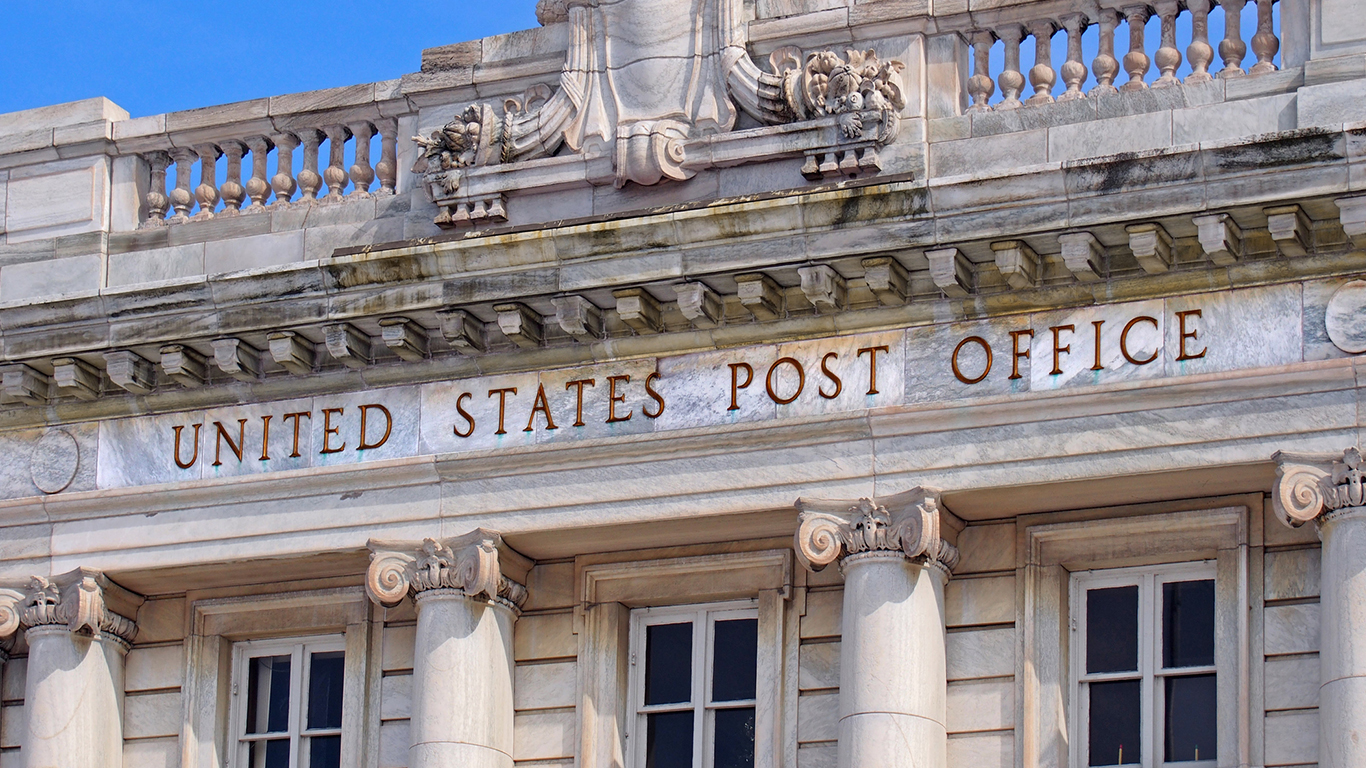
The U.S. Postal Service (USPS) is famous for a number of reasons. Benjamin Franklin became the first postmaster general in 1775. The USPS delivers the mail, no matter what the weather. More recently, it has lost billions of dollars a year and has become a political hot potato in Congress as it tries to map a future where it will not be reliant on the U.S. government. Added to the list of the role of the post office is new research that shows it is the most favorably rated federal agency among a number that were measured in a major new survey.
Pew Research recently asked a group of Americans which agencies of the government they view most favorably and less favorably. The USPS rating was 90% favorable and 8% unfavorable. That was immediately ahead of the National Park Service with 86% favorable to 7% unfavorable split, the National Aeronautics and Space Administration (NASA) at 81% to 10%, and the Centers for Disease Control and Prevention (CDC) at 80% to 12%. Favorable ratings of agencies dropped off a great deal after those. A total of 16 agencies were mentioned in the survey. Fourteen had more favorable than unfavorable ratings. The study included 2,004 people who were questioned between September 5 and September 16. One might wonder whether opinions would change based on the surprising things the government knows about you.
At the other end of the spectrum from the post office was Immigration and Customs Enforcement (ICE), which has been in the news incessantly recently. Its unfavorable rating was 54%, compared with 42% favorable. The only agency close to ICE in terms of unfavorable ratings was the Department of Education, which had 48% favorable and 48% unfavorable split.
The USPS occupies a unique place in the U.S. government. It is run by a board of governors that includes 11 members. Nine are appointed by the U.S. president and confirmed by the Senate. One is the postmaster general. The last is the postmaster general’s chief deputy. Another board, the Postal Regulatory Commission, approves, among other things, postal rates. Because of these restraints, USPS management often complains it does not control its own fate, and therefore its own profitability.
[nativounit]
The USPS is huge, with 497,157 career employees and 137,290 non-career employees. The agency manages 31,324 post offices. In the most recently reported quarter, its revenue was $17.1 billion and it had a net loss of just short of $2.3 billion.
Among the criticisms of the USPS is that it is not needed anymore, at least at its current size. UPS and FedEx deliver many of the parcels and letters circulated in the United States. Amazon also has moved into this business. Much of what was first class mail is handled via email. Among the most often asked questions about the future of the post office is whether it needs over 31,000 locations and has to deliver mail six days a week. Post offices can be found in some of America’s tiniest towns.
Americans love the National Park Service (every state has a favorite National Park) and NASA (responsible for so many modern inventions). Whatever the future of the post office, it has clear public support now too. That may be critical to whether it is preserved as it is.
[recirclink id=581001]
[wallst_email_signup]














 Top Gaining Stocks
 Top Losing Stocks