


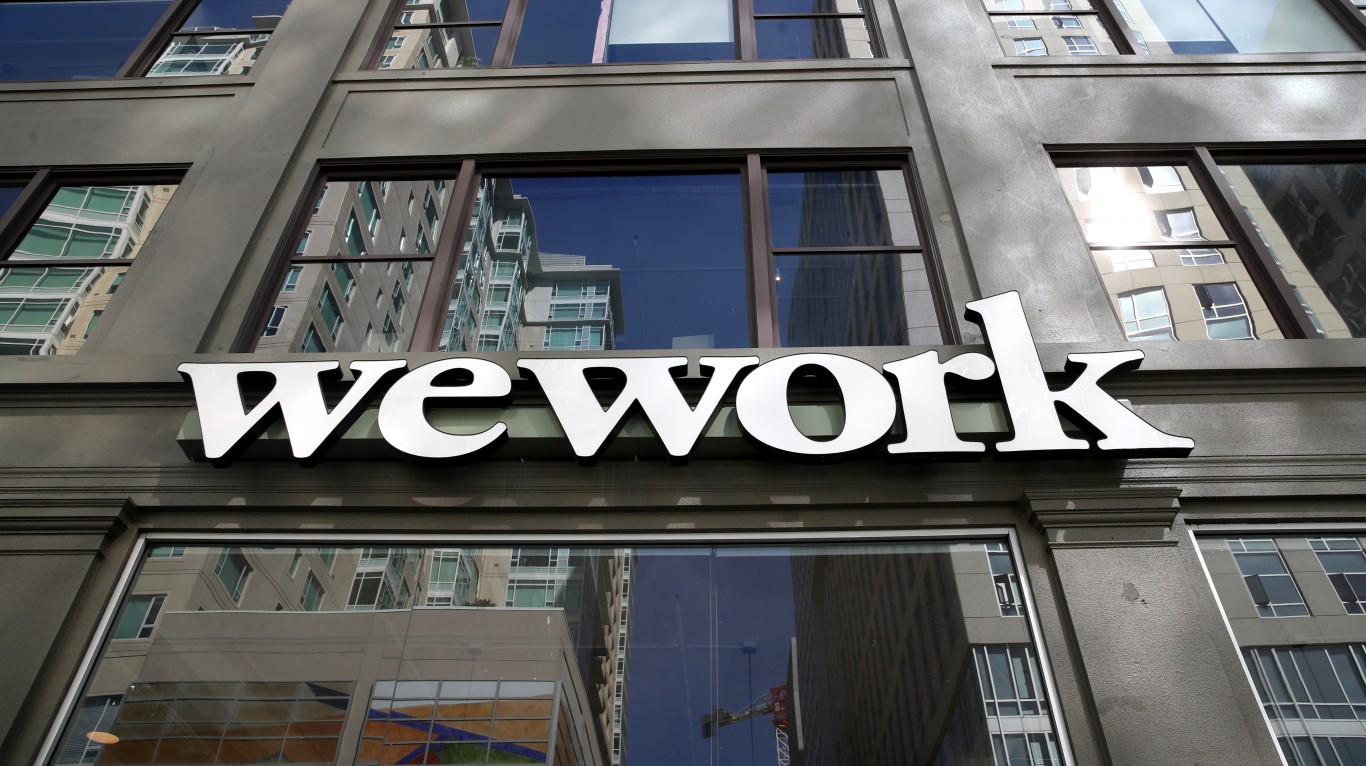
WeWork may run out of money and go out of business, it admitted in an SEC filing. The filing said “substantial doubt exists” that the office rental company will make it financially. What happens to WeWork next will determine what will happen to tens of thousands of people and companies who are WeWork “residents” or “members.” (These industries are laying off the most workers.)
[in-text-ad]
The press has recounted WeWork’s emergence as the world’s largest office-sharing company to its present state. Its current financial situation is so poor that even vulture investors will not take a chance on a rebound. WeWork said it would try to cut its own rent costs in the buildings where its facilities are located. The success of that depends on whether these landlords have financial problems or can afford to kick WeWork out. Many of these landlords are already in trouble themselves because of the “work from home” policies of their other tenants.
[nativounit]
Two things could happen to WeWork and, therefore, its tenants. A financial firm could take it out of Chapter 11. That would rely on breaking the leases with landlords, which could set off messy battles that would drive WeWork members away. That, in turn, makes WeWork’s revenue problems worse. It is a downward spiral.
[wallst_email_signup]
Alternatively, WeWork could be liquidated. Its office locations would be sold off, one by one in some cases, to other office-sharing companies. Given WeWork’s massive office footprint, these properties will not have enough buyers.
[recirclink id=1291659]
WeWork members could be without offices in some places. They will need to scrabble to find space in their neighborhoods to relocate. If WeWork cannot, some of its members must tell their employees to work from home.
Where Will WeWork Renters Go?


© peshkov / Getty Images

Douglas A. McIntyre is the co-founder, chief executive officer and editor in chief of 24/7 Wall St. and 24/7 Tempo. He has held these jobs since 2006.
McIntyre has written thousands of articles for 24/7 Wall St. He is an expert on corporate finance, the automotive industry, media companies and international finance. He has edited articles on national demographics, sports, personal income and travel.
His work has been quoted or mentioned in The New York Times, The Wall Street Journal, Los Angeles Times, The Washington Post, NBC News, Time, The New Yorker, HuffPost USA Today, Business Insider, Yahoo, AOL, MarketWatch, The Atlantic, Bloomberg, New York Post, Chicago Tribune, Forbes, The Guardian and many other major publications. McIntyre has been a guest on CNBC, the BBC and television and radio stations across the country.
A magna cum laude graduate of Harvard College, McIntyre also was president of The Harvard Advocate. Founded in 1866, the Advocate is the oldest college publication in the United States.
TheStreet.com, Comps.com and Edgar Online are some of the public companies for which McIntyre served on the board of directors. He was a Vicinity Corporation board member when the company was sold to Microsoft in 2002. He served on the audit committees of some of these companies.
McIntyre has been the CEO of FutureSource, a provider of trading terminals and news to commodities and futures traders. He was president of Switchboard, the online phone directory company. He served as chairman and CEO of On2 Technologies, the video compression company that provided video compression software for Adobe’s Flash. Google bought On2 in 2009.









 Top Gaining Stocks
 Top Losing Stocks