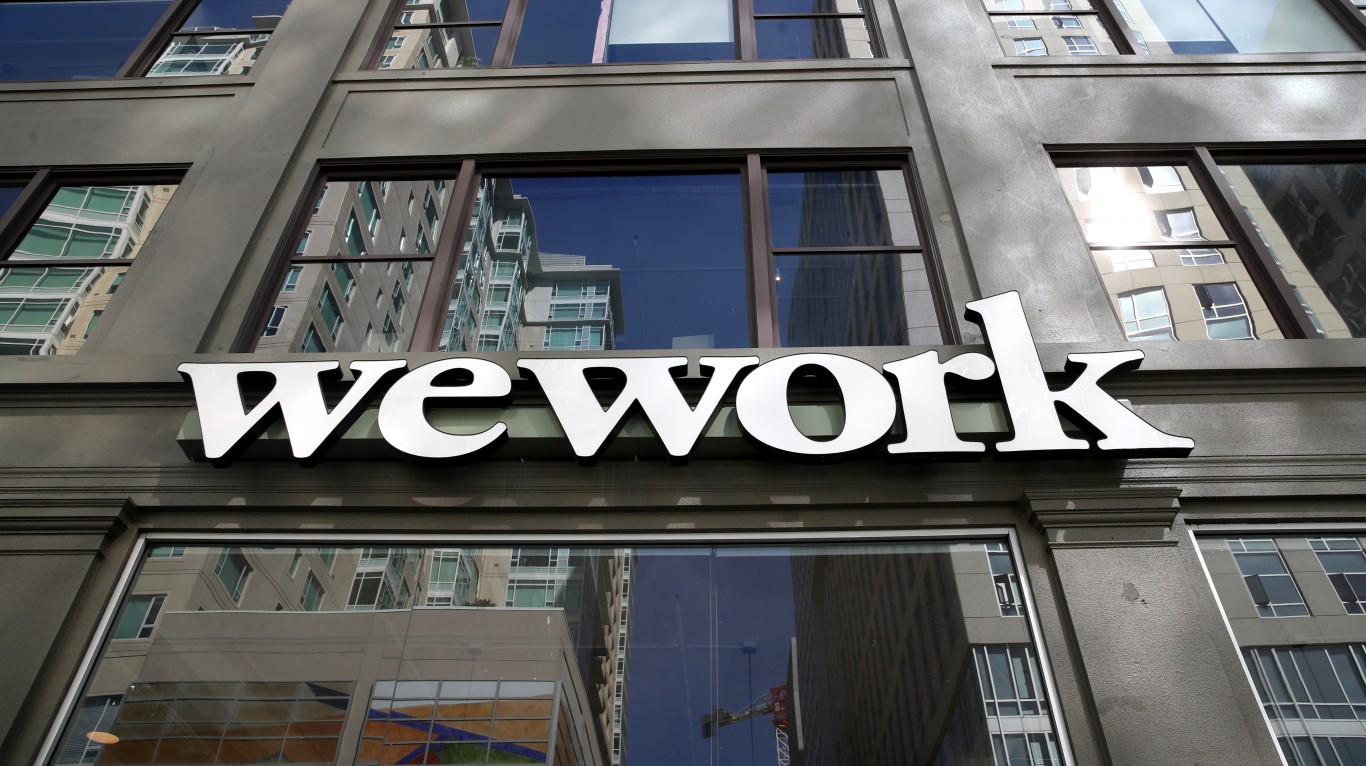
WeWork Now Has 600 Locations in 122 Cities

Photo of Douglas A. McIntyre
By Douglas A. McIntyre Updated Published
This post may contain links from our sponsors and affiliates, and Flywheel Publishing may receive compensation for actions taken through them.
WeWork Now Has 600 Locations in 122 Cities

© Tigeroner / Getty Images

WeWork has released its new strategic plan, which is meant to be its public statement of a nearly impossible turnaround. The need to cut costs is immediate. The ways to increase growth are limited, particularly by cash availability. WeWork continues to be huge, with 600 offices in 122 cities. While it will make its first cuts via discarding “noncore” businesses, it will still have too large a footprint in the temporary office business.

According to the document, WeWork’s 600 offices have 676,000 desks, which is presumably the companies prime metric for what it can rent. Its “pipeline” would take that total to 969,000 desks, mostly because of $6 billion over the past five years.

The plan to divest or close noncore businesses is evident in detail. Nothing will be left after the process beyond the “rent a desk” business, about the time the economy is about to move into recession. Since this will mean a contraction of corporate spending, WeWork faces less customer demand and an environment in which there will be a downturn in the ability to tenants to pay the prime rents WeWork charges. WeWork will contend with customers who want to break leases, just has it tries to break leases of its own with buildings in which it does not need that amount of space it planned on needing.

WeWork claims to have an annual revenue run rate of $4.2 billion. What is not clear is whether that can accelerate at the double-digit rates it has in the past. WeWork may lose much of the attractiveness as relentlessly bad press has tarnished its brand. As it cuts workers, it will be unable to provide that same services it has in the past. Potential customers may turn to their competitors with barely a thought about whether their employees view WeWork as a “great place to work” anymore.

[nativounit]

WeWork is at the start of a turnaround, with a plan. It is a plan that very probably will not work.

[recirclink id=591464]
[wallst_email_signup]

Photo of Douglas A. McIntyre
About the Author Douglas A. McIntyre →

Douglas A. McIntyre is the co-founder, chief executive officer and editor in chief of 24/7 Wall St. and 24/7 Tempo. He has held these jobs since 2006.

McIntyre has written thousands of articles for 24/7 Wall St. He is an expert on corporate finance, the automotive industry, media companies and international finance. He has edited articles on national demographics, sports, personal income and travel.

His work has been quoted or mentioned in The New York Times, The Wall Street Journal, Los Angeles Times, The Washington Post, NBC News, Time, The New Yorker, HuffPost USA Today, Business Insider, Yahoo, AOL, MarketWatch, The Atlantic, Bloomberg, New York Post, Chicago Tribune, Forbes, The Guardian and many other major publications. McIntyre has been a guest on CNBC, the BBC and television and radio stations across the country.

A magna cum laude graduate of Harvard College, McIntyre also was president of The Harvard Advocate. Founded in 1866, the Advocate is the oldest college publication in the United States.

TheStreet.com, Comps.com and Edgar Online are some of the public companies for which McIntyre served on the board of directors. He was a Vicinity Corporation board member when the company was sold to Microsoft in 2002. He served on the audit committees of some of these companies.

McIntyre has been the CEO of FutureSource, a provider of trading terminals and news to commodities and futures traders. He was president of Switchboard, the online phone directory company. He served as chairman and CEO of On2 Technologies, the video compression company that provided video compression software for Adobe’s Flash. Google bought On2 in 2009.

Featured Reads

Our top personal finance-related articles today. Your wallet will thank you later.

Continue Reading

Top Gaining Stocks

CBOE Vol: 1,568,143
PSKY Vol: 12,285,993
STX Vol: 7,378,346
ORCL Vol: 26,317,675
DDOG Vol: 6,247,779

Top Losing Stocks

LKQ
LKQ Vol: 4,367,433
CLX Vol: 13,260,523
SYK Vol: 4,519,455
MHK Vol: 1,859,865
AMGN Vol: 3,818,618