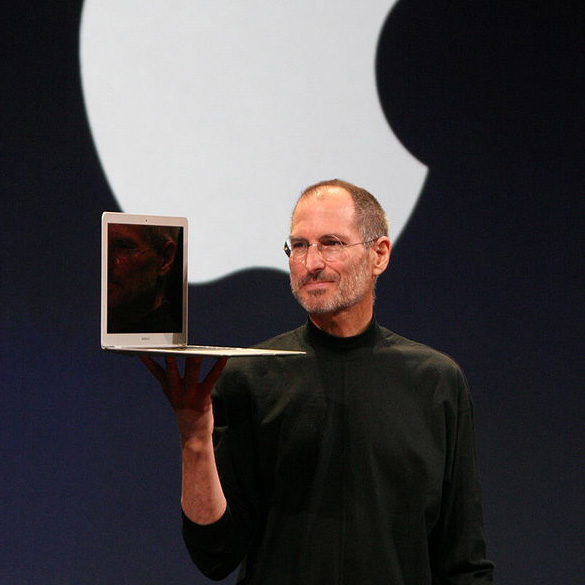
New iPhone Launched: Ghost of Steve Jobs Finally Leaves Apple

Photo of Douglas A. McIntyre
By Douglas A. McIntyre Published
This post may contain links from our sponsors and affiliates, and Flywheel Publishing may receive compensation for actions taken through them.

Steve Jobs’s ghost has lingered at Apple Inc. (NASDAQ: AAPL) for nearly two years, as the legacy of his products has been passed from one version of the iPhone version to the next, from iPad to iPad. The bumbling introduction of the new iPhone 5S and iPhone 5C, each a product barely better than its predecessor, shows that whatever product plans Jobs left behind have been exhausted. Even if he imagined the not-yet-launched iWatch, his passion for getting brand new products to the market first has perished, too.

Nearly everyone who saw or read about the release of the new products felt the same. Nothing was nifty about the latest versions of Apple’s once truly revolutionary smartphone, itself close to seven years old. The question has been asked repeatedly whether Jobs might have improved the product more, or changed it entirely. No matter how that question gets answered, a smartphone with a little bit better camera, a little bit better processor and the kind of fingerprint security from a Batman movie did not impress.

Analysts ask what Apple might have done with the new phone. There are a few answers, based on features that were not improved.

One of the last things Jobs spent much time on, according to people who claim to know, was Siri. He considered it a first, a least for a smartphone that priced at $500 or so. It has not been improved much. It has not become a voice recognition device that can answer really complex questions. It cannot take a voice version of a Ph.D. thesis, type it, correct grammar and spelling of any word in the world in any language, and check and add sources of facts. Such technology is in middle stages elsewhere, but not at Apple.

The new iPhone does not have a much stronger case or screen. Either can be broken almost as easily as a glass, when dropped from an even modest height. The fumbled fingered can find their fumbling expensive. Again, accessory makers have built products to protect the delicate iPhone. Apple has not even tried to make its flagship product physically invincible.

Of course, there is the battery. The iPhone’s does not last as long without a charge as others in the market. Apple could have invented a battery that had a life several times as long as any other. The new iPhone’s battery life is no better than the one in its predecessor.

The guesswork about what the iPhone might have been can go on and on. So can the game of whether another product should have been invented to begin to supplant it. Jobs liked to disintermediate his own creations. There is no evidence of that in the iPhone 5S or 5C. One was created because Apple needed to keep a product cycle to sell new smartphones. The other was built to help Apple in China.

Apple finally and permanently has been turned over to Jobs’s lieutenants. His pictures can be taken off the walls at Apple headquarters. There is nothing of him left.


Photo of Douglas A. McIntyre
About the Author Douglas A. McIntyre →

Douglas A. McIntyre is the co-founder, chief executive officer and editor in chief of 24/7 Wall St. and 24/7 Tempo. He has held these jobs since 2006.

McIntyre has written thousands of articles for 24/7 Wall St. He is an expert on corporate finance, the automotive industry, media companies and international finance. He has edited articles on national demographics, sports, personal income and travel.

His work has been quoted or mentioned in The New York Times, The Wall Street Journal, Los Angeles Times, The Washington Post, NBC News, Time, The New Yorker, HuffPost USA Today, Business Insider, Yahoo, AOL, MarketWatch, The Atlantic, Bloomberg, New York Post, Chicago Tribune, Forbes, The Guardian and many other major publications. McIntyre has been a guest on CNBC, the BBC and television and radio stations across the country.

A magna cum laude graduate of Harvard College, McIntyre also was president of The Harvard Advocate. Founded in 1866, the Advocate is the oldest college publication in the United States.

TheStreet.com, Comps.com and Edgar Online are some of the public companies for which McIntyre served on the board of directors. He was a Vicinity Corporation board member when the company was sold to Microsoft in 2002. He served on the audit committees of some of these companies.

McIntyre has been the CEO of FutureSource, a provider of trading terminals and news to commodities and futures traders. He was president of Switchboard, the online phone directory company. He served as chairman and CEO of On2 Technologies, the video compression company that provided video compression software for Adobe’s Flash. Google bought On2 in 2009.

Continue Reading

Top Gaining Stocks

CBOE Vol: 1,568,143
PSKY Vol: 12,285,993
STX Vol: 7,378,346
ORCL Vol: 26,317,675
DDOG Vol: 6,247,779

Top Losing Stocks

LKQ
LKQ Vol: 4,367,433
CLX Vol: 13,260,523
SYK Vol: 4,519,455
MHK Vol: 1,859,865
AMGN Vol: 3,818,618