


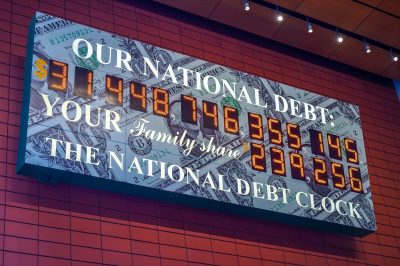
 There is not a man with a typewriter who can avoid writing about how much debt the US government has and how much more it will have to take on. Paulson’s program will put $700 billion more on the "red" side of the ledger. The deficit for the federal government’s fiscal year will be well in excess of $1 trillion. If tax income drops due to the recession, that number may turn out to be the hope of the damned.
The conclusion most people draw from all of that exhausting economic thinking is that the new president will not have any money to fix things and keep those things fixed that were already fixed over the last decade. No one needs a new headline. Just copy it from the next guy. "Obama’s Hands Are Tied".
But, they are not idle hands. Whether citizens view him as a free-spending radical who just wants to drain the checking accounts of the rich or just another guy elected president during another crisis, some expensive problems will not go unaddressed.
Treasury already has its big chunk of capital and it has no reason to part with that. Banks will get some. Perhaps insurance companies. If credit card defaults and LBO failures keep going up, they will join a continuing drop in the housing market as a reason that $700 billion may not be enough.
The most admired analysts covering the car industry, The Center for Automotive Research, recently reported that a collapse of the US auto world would kill three million jobs. That would take unemployment to 8% even if no one else in America lost a job. It would damage personal income by nearly $300 billion.
A walk around other large industries such as retail and airlines would yield equally dismal data. Without an unimaginable amount of money put into the private sector, the economy could go into a 2009 version of The Great Depression. The public is against that, but it is well to remember that a year ago most economists thought the US would avoid a recession. What 2008 has proved is that economists are no more accurate than the TV weatherman. They just get paid less.
On the back of an envelope, it is entirely possible to make the case that the federal government could ring up a $3 trillion deficit over the next two years. Since that has never been done before, it is impossible to predict the side-effects. Nausea and dizziness are probably listed on the label. And, if the arousal lasts more than four hours, call a doctor.
All of this deep factoring brings the analysis around to the question of whether the US government can raise the money to cover the big hole it is digging. The answer may be more simple than many people would guess.
If the Chinese, the Saudis, and others with a lot of extra capital, keep buying US debt, the amount that the Congress can write checks for is phenomenally large. If a global recession pushes China back into the dark ages, the proposition becomes more difficult by a factor of ten or so.
Only people in mental wards or on hallucinogens would suggest that the US government could default on a dollar of its debt, but no one ever believed that General Motors or AUG could go bankrupt. Borrowing has its limits, even if they are colossal to the extent that they cannot be imagined.
At some point Uncle Sam’s extended hand will be cut off. Then the government will have to decide whether it can cover the note. There is no absolute guarantee that the answer is "yes."
Credit default swaps on US debt may just became a big business.
Douglas A. McIntyre






 Top Gaining Stocks
 Top Losing Stocks