Detroit Tries to Get Its Residents Back, Without Success

Photo of Douglas A. McIntyre
By Douglas A. McIntyre Published
This post may contain links from our sponsors and affiliates, and Flywheel Publishing may receive compensation for actions taken through them.

Bankruptcy (Chapter 9) may have bolstered Detroit’s balance sheet by ridding it of billions of dollars in debt. The media have begun to cover events that point to a resurrection of the city, a process dubbed Detroit 2.0. However, unless Detroit can get back its residents, or find new ones, it will lack the tax base, and the ability to drive improved infrastructure, that will leave it in an economic twilight.

Detroit has a population of 680,000 residents. That is down from 1.8 million in 1950 and 1.5 million in 1970. The U.S. car business began to lose market share to the Japanese in the 1970s. As that trend accelerated, car companies moved factories outside the city or closed them. Car quality perception and union costs made matters worse. The life blood was slowly sucked out of the city.

The resurrection of Detroit is an illusion. The population is not growing. According to the Detroit Free Press:

Detroit continues to lose residents, but the population loss appears to be slowing, with about 1% moving out between 2013 and 2014, according to estimates released today by the U.S. Census Bureau.

In the tri-county area, the Oakland County suburbs of Lyon and Oakland townships and Sylvan Lake, as well as Macomb and Washington townships in Macomb County grew the fastest, according to the estimates.

ALSO READ: America’s Most Segregated Cities

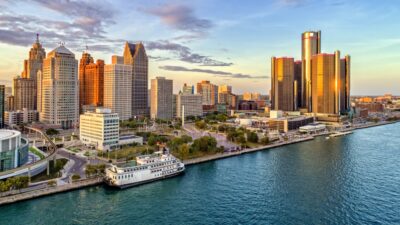
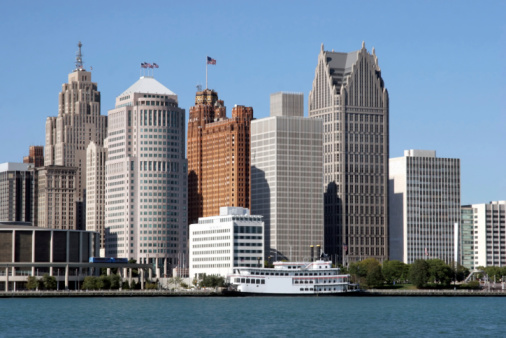
Apparently, some Detroit residents have not moved too far away. They have migrated to suburban cities that are only miles from Renaissance Center in the heart of downtown, one of the most visible attempts at a Detroit comeback. Finished in 1977, the project was led by Ford Motor Co. (NYSE: F) CEO Henry Ford II and financed partially by his car company. Ironically, it is now home to the General Motors Co. (NYSE: GM) headquarters. The project failed to pull large numbers of people to live in the center of the city.

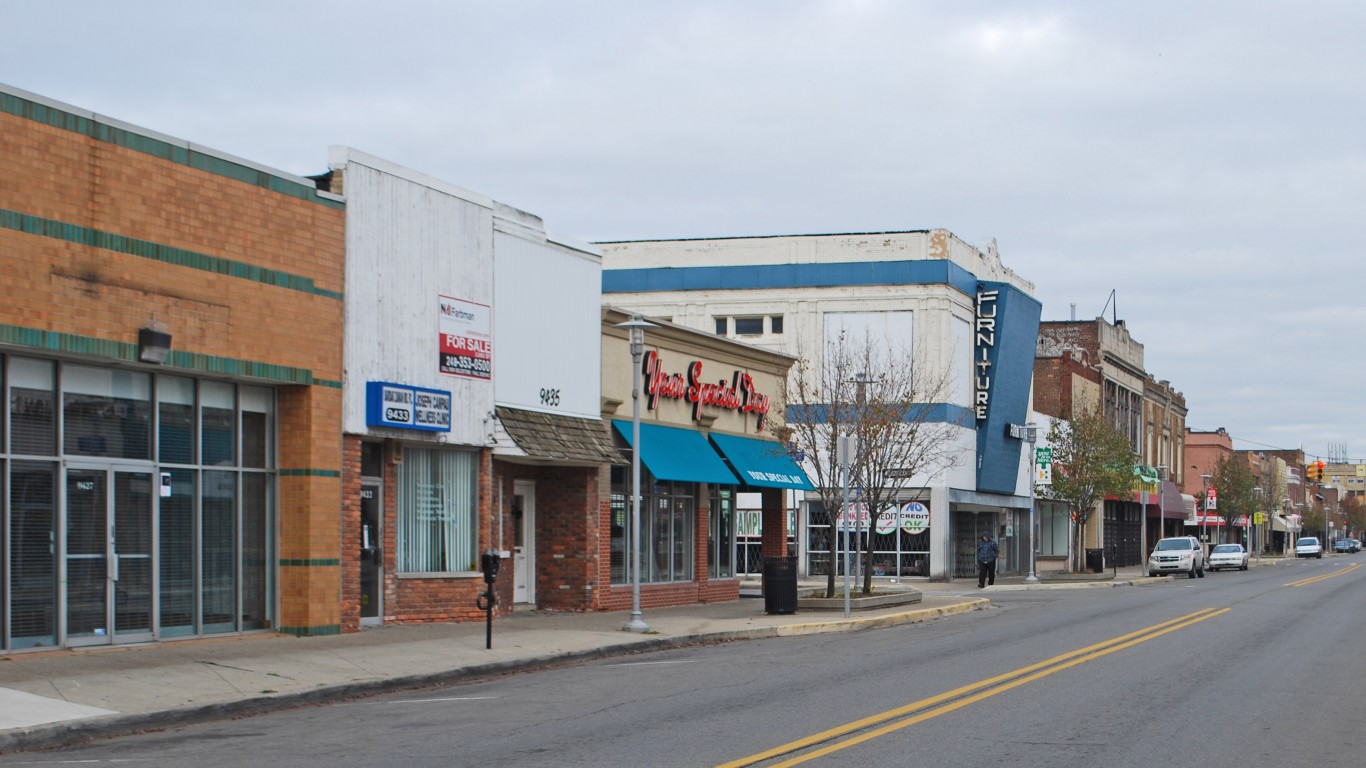
The fact of the matter is that most of the people who have stayed in Detroit are poor. According to data from The American Community Survey, the median household income in Detroit is about half the national average of just over $50,000. The poverty rate is about three times higher. The city is in the midst of bulldozing thousands of houses.

Part of the myth about the Detroit comeback is that the city has started to rebuild its infrastructure and city services. A symbol of this is that many of the broken or burned out street lights have or are being replaced. However, Detroit is still “under-policed” and crime remarkably high.

A city cannot tax people who do not have money, and taxes on the small number of healthy businesses is a barely better path to raise city income. In all probability, Detroit has to give some sort of tax breaks to lure businesses into the city. Put simply, Detroit’s tax base is not enough to turn around the city.

Detroit’s unlikely turnaround, Detroit 2.0, becomes more unlikely by the day.

ALSO READ: 10 Cities With the Worst Traffic

Photo of Douglas A. McIntyre
About the Author Douglas A. McIntyre →

Douglas A. McIntyre is the co-founder, chief executive officer and editor in chief of 24/7 Wall St. and 24/7 Tempo. He has held these jobs since 2006.

McIntyre has written thousands of articles for 24/7 Wall St. He is an expert on corporate finance, the automotive industry, media companies and international finance. He has edited articles on national demographics, sports, personal income and travel.

His work has been quoted or mentioned in The New York Times, The Wall Street Journal, Los Angeles Times, The Washington Post, NBC News, Time, The New Yorker, HuffPost USA Today, Business Insider, Yahoo, AOL, MarketWatch, The Atlantic, Bloomberg, New York Post, Chicago Tribune, Forbes, The Guardian and many other major publications. McIntyre has been a guest on CNBC, the BBC and television and radio stations across the country.

A magna cum laude graduate of Harvard College, McIntyre also was president of The Harvard Advocate. Founded in 1866, the Advocate is the oldest college publication in the United States.

TheStreet.com, Comps.com and Edgar Online are some of the public companies for which McIntyre served on the board of directors. He was a Vicinity Corporation board member when the company was sold to Microsoft in 2002. He served on the audit committees of some of these companies.

McIntyre has been the CEO of FutureSource, a provider of trading terminals and news to commodities and futures traders. He was president of Switchboard, the online phone directory company. He served as chairman and CEO of On2 Technologies, the video compression company that provided video compression software for Adobe’s Flash. Google bought On2 in 2009.

Featured Reads

Our top personal finance-related articles today. Your wallet will thank you later.

Continue Reading

Top Gaining Stocks

DDOG Vol: 15,561,932
FTNT Vol: 9,862,762
QCOM Vol: 27,736,188
PTC
PTC Vol: 1,618,563
ALB Vol: 2,528,773

Top Losing Stocks

ZTS Vol: 17,055,298
TPR Vol: 2,953,880
CTRA Vol: 73,319,495
TER Vol: 1,402,248
AKAM Vol: 3,338,225