



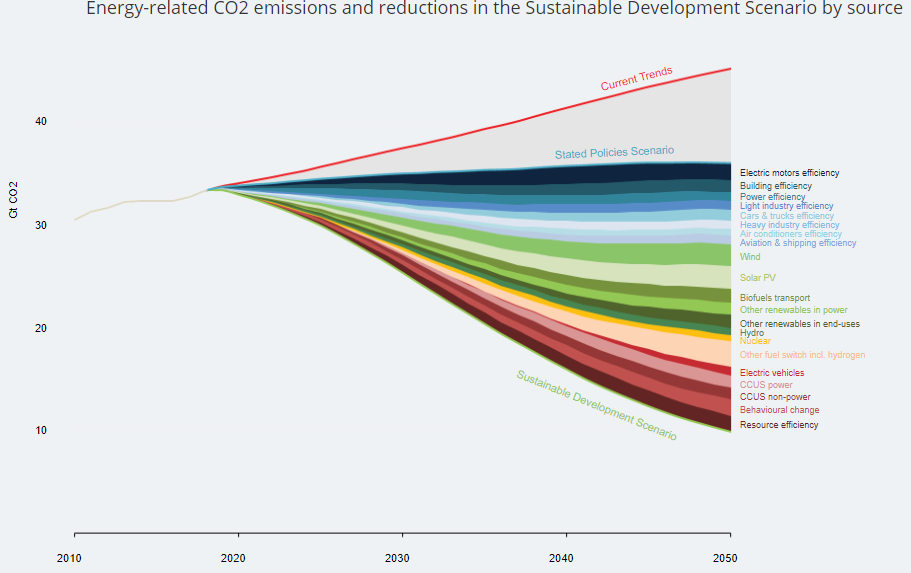
Even if the nations that have agreed to achieve net-zero carbon emissions by 2050 manage to meet that target, global carbon dioxide emissions by then would still total some 22 billion metric tons. At that rate, the average global temperature will rise by around 2.1 degrees Celsius in 2100.
Limiting the increase in temperature to 1.5 degrees by 2100 “calls for nothing less than a complete transformation of how we produce, transport and consume energy,” according to a new report, Net Zero by 2050, released Tuesday by the International Energy Agency (IEA).
Under IEA’s net-zero emissions scenario, coal demand drops by 90% by 2050 while demand for oil plummets by 75% and natural gas demand falls by half. At that rate of decline, IEA declares that “no fossil fuel exploration is required and no new oil and natural gas fields are required beyond those that have already been approved for development.”
In other words, fossil-fuel providers can stop spending on exploration and start spending on technologies that will mitigate rather than worsen climate change. Or, put more baldly, the IEA has just declared the end of the fossil fuel era.
[nativounit]
The American Petroleum Institute (API) does not agree:
Any pathway to net zero must include continued innovation and use of natural gas and oil, which remains crucial to displacing coal in developing nations and enabling renewable energy. Our industry is committed to shaping a cleaner future by advancing technologies and policymaking to reduce emissions while providing the affordable, reliable energy modern life depends on.
IEA notes that “all” the technologies already exist to make the required emissions cuts by 2030 and that the policies that can drive the deployment of those technologies are “already proven.” The report states that fossil fuel subsidies must be phased out in the current decade, along with policies that limit or eliminate incentives “for the use of certain fuels and technologies, such as unabated coal‐fired power stations, gas boilers and conventional internal combustion engine vehicles.”
At the same time that governments are quadrupling global solar and wind generation capacity and selling 18 times as many electric vehicles, leaders also must continue to innovate and deploy technologies that are not yet available in order to reach net-zero by 2050. The report notes that about half the reductions needed by 2050 will come from technologies that are still on the drawing board.
The following timeline from the report represents the IEA’s assessment of how to reduce carbon dioxide emissions from around 33 billion metric tons in 2020 to zero in 2050. Note that no new gasoline- or diesel-powered car sales are allowed after 2035.
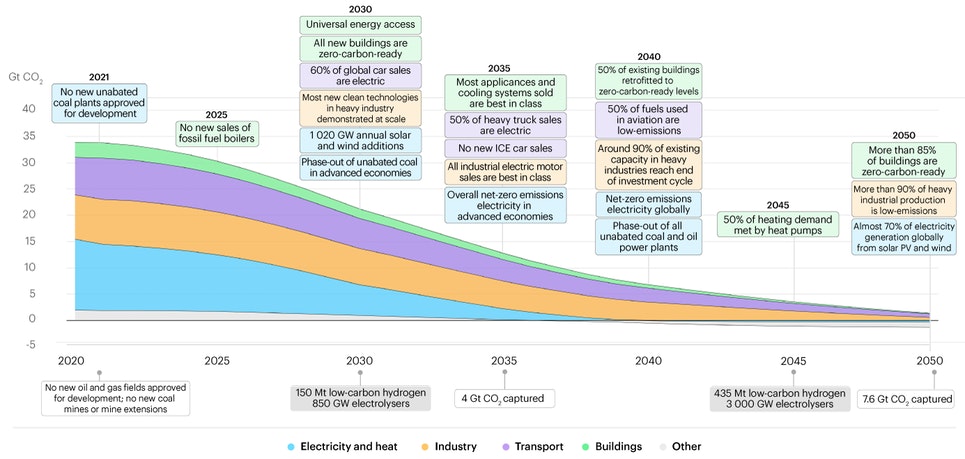
Spending on low- and no-carbon technologies needs to more than double between now and 2030 from $2.3 trillion globally to around $5 trillion, representing about an additional 1% of global gross domestic product.
[recirclink id=882604][wallst_email_signup]






 Top Gaining Stocks
 Top Losing Stocks