



The Energy Institute at the University of Texas at Austin last week released a series of white papers combined as a single report called “The Full Cost of Electricity (FCe-).” The study has calculated a levelized cost of electricity (LCOE) by U.S. county in an effort to estimate the most efficient type of electricity generation plant for different parts of the United States.
The researchers calculated an LCOE for several types of new power plants: bituminous and sub-bituminous coal with both partial (30%) and full (90%) carbon capture and sequestration; natural gas, combined cycle with and without carbon capture and sequestration; natural gas combustion turbine; nuclear; onshore wind; solar photovoltaic (PV), both residential and utility-scale; and concentrating solar.
The standard method for calculating LCOE includes estimating the amount of money it takes for an electrical generation technology to produce a kilowatt-hour (kWh) of electricity over the plant’s total lifetime. To this calculation the researchers added variations in building costs and operating identical plant technologies in different geographies. The new method for calculating also integrates costs from externalities including air emissions, combustion CO2, and embedded life cycle analysis greenhouse gases.
[nativounit]
The following map from the study shows the least-cost option for every county in the United States using the LCOE calculation that includes externality costs.
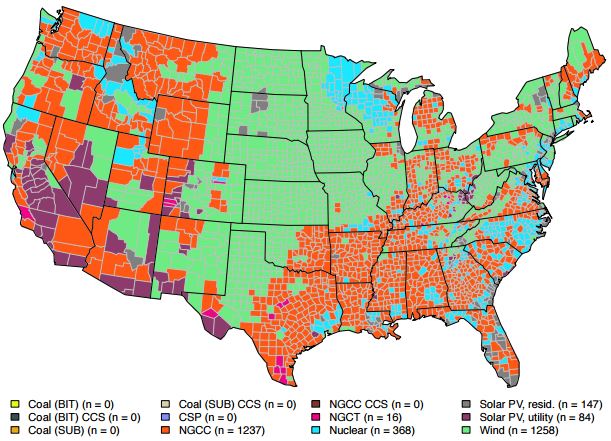
There is bad news for the U.S. coal industry in this study: coal plants of any kind are never the least-cost option except in 3% of U.S. counties, and only when externality costs are excluded.
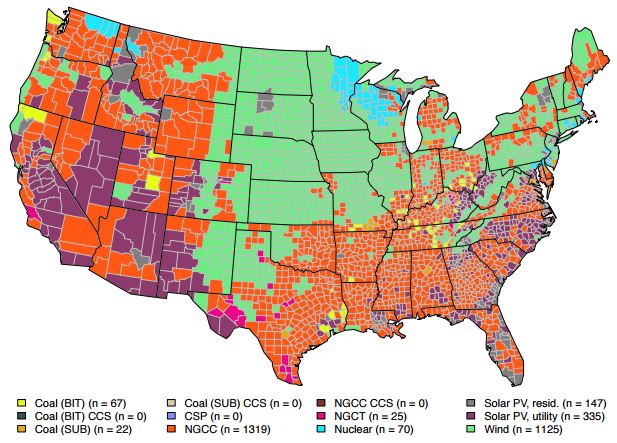
The cheapest option in most counties is wind, and in places where the wind is not strong, natural gas, combined cycle plants are the least cost option.
Utility-scale solar PV plants are the least-cost option in sunny parts of the country, mostly in the Southwest and southern California. Rooftop solar, though rarely the least-cost option, is the only option that is viable in every U.S. county.
In their conclusion to this paper the researchers note:
The internalization of factors that are traditionally not considered is important for policy decisions that seek to reduce environmental impacts in an economically efficient way. Geographic emphasis is also important, because the best technology decision is different depending on the location. We also find that when the minimum technology cost (including externalities) is found for each county, natural gas combined cycle, wind, and nuclear power are all the least-cost option the most frequently, but are sensitive to natural gas and carbon prices.
The full study is available at the Energy Institute website. The first paper, titled “New U.S. Power Costs: by County, with Environmental Externalities” is also available at the website.
[wallst_email_signup]









 Top Gaining Stocks
 Top Losing Stocks