


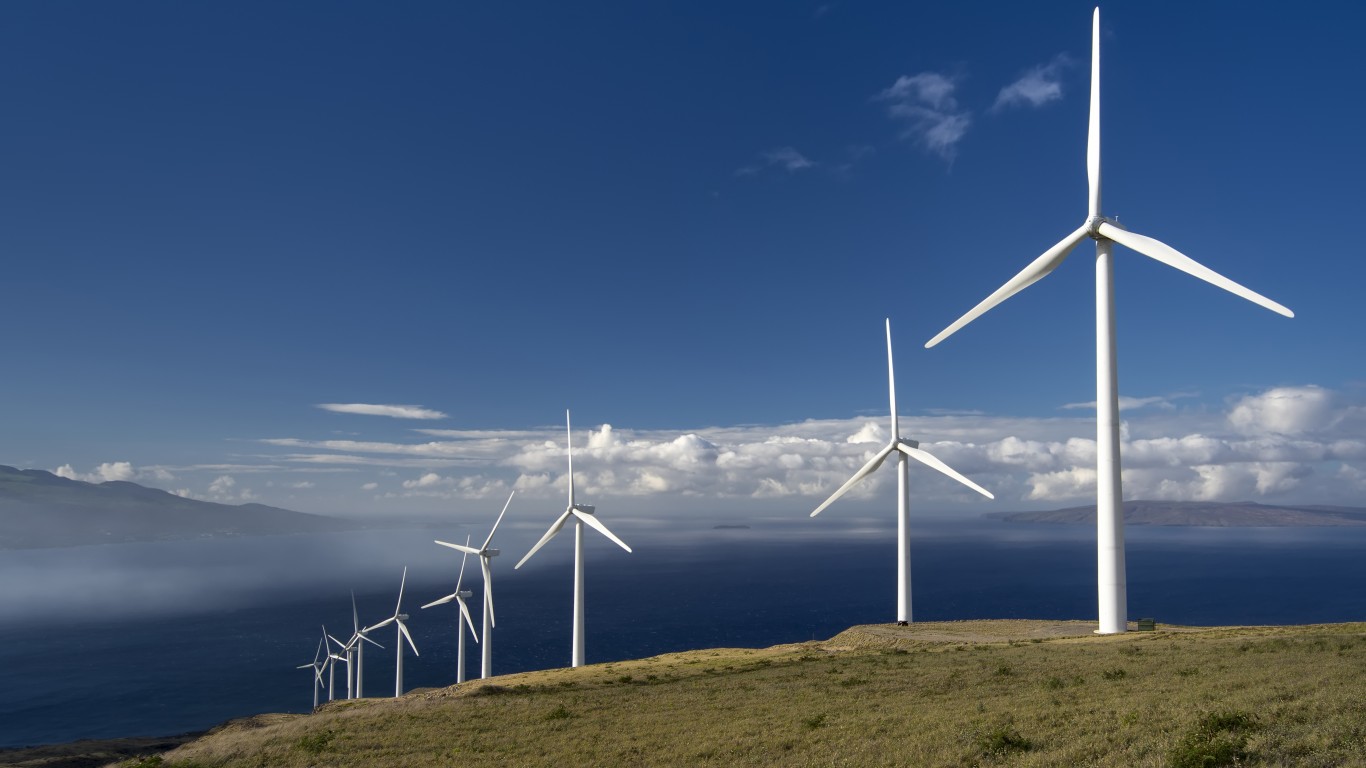
Wind power currently generates about 0.3% of annual global electricity demand, or 69 terawatt-hours (TWh) of the 23,000 TWh total. The technical potential for offshore wind generation is 36,000 TWh just in water less than 60 meters deep and within 60 miles of the shoreline. Moving further offshore with floating turbines could meet projected 2040 global demand 11 times over.
That’s among the conclusions of a special report from the International Energy Agency (IEA), Offshore Wind Outlook 2019, released Friday. Dr. Fatih Birol, executive director of the IEA, commented, “In the past decade, two major areas of technological innovation have been game-changers in the energy system by substantially driving down costs: the shale revolution and the rise of solar PV. And offshore wind has the potential to join their ranks in terms of steep cost reduction.”
The IEA believes that offshore wind capacity is positioned to increase by “at least 15-fold by 2040, becoming a $1 trillion business.” Using current investment plans and policies, global offshore wind is projected to expand by 13% annually and will exceed 20 gigawatts (GW) of capacity additions annually by 2030 at a total 20-year capital cost of $840 billion.
The less good news is that the rate of growth and spending need to be even higher in order to meet global climate and sustainability goals: capacity additions would have to run closer to 40 GW annually during the 2030s and total investment would need to rise to $1.2 trillion.
The European Union has led the world in developing offshore wind capacity and is well-positioned to maintain its leadership, although China’s growth over the next two decades is forecast to be faster. From around 20 GW of capacity today, EU capacity is set to rise to 130 GW by 2040. That could rise even more, to 180 GW, if the EU reaches its carbon-neutrality goals.
[nativounit]
Chinese offshore wind accounts for just 4 GW of capacity today, but that could rise to 110 GW by 2040, and if policies to meet global sustainability goals are reached, that total could rise to 170 GW.
The United States lags far behind with just one 30-megawatt (MW) offshore wind farm currently in operation (a 1.1-GW project offshore of Atlantic City was greenlighted in July and is expected to be completed in 2024). Under the IEA’s base scenario, U.S. offshore wind capacity rises to 40 GW by 2040 with a total investment of $100 billion. Under the sustainable scenario, capacity could reach 70 GW with an investment averaging $7 billion annually for the next 20 years.
Government policies and incentives will play a leading role in achieving the IEA’s projections, but new offshore wind development will have to be profitable in order to attract investment. In that vein, the agency estimates 40% of the lifetime costs of an offshore wind project “have significant synergies with the offshore oil and gas sector.” That translates to a market opportunity of some $400 billion over the next 20 years.
That’s not chump change, but the reality is that it’s also not much. U.S. oil giants Exxon Mobil and Chevron combined raked in more than $450 billion in revenues last year and both spent far more than $7 billion on new capital projects. These firms, and other supermajors like Shell and BP, are unlikely to invest much in offshore wind projects. The primary investments have, and likely will continue to, come from wind project developer-owners and large investor groups like pension funds. Offshore drilling and services firms such as Transocean and Diamond Offshore that have expertise in construction and operating floating platforms stand to profit most from a surge in developing offshore wind capacity.
Without government support, however, the potential for offshore wind development won’t be realized:
Governments and regulators can clear the path ahead for offshore wind’s development by providing the long-term vision that will encourage industry and investors to undertake the major investments required to develop offshore wind projects and link them to power grids on land. That includes careful market design, ensuring low-cost financing and regulations that recognise that the development of onshore grid infrastructure is essential to the efficient integration of power production from offshore wind.
[recirclink id=587969]
[wallst_email_signup]






 Top Gaining Stocks
 Top Losing Stocks