


Since its 1957 debut, the S&P 500 Index has been such a strong and reliable arbiter of US stock market health that Warren Buffett and Charlie Munger have both routinely touted it in interviews. In 2007, Buffett famously bet Ted Seides of Protégé Partners $10 million that an S&P 500 fund would beat Seides’ choice of hedge funds over a 10-year span, with proceeds to go to charity. In the end, the S&P 500 returned 125.8%gain vs. 36.3% for the hedge funds.
Such is the index’s popularity that the $1.3 trillion net asset Vanguard S&P 500 ETF (NYSEARCA: VOO | VOO Price Prediction) is now the largest ETF in the world. With 10.79% year-to-date returns at the time of this writing, the S&P 500 is on track for another year of double digit returns by the end of December. Rival State Street’s SPDR S&P 500 ETF (NYSEARCA: SPY) is right at its heels with a 10.72% year-to-date return. Up until when Buffett began selling Apple and Bank of America stocks to load up on cash in Q4 2024, both SPY and VOO were held in the Berkshire Hathaway portfolio.
However, a new, first time ETF from a financial firm best known for its founder’s unconventional market views on Wall Street is, so far, smoking S&P 500 ETFs in its wake, with a year-to-date (as of Sept.1) return of 22.19% according to Portfolioslab.Launched in November 2024, the Fundstrat Granny Shots US Large Cap ETF (NYSEARCA: GRNY) was appropriately dubbed for its unconventional, yet effective approach towards portfolio management. It’s the brainchild of Fundstrat founder Tom Lee, who has a 25+ year history of zigging where others zag, no matter what his Wall Street peers might say.
From Cabinets To Star Wars And The Lost Ark
Tom Lee’s Wall Street career, going from 20+ years as a bulge bracket analyst to media darling stock and crypto guru, parallels that of Harrison Ford, who earned his living as a carpenter for over a decade while acting in obscurity until his big breaks in the Star Wars and Indiana Jones movie franchises.
Since 1977, with his iconic scene stealing performance as Han Solo in Star Wars, Harrison Ford has been one of Hollywood’s most bankable older leading men. After indelibly catapulting himself into global pop culture and sci-fi culture eternity, Harrison Ford has continued to portray archetypal American heroes, such as Tom Clancy’s CIA analyst Jack Ryan in Patriot Games (1992) and Clear and Present Danger (1994); cyborg hunter Rick Decker in Blade Runner (1982) and Blade Runner 2049 (2017); and of course, fan favorite Indiana Jones in Raiders of the Lost Ark (1981), Indiana Jones and the Temple of Doom (1984), Indiana Jones and The Last Crusade (1989), Indiana Jones and the Kingdom of the Crystal Skull (2008), and Indiana Jones and The Dial of Destiny (2023). Even at age 83, Ford refuses to retire, and appeared most recently as antagonist General Thaddeus “Thunderbolt” Ross in Captain America: Brave New World (2025).
However, for over a decade, Harrison Ford was a struggling actor who was better known as a carpenter. His more famous clients included journalists John Gregory Dunne and Joan Didion. When Ford was finally cast as Han Solo, he was already 35, married with two kids. Although he was hailed as an “overnight” sensation, Ford had labored in small roles since the mid 1960s and earned his living from carpentry until movie stardom finally beckoned. In a similar career trajectory, Tom Lee spent over 20 years as bulge bracket equities analyst before showing an early sign of independent thought in 2002, and then disrupting the Wall Street analyst club in 2017.
“I took the one less traveled by, And that has made all the difference” – Robert Frost

Tom Lee’s refusal to play things safe and make risky bullish prognostications put him on the cryptocurrency map when he became the first Wall Street analyst to cover Bitcoin, predicting a $55,000 target price when it had just reach a high of $2,450.
A Michigan native and Wharton graduate, Fundstrat founder Tom Lee is the son of Korean immigrant parents whose professions may have influenced his career as an equities analyst-turned ETF issuer: his father is a psychiatrist and his mother is a franchise owning entrepreneur.
Lee has spent over 20 years on Wall Street as an equities analyst. Starting at Kidder, Peabody and Solomon Smith Barney, he soon took a prominent role at JP Morgan Chase. After years of seeing the cozy relationships between public companies and Wall Street analysts, Lee began displaying a stubborn independent streak in 2002. He released an analysis report of Nextel
that posed a number of inconvenient questions that hinted at accounting irregularities and misleading metrics that obscured transparency. In response, Nextel wrote a scathing rebuttal in The Wall Street Journal to do damage control, but failed to address the questions and accounting inconsistencies posed by Lee. Sticking to his guns, Lee was proven right when Nextel’s subsequent deal with Sprint validated his analyses: the acquisition made history as the most disastrous merger in the telecom industry.
Fundstrat Capital launched when Lee left JP Morgan in 2014. Taking cryptocurrencies seriously way before the majority of his Wall Street peers, Tom Lee became the first Wall Street analyst to, in 2017, publicly go on record in analyzing Bitcoin (BTC) . At the time, Bitcoin had hit a new high of $2,450 and many investors feared it was a bubble. On the contrary, Lee projected a 5-year price target of $55,000. Tom Lee’s comfort in public appearances and willingness to answer random audience questions both in person and online rapidly expanded his reputation among cryptocurrency and DIY equity investors. Therefore, it was no surprise that certain groups in the investment community were already excited when news of Fundstrat’s first ever ETF would be released in Q4 2024. But even Lee himself has expressed amazement at the huge response, although less so at GRNY’s sterling performance.
The Granny Shots Recipe
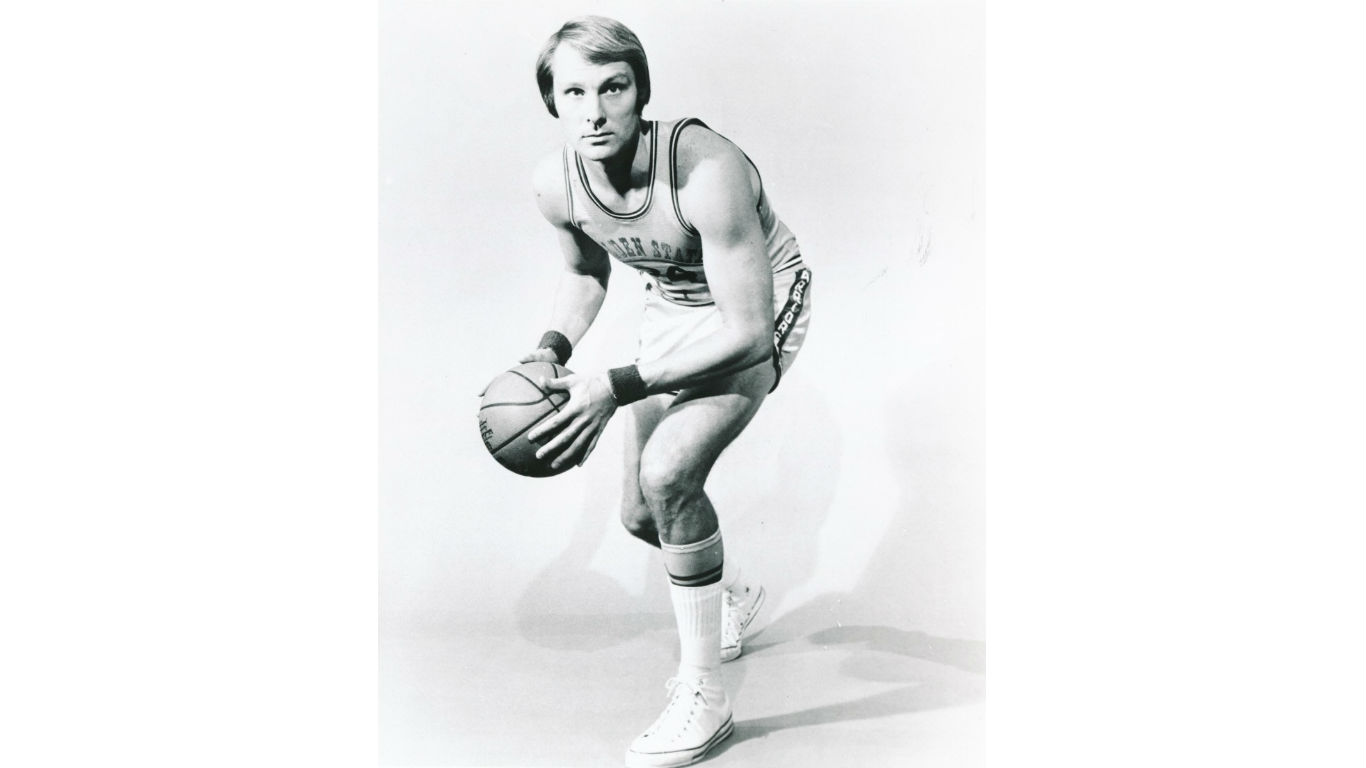
Despite his incredible NBA dominance, Wilt Chamberlain’s notoriously poor free throw shooting led to Rick Barry’s offer to teach him the Granny Shot, which Barry executed with nearly 90% lifetime accuracy throughout his NBA career – but Chamberlain turned him down.
Due to its lack of aesthetics and its prevalent use by children and elderly people who lack adequate strength to execute a conventional overhand free throw, the Granny Shot is nevertheless statistically more accurate and consistent. Its best known exponent is 1970s NBA and ABA star Rick Barry, who created the point forward position, won a championship ring and MVP award with the Golden State Warriors in 1975, won the NBA scoring title in 1966-67, and finished with a Granny Shot fueled 89.9% lifetime free throw average.
Barry offered to teach the Granny Shot to Shaquille O’Neal and Wilt Chamberlain, both notoriously poor free throw shooters. Their refusals both stemmed from perceived risks to their “image”. Barry’s response when a fan tried to poke fun at the Granny Shot was, “Isn’t the ball going in the basket?” Such imperviousness to outside opinions also drives Tom Lee.
As an actively managed ETF, the GRNY portfolio is subject to change without notice. Unlike a majority of ETFs that are passively managed and pegged to a specific index to replicate and track with the addition of a few tweaks, GRNY rethinks the ETF approach in several ways:
- Comparable to the underhanded Granny Shot free throw, GRNY stock selection qualification requires the stock to fall under a number of off-the-wall and unconventional investment themes that Fundstrat has identified as growth drivers.
- Qualifying stocks must align with at least two (2) themes identified in the investment themes to warrant portfolio inclusion.
- There are three short term (6-12 month) themes: Style Tilt, Seasonality, and PMI Recovery.
- The four long term (3-5 year) themes are: Energy/Cybersecurity, Millennials Impact, Global Labor Suppliers (an AI parameter), and Easing Financial Conditions.
- The multiple themes concept is designed to choose sufficiently diverse growth stocks that will supply a portfolio with resilience against a range of potentially adverse news events.
- Qualifying in more than two themes does not necessarily lead to greater portfolio weighting for any particular stock, as additional criteria is used for that determination.
- The portfolio is limited to roughly 35-40 S&P 500 stocks that meet the Fundstrat multiple investment theme parameters. It is rebalanced every quarter.
The top 10 largest holdings in GRNY at the time of this writing are:
- Palo Alto Networks: 2.83% (4 themes)
- American Express: 2.79% (2 themes)
- Alphabet Inc. Class A (Google): 2.71% (4 themes)
- Expedia Group: 2.67% (2 themes)
- Live Nation Entertainment: 2.66% (2 themes)
- Tesla, Inc.: 2.69% (2 themes)
- JP Morgan Chase: 2.66% (2 themes)
- Garmin Ltd.: 2.66% (3 themes)
- Bank of New York Mellon: 2.64% (2 themes)
- GE Aerospace: 2.62% (2 themes)
Three-Way Shootout
GRNY takes on both VOO and SPY to triumph over both in terms of YTD returns.
Given that GRNY only has a 9-month history, a historical performance match-up against SPY (inception: 1-22-1993) and VOO (inception: 9-7-2010) would not make much sense. Therefore, the following comparison-worthy criteria is cited below:
|
Category |
GRNY |
VOO |
SPY |
|
YTD Return: |
22.19% |
10.79% |
10.72% |
|
Number of Holdings: |
35 |
507 |
504 |
|
Total Assets: |
$2.436 billion |
$1.33 trillion |
$652.63 billion |
|
Expense Ratio: |
0.75% |
0.03% |
0.09% |
|
Daily Average Volume: |
3.06 million shares |
6.296 million shares |
69.83 million shares |
|
Price: |
$23.35 |
$593.08 |
$645.05 |
|
NAV: |
$23.33 |
$592.70 |
$644.72 |
Top 10 Holdings:
|
VOO |
SPY |
|
Nvidia – 8.07% |
Nvidia – 8.07% |
|
Microsoft – 7.38% |
Microsoft – 7.37% |
|
Apple – 5.77% |
Apple – 5.77% |
|
Amazon – 4.12% |
Amazon – 4.11% |
|
Meta Platforms (Facebook) – 3.12% |
Meta Platforms (Facebook) – 3.12% |
|
Broadcom – 2.57% |
Broadcom – 2.57% |
|
Alphabet (Google) Class A – 2.08% |
Alphabet (Google) Class A – 2.08% |
|
Alphabet (Google) – 1.68% |
Alphabet (Google) – 1.68% |
|
Berkshire Hathaway – 1.61% |
Berkshire Hathaway – 1.61% |
|
Tesla – 1.61% |
Tesla – 1.61% |
Although both VOO and SPY have much lower expense ratios due to being passively managed, this still does not reduce GRNY’s far superior year-to-date return rate, which is roughly double that of both S&P 500 ETFs. This may be the result of:
- Both VOO and SPY rebalance their portfolios quarterly. GRNY’s portfolio can change at any given time.
- The S&P 500 Index and its corresponding ETFs are heavily weighted in the Magnificent 7 stocks, which all have a significant AI focus. Ai has recently been involved with several lawsuits and reported incidents over humans being harmed or killed by AI. Additional negative news can bring down the index, and both VOO and SPY down in sympathy.
- By contrast, the multiple theme drivers rationale for a selected stock in GRNY is to ensure favorable odds of continued support, in case the trend or narrative drops in popularity or receives a streak of negative news. For example, if a stock appeals to both Millennials and the AI followers, the chances of interest from both sectors waning is considerably smaller than if only one or the other.
With a record $2 billion inflows in just its first nine months, Fundstrat has the wind at its back. So strong has been the response for GRNY is that Tom Lee recently announced that Fundstrat had registered two additional ETFs for the near future: one is a (presumably) aggressive growth small-cap ETF, while the the other is a covered call ETF, comparable to the YieldMax offering or the popular JP Morgan Equity Premium ETF (NYSEARCA: JEPI) of his former employer.
Based on his past choices and current path, if one were to search for a real-life example of Robert Frost’s “The Road Not Taken” , Tom Lee might make many people’s Top 10 lists.










 Top Gaining Stocks
 Top Losing Stocks