



From Steady Climb to Breakout Momentum
On Friday, IonQ‘s (NYSE:IONQ | IONQ Price Prediction) stock exploded nearly 19%, closing above $55 per share for the first time in months, and shares are ticking up another 4% in morning trading today, hovering around $56.50 amid heightened volume.
The catalyst was that the quantum computing leader received a regulatory green light for its high-stakes acquisition of Oxford Ionics, a UK-based trapped-ion specialist. The UK’s Investment Security Unit cleared the deal, removing the last hurdle for a transaction valued at over $1 billion.
Oxford Ionics’ photonic interconnect tech promises to accelerate IonQ’s roadmap toward 800 logical qubits by 2027 and 80,000 by 2030 — milestones critical for commercial-scale quantum advantage.
The news amplified an already existing sector buzz. Just days prior, Nvidia (NASDAQ:NVDA) joined a funding round for Honeywell‘s (NYSE:HON) Quantinuum, validating quantum computing’s potential and lifting peers like Rigetti and D-Wave. IonQ’s fresh moves, including the IonQ Federal division launch for U.S. government contracts and a new CFO/COO appointment, are fueling optimism.
Analysts at Rosenblatt hailed the acquisition as a “game-changer,” noting it bolsters IonQ’s edge in scalable, error-resistant hardware. Over the past year, IONQ has surged over 700%, reflecting investor bets on quantum’s post-AI hype cycle.
Quantum Computing Pioneer in a Crowded Field
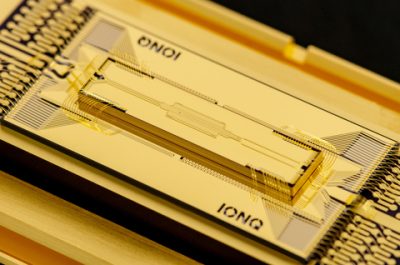
Founded in 2015, IonQ is a trailblazer in quantum computing, specializing in trapped-ion technology. Unlike superconducting qubits favored by giants like IBM (NYSE:IBM) or Google’s Quantum AI division, IonQ traps individual ytterbium ions in electromagnetic fields, using lasers to manipulate qubits.
This approach delivers superior fidelity — up to 99.9% accuracy per operation — and all-to-all connectivity, enabling complex computations with fewer errors. IonQ’s systems, like its Aria and Forte models, boast 29 to 32 algorithmic qubits, outpacing many rivals in error-corrected performance.
What sets IonQ apart from other quantum stocks? While Rigetti Computing (NASDAQ:RGTI) and D-Wave Quantum (NYSE:QBTS) chase niche annealing or hybrid models, IonQ emphasizes universal gate-based computing via cloud access.
Partnerships with Amazon‘s (NASDAQ:AMZN) AWS, Microsoft (NASDAQ:MSFT) Azure Quantum, and Google Cloud Marketplace allow seamless integration, democratizing access without massive upfront hardware costs.
IonQ offers quantum computing as a service, focusing on applications like optimization, drug discovery, and cryptography. This cloud-based approach sets IonQ apart from companies that focus solely on hardware, positioning it as a scalable enabler rather than a standalone hardware provider.
With over $100 million in government contracts and collaborations like AstraZeneca (NASDAQ:AZN) for quantum-accelerated chemistry, IonQ blends innovation with real-world applicability in an industry projected to hit $100 billion by 2035, according to McKinsey.
Sky-High Expectations or Smart Bet?
At $55 per share and above, IonQ’s market cap exceeds $16.5 billion, but does it justify a buy? Full-year 2024 revenue hit $43.1 million — a robust 95% year-over-year jump — while bookings reached $95.6 million.
For 2025, guidance calls for $82 million to $100 million in revenue, driven by cloud subscriptions and deals like the $54.5 million U.S. Air Force contract for quantum networking. The second quarter showed 172% sequential growth, with pro forma cash reserves at $1.6 billion after a $1 billion equity raise, allowing it to fund acquisitions without dilution risks.
Yet, its valuation invites caution. IonQ’s price-to-sales ratio clocks in at over 300x, dwarfing the tech sector’s 3x to 5x average, and even AI darlings like Nvidia at 26x. Analysts at Alpha Spread deem IONQ stock is overvalued by 94%.
The company continues to operate at a loss. IonQ’s Q2 operating expenses topped $177 million against $20.7 million in quarterly revenue, yielding a cash burn that could deplete reserves in two years without breakthroughs. Wall Street’s consensus price target is $55, indicating it hit its fair value on Friday, though bulls like Rosenblatt eye $70 per share on potential acquisition synergies.
Key Takeaway
For risk-tolerant investors, IONQ stock is a speculative buy. Its trapped-ion fidelity and partnerships position it for explosive growth if quantum hits an inflection point by 2030. Bears cite unproven scalability and competition from IBM’s 1,000-qubit chips.
At current levels, IonQ is a momentum-driven stock — ideal for traders, but everyone else should wait for a dip below $50 before staking a long-term entry. Quantum computing’s “Nvidia moment” could cause its stock to 10x, according to Forbes, but volatility still demands investors use caution.
Even if fault-tolerant quantum computing remains years away — potentially a decade per skeptics — IonQ boasts a viable business today. Its hybrid quantum-classical services already deliver value in optimization and AI enhancement, outperforming classical methods in niche tasks like materials simulation.
IonQ isn’t betting solely on sci-fi breakthroughs; it’s building a hybrid ecosystem that seeks profitability in the interim, making it a resilient player in a nascent field.












 Top Gaining Stocks
 Top Losing Stocks