


Quantum computing stocks were among the hottest investments in 2024, with several pure plays delivering gains opf 1,000% or more as investor excitement peaked around breakthroughs in qubit stability and early commercial contracts. In 2025, however, the sector cooled significantly — hype gave way to scrutiny over timelines, profitability, and technical hurdles. Year-to-date gains in 2026 have been markedly smaller, with most names trading well off their highs.
Yet many quantum stocks continue to outperform the S&P 500 over multi-year periods. In this shifting landscape, IonQ (NYSE:IONQ | IONQ Price Prediction) just announced a transformative $1.8 billion deal to acquire semiconductor foundry SkyWater Technology (NASDAQ:SKYT), which raises the question of whether IonQ is the clearest pure-play leader.
The First Vertically Integrated Quantum Company
This morning, IonQ announced it will acquire SkyWater Technology for $35.00 per share in a cash-and-stock transaction valued at approximately $1.8 billion. SkyWater shareholders will receive $15.00 in cash and $20.00 in IonQ stock, representing a 38% premium to SkyWater’s 30-day volume-weighted average price as of last Friday. The deal is expected to close in the second or third quarter, pending SkyWater shareholder approval and regulatory clearances.
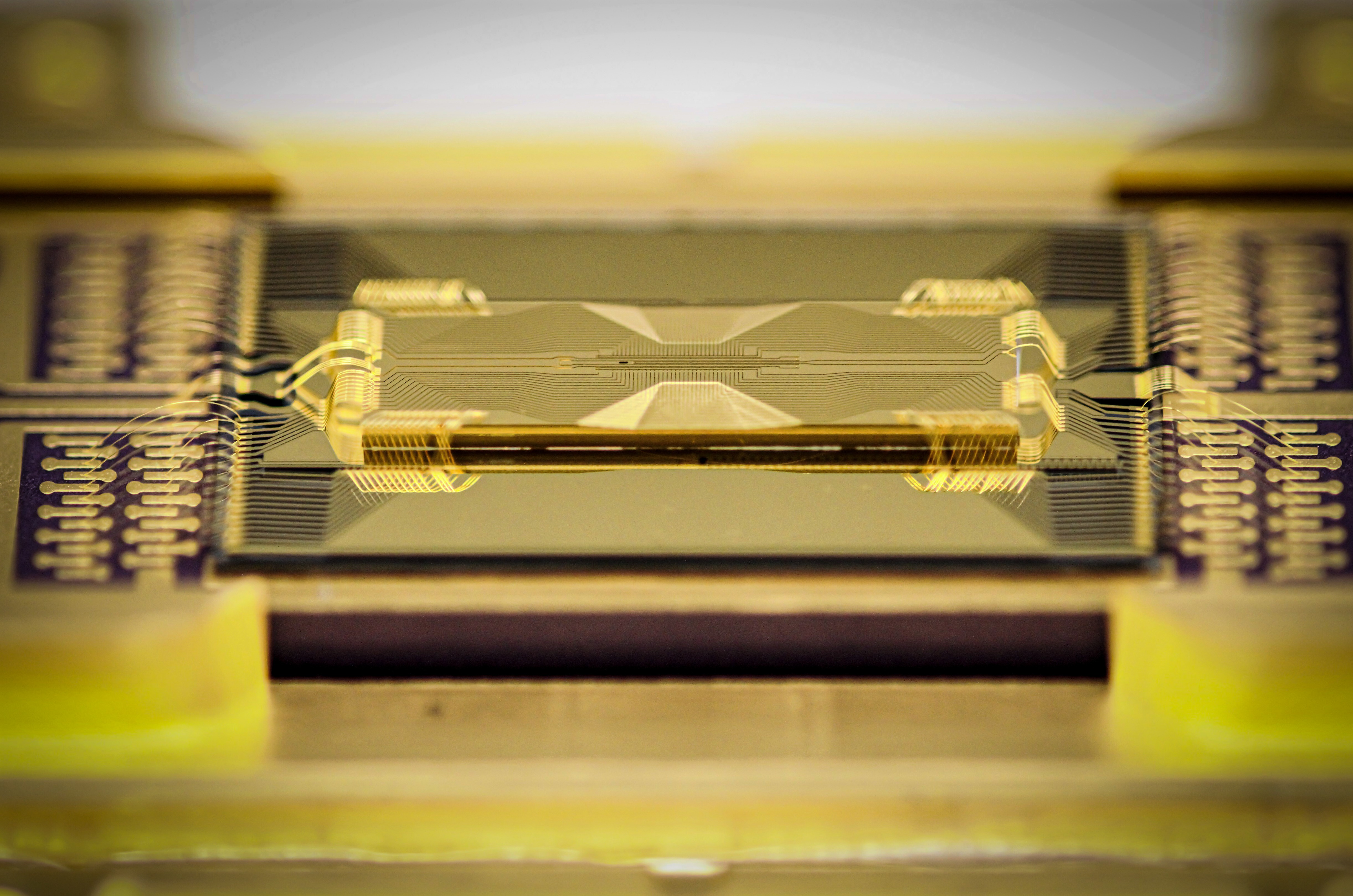
SkyWater is the largest exclusively U.S.-owned pure-play semiconductor foundry and holds rare DMEA Category 1A Trusted Foundry accreditation, making it a critical partner for defense and government programs that require secure domestic supply chains. By bringing SkyWater in-house, IonQ gains direct control over advanced chip design, packaging, and fabrication — capabilities essential for scaling trapped-ion quantum systems.
IonQ CEO Niccolo de Masi called the deal “transformational,” stating it will “materially accelerate its quantum computing roadmap and secure its fully scalable supply chain domestically.” SkyWater CEO Thomas Sonderman added that the combination will “accelerate multiple engineering pathways for next-generation quantum chips, delivering speed, precision, and scale.”
Growth by Acquisition
The acquisition builds on IonQ’s 2025 purchases of Oxford Ionics for over $1 billion, Lightsynq Technologies, and Capella Space, further widening its lead in building a full-stack platform that spans hardware, software, networking, sensing, and now chip fabrication.
IonQ expects the integration to reduce wafer iteration times, enable parallel prototyping, and speed functional testing. The company now anticipates starting functional testing of 200,000-qubit chips in 2028 — earlier than previously projected — while accelerating its path to 2,000,000-qubit systems by up to a year.
SkyWater’s facilities in Minnesota, Florida, and Texas will become Regional Quantum Production Hubs, supporting secure U.S.-based production for quantum computing, networking, security, and sensing applications.
Market Reaction and Financial Context
IonQ shares rose about 7% in morning trading following the announcement, while SkyWater jumped nearly 6%. The move positions IonQ to emulate vertically integrated leaders like Nvidia (NASDAQ:NVDA) in an emerging field.
For context, IonQ reported strong 2025 momentum: third-quarter revenue reached $39.9 million — up 222% year-over-year — with full-year 2025 guidance raised to $106 million to $110 million, implying around 150% growth. Cash reserves stood at $1.5 billion, supporting aggressive R&D without immediate profitability pressure.
Pure-play competitors such as Rigetti Computing (NASDAQ:RGTI) and D-Wave Quantum (NYSE:QBTS) remain largely dependent on third-party foundries and lack IonQ’s breadth of acquisitions and domestic trusted-foundry access. IonQ’s trapped-ion systems already operate at room temperature with two-qubit gate fidelities above 99.9%, advantages that reduce cooling complexity and improve scalability versus superconducting approaches used by many rivals.
JPMorgan analyst Peter Peng noted that the SkyWater transaction helps IonQ emulate Nvidia’s vertically integrated model and positions it to capture portions of a projected $46 billion to $97 billion market by 2035 across computing, sensing, and communications.
Key Takeaway
IonQ is definitely not a stock for everyone. It trades at extreme multiples — forward price-to-sales around 246 times trailing revenue of just $43 million — and persistent operating losses. Quantum computing also remains highly speculative: fault-tolerant systems that deliver real-world advantage are still years away, and technical hurdles around error rates, scaling, and commercial use cases persist. Competition from deep-pocketed giants like IBM (NYSE:IBM), Google, and Microsoft (NASDAQ:MSFT) is intensifying.
For risk-tolerant investors who believe quantum will be the next AI-scale disruption, however, IonQ is increasingly the clearest pure-play path — now with its own U.S.-based foundry, a growing acquisition track record, and a widening moat.












 Top Gaining Stocks
 Top Losing Stocks