


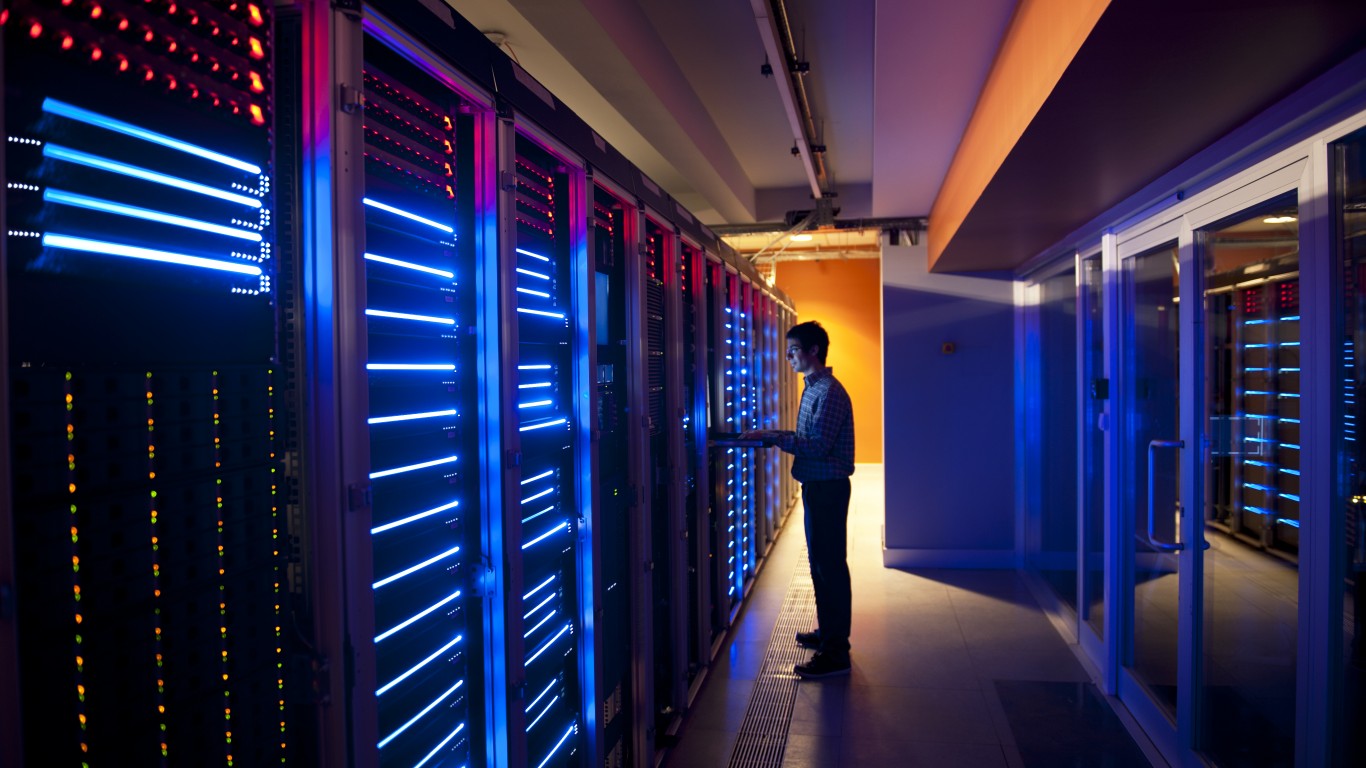
Nebius Group (NASDAQ:NBIS | NBIS Price Prediction) was pulled out of obscurity earlier this year when Nvidia (NASDAQ:NVDA) revealed its hidden investment portfolio had taken a stake in the AI data center stock. It participated in a $700 million private placement last December and today owns nearly 1.2 million shares valued at about $112 million at current prices. It has quickly become a pivotal force in the AI infrastructure landscape, capitalizing on the explosive need for GPU-intensive processing.
This focus has driven remarkable growth, with core AI revenues soaring approximately 400% year-over-year and 40% quarter-over-quarter in the latest period. The stock surged to record highs last month, reflecting investor enthusiasm for its positioning in the booming AI sector.
Yet, shares have since plummeted 33% from that peak, including a sharp 20% decline over the past week. The downturn traces back to third-quarter earnings that fell short of revenue expectations, raising flags about near-term margins strained by aggressive investments in expansion. Despite this, deeper indicators reveal resilience and untapped potential that savvy investors should not overlook.
Harnessing Power as the Ultimate AI Enabler
In the race to dominate AI, energy supply emerges as the primary limiting factor, far more than chip availability. Microsoft (NASDAQ:MSFT) CEO Satya Nadella recently said, “compute is not the bottleneck, but energy and data center space is.”
Each additional unit of electricity directly correlates to the number of high-performance accelerators a data center can support, unlocking greater computational output and sales.
Nebius’s ambitious hike in contracted capacity goals to 2.5 gigawatts by late 2026 — up from earlier projections — underscores a strategic bet on sustained demand. This scale isn’t arbitrary; it aligns with the reality that AI training and inference require vast energy resources, often equivalent to those needed to power small cities.
Achieving multi-gigawatt operations would enable Nebius to accommodate hundreds of thousands of cutting-edge GPUs, transforming it into a cornerstone provider for AI workloads. The company’s third-quarter report highlighted a complete sellout of available capacity, showcasing the market’s immediate hunger.
Such commitments don’t materialize without firm customer pipelines, which it has. Moreover, power infrastructure, once established, creates formidable barriers to entry. Competitors face prolonged timelines — typically two to three years — to develop comparable facilities, giving early movers like Nebius a durable edge.
Securing Game-Changing Partnerships with Tech Titans
Nebius’s ability to attract heavyweight clients cements its investment appeal. A newly announced five-year, $3 billion contract to deliver AI infrastructure to Meta Platforms (NASDAQ:META) exemplifies this traction, as does its $17.4 billion deal with Microsoft, which is also aggressively building out its AI capabilities. These partnerships validate Nebius’s technical prowess and reliability in handling mission-critical operations, positioning it for exponential scaling.
Even amid the recent earnings miss — where overall sales hit $146 million against estimates of $156 million — adjusted earnings surpassed forecasts. EBITDA of negative $5.2 million versus negative $5.8 million expected amid heavy capex signals efficiency and disciplined management.
Hyperscaler deals also enhance economies of scale, reducing per-unit costs as volume ramps up. In an era where AI spending is projected to exceed trillions globally, Nebius’s role as a preferred supplier could translate to market share gains, especially as smaller players struggle with funding or regulatory hurdles for power development.
Building a Revenue Flywheel
The true allure of Nebius lies in its business model’s inherent compounding dynamics. Substantial upfront investments in data centers yield recurring revenues as clients embed their operations within the ecosystem. AI workloads are notoriously sticky; once optimized on a platform with assured power and cooling, migration becomes prohibitively expensive and disruptive. This leads to extended contracts and upgrades through successive hardware generations, creating a self-reinforcing cycle of growth.
Looking ahead, the company’s 2026 annual recurring revenue target of $8 billion — dwarfing current figures — reflects confidence in this trajectory. While funding the buildout may involve dilution or debt, the payoff potential overshadows these risks, particularly given the sold-out quarters and robust demand signals.
Power scarcity will continue to constrain rivals, amplifying Nebius’s advantages. Broader market trends, such as increasing AI adoption in enterprise and consumer applications, further support this outlook. Investors fretting over short-term misses may miss the forest for the trees, as the stock’s correction presents an entry point into a high-conviction play on AI’s infrastructural backbone.
Key Takeaway
Collectively, these elements forge a powerful bull case for Nebius at current levels. The share price retreat discounts explosive AI revenue growth, capacity exhaustion, and landmark deals with industry leaders like Meta and Microsoft. Scaling to gigawatt-class power infrastructure ensures sustained dominance in a sector where energy access is king, fostering sticky customer relationships and compounding returns.
With clear visibility into multi-billion-dollar ARR by 2026, the present valuation dip ignores the long-term catalysts, making now an opportune moment to buy before broader recognition drives a rebound.










 Top Gaining Stocks
 Top Losing Stocks