


AT&T (NYSE: T | T Price Prediction) and Verizon (NYSE: VZ) both reported Q3 earnings in late October, revealing two telecom giants moving in sharply different directions. AT&T leaned into its fiber-wireless convergence bet while Verizon signaled an urgent need for transformation.
Fiber Fuels AT&T While Verizon Faces Revenue Pressure
AT&T posted $30.70 billion in revenue, missing estimates by $190 million but growing 1.6% year over year. Consumer fiber broadband jumped 16.8% to $2.2 billion. Management highlighted that 41% of AT&T Fiber households now also subscribe to AT&T Mobility, validating CEO John Stankey’s convergence strategy of “winning the race to lead in convergence.” Mobility service revenue climbed 2.3% to $16.9 billion.
Verizon missed revenue estimates by a far wider margin, reporting $33.82 billion against a $35.31 billion consensus—a $1.49 billion shortfall. Wireless service revenue grew just 2.1% to $21.0 billion, while equipment revenue rose 5.2% to $5.6 billion on device upgrade cycles. Net income surged 48% to $5.06 billion, reflecting margin expansion rather than top-line momentum.
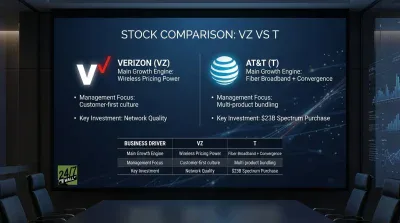
| Metric | AT&T | Verizon |
| Revenue Growth | +1.6% YoY | +1.5% YoY |
| Revenue vs. Estimate | $30.70B (missed by $190M) | $33.82B (missed by $1.49B) |
| Key Growth Driver | Fiber broadband (+16.8%) | Equipment sales (+5.2%) |
| Strategic Focus | Fiber-wireless convergence | Cultural transformation |
One Invests While the Other Restructures
AT&T spent $23 billion to acquire low-band and mid-band spectrum from EchoStar, signaling continued investment in network capacity. The company repurchased $1.5 billion in shares during Q3, bringing year-to-date buybacks to $2.4 billion. Free cash flow reached $4.9 billion, up from $4.6 billion the prior year. Management reiterated guidance for 3% or better mobility service revenue growth and mid-to-high-teens fiber broadband expansion.
Verizon took a different path. CEO Dan Schulman described the company as standing at “a critical inflection point” and promised to “aggressively transform our culture, our cost structure, and the financial profile.” Three weeks after earnings, Verizon announced plans to eliminate 15,000 jobs—15% of its workforce and the largest layoff in company history. The company will also convert 200 stores to franchises. A Reddit post in r/stocks capturing the news drew 1,375 upvotes and 183 comments.
What Comes Next for Both Businesses
AT&T needs to prove fiber growth can sustain mid-teens gains as penetration increases. The convergence strategy looks promising at 41% attachment, but maintaining momentum requires consistent execution.
Verizon faces a more urgent test. The 15,000 job cuts must deliver cost savings without damaging service quality in a business where customer experience drives retention. Management guided for just 2.0% to 2.8% wireless service revenue growth, well below AT&T’s 3%+ target.
Comparing Strategic Positions
AT&T’s fiber-wireless convergence strategy is showing measurable results, with 16.8% broadband growth and 41% household attachment rates. The company returned $2.4 billion to shareholders while investing $23 billion in strategic spectrum. Management reiterated guidance for 3% or better mobility service revenue growth and mid-to-high-teens fiber broadband expansion.
Verizon is pursuing a different approach focused on transformation. The company’s 15,000 job cuts and cultural overhaul represent a significant restructuring effort. Management guided for 2.0% to 2.8% wireless service revenue growth. Verizon’s 6.56% dividend yield reflects the company’s continued commitment to shareholder returns, having raised its dividend for the 19th consecutive year.











 Top Gaining Stocks
 Top Losing Stocks