


Retirees hunting for monthly income often gravitate toward familiar dividend aristocrats or high-yield bond funds, but many are missing a compelling option hiding in plain sight. Vanguard Emerging Markets Government Bond ETF (NYSEARCA:VWOB | VWOB Price Prediction) delivers consistent monthly distributions, a 5.66% yield, and something most income investors don’t expect from bond funds: meaningful capital appreciation.
The Return Engine: Income Plus Surprise Gains
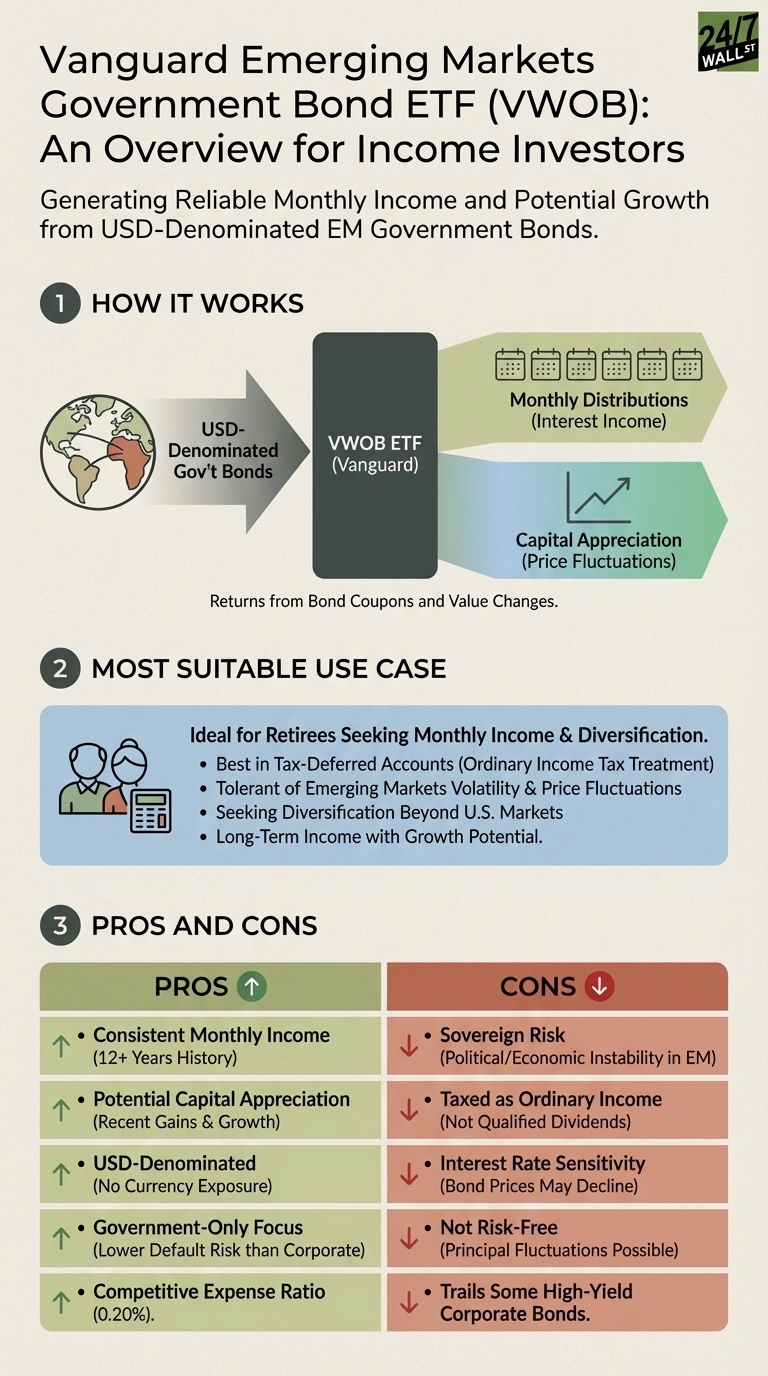
VWOB tracks USD-denominated government bonds issued by emerging market countries. The fund generates returns through two channels: interest income from bond coupons, distributed monthly to shareholders, and price appreciation as bond values fluctuate with interest rates and credit conditions.
The income story is straightforward. VWOB has paid monthly distributions for over 12 years, with recent payments averaging $0.32 per share. These distributions have grown roughly 14% over the past two years, from around $0.28 monthly in 2023 to $0.32 in 2025, providing a modest inflation hedge.
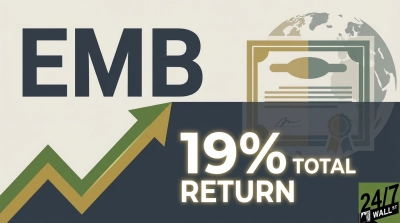
The surprise benefit is capital appreciation. Shares have climbed 13.5% year-to-date through December 19, 2025, rising from $59.41 to $67.43. Combined with the 5.66% yield, total returns exceed 19% for the year. Over the past decade, the fund has delivered 50% cumulative returns, proving that emerging markets bonds offer more than just income.
Does It Deliver for Retirees?
VWOB succeeds at its core mission: generating reliable monthly income with diversification beyond U.S. markets. The fund’s government-only focus reduces default risk compared to corporate emerging markets debt, while USD denomination eliminates currency exposure for American retirees.
The 0.20% expense ratio is competitive, though not the lowest in the category. More importantly, the fund has demonstrated resilience through multiple rate cycles while maintaining distribution consistency.
The Tradeoffs
Emerging markets bonds carry sovereign risk. Economic instability or political turmoil in countries like Brazil, Mexico, or Indonesia can impact bond prices and income stability. While government bonds are less risky than corporate debt, they’re not risk-free.
Tax treatment is another consideration. Distributions are primarily interest income, taxed as ordinary income rather than qualified dividends. Retirees in higher tax brackets should consider holding VWOB in tax-deferred accounts.
Finally, while the fund has delivered capital appreciation recently, bond funds can experience price declines during rising rate environments or emerging markets stress periods.
Who Should Avoid VWOB
Investors seeking maximum current income should look elsewhere. The 5.66% yield, while attractive, trails some high-yield corporate bond funds. Conservative retirees uncomfortable with emerging markets exposure or those requiring absolute capital preservation should stick with Treasury funds or money market accounts.
Consider EMB as an Alternative
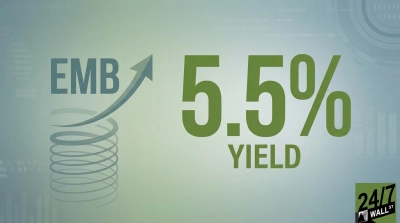
iShares J.P. Morgan USD Emerging Markets Bond ETF (NYSEARCA:EMB) offers a similar strategy with $15.7 billion in assets, providing superior liquidity for larger positions. However, EMB charges 0.39% annually versus VWOB’s 0.20%, and yields slightly less at 5.50%. For cost-conscious investors, VWOB’s lower fees and comparable performance make it the better value.
VWOB fits best in diversified retirement portfolios seeking monthly income with growth potential, but emerging markets volatility means it’s not suitable for investors who can’t tolerate principal fluctuations.










 Top Gaining Stocks
 Top Losing Stocks