


The iShares J.P. Morgan USD Emerging Markets Bond ETF (NYSEARCA:EMB | EMB Price Prediction) is delivering something rare: double-digit price appreciation without touching overheated US equities. The fund has returned 13.4% year-to-date while throwing off a 5.5% dividend yield, putting total returns near 19% for 2025. That’s within striking distance of the S&P 500’s 16% performance, but without the nosebleed valuations that have investors nervous heading into 2026.
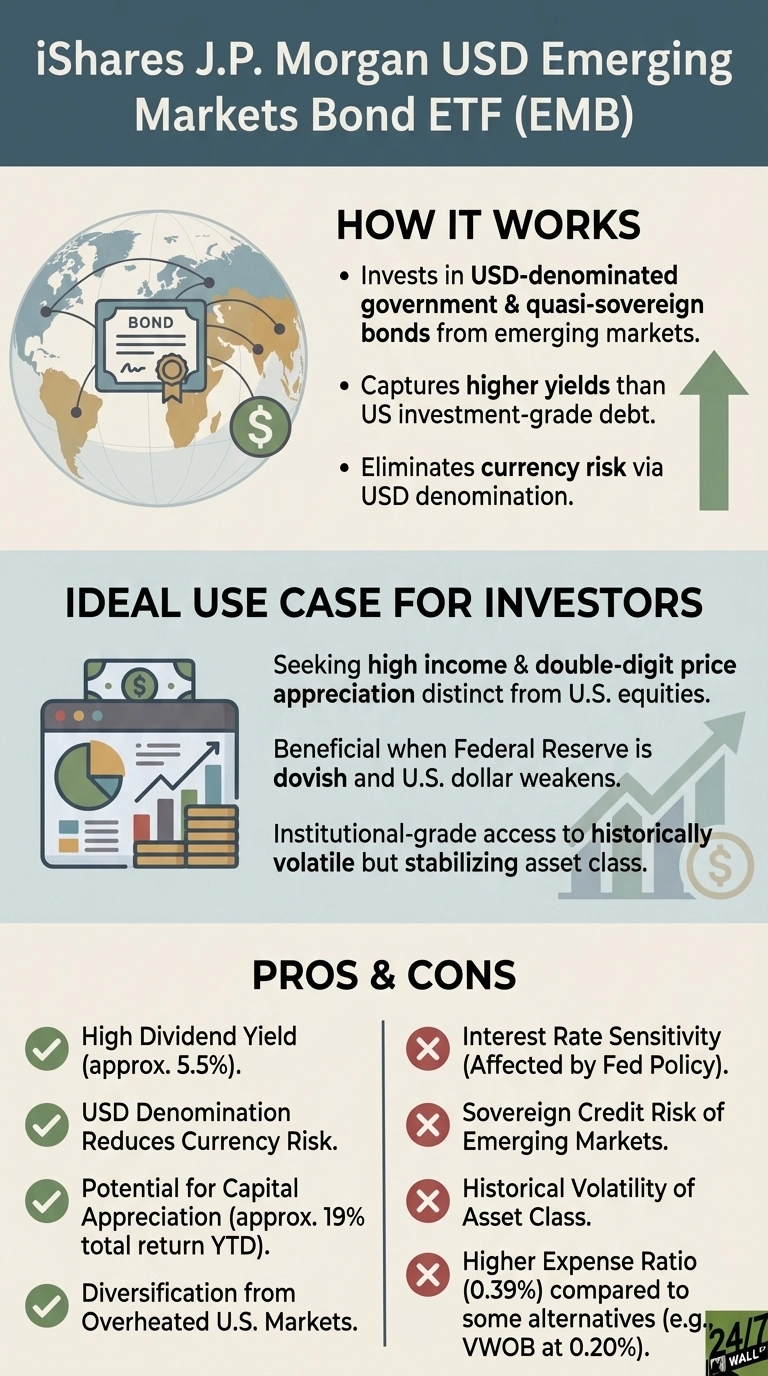
EMB holds USD-denominated bonds issued by emerging market governments and quasi-sovereign entities. The dollar denomination eliminates currency risk while capturing higher yields than US investment-grade debt. With $15.7 billion in assets and a 0.39% expense ratio, the fund offers institutional-grade access to a historically volatile asset class showing surprising stability. Institutional investors hold over 91% of shares, suggesting professional allocators see value beyond the headline yield.
The Fed Pivot That Could Supercharge EM Bonds
The biggest macro factor for EMB in 2026 is the Federal Reserve’s rate trajectory. Emerging market bonds historically rally when the Fed turns dovish and the dollar weakens. Markets are pricing in potential rate cuts for 2026 as inflation moderates and growth concerns mount. Each 25 basis point cut makes EM yields more attractive on a relative basis while reducing the dollar’s appeal as a safe haven.
Watch the Fed’s quarterly Summary of Economic Projections and the dot plot released after each FOMC meeting. If the median projection shifts toward two or more cuts in 2026, expect EM bonds to benefit from both spread compression and increased capital flows. The December 2025 meeting signaled a more cautious Fed, setting the stage for potential easing.
Secondary factors include emerging market central bank policy discipline and commodity price stability, both of which have improved markedly. India’s inclusion in major EM bond indices during 2025 has driven structural inflows that should continue through 2026.
Income Consistency and Portfolio Mechanics
EMB’s monthly distributions have ranged from $0.38 to $0.42 per share recently, translating to that 5.5% annualized yield. Unlike equity-focused income strategies relying on option premiums or leverage, EMB’s yield comes directly from bond coupons, making it more predictable. The fund’s 12% portfolio turnover keeps trading costs low and tax efficiency high.
Monitor BlackRock’s monthly fact sheets for shifts in duration or credit quality. The fund typically maintains exposure across investment-grade and high-yield EM debt. Watch for changes in country allocation, particularly exposure to higher-risk sovereigns if spreads tighten too aggressively.
Consider VWOB for Lower Costs
The Vanguard Emerging Markets Government Bond ETF (NASDAQ:VWOB) offers similar exposure with a 0.20% expense ratio, nearly half EMB’s cost. VWOB’s $6.8 billion in assets provides adequate liquidity while potentially adding 19 basis points annually to returns through fee savings alone.
The key for 2026: watch Fed policy for rate cut signals and monitor EMB’s monthly distributions for yield sustainability as EM fundamentals continue strengthening.









 Top Gaining Stocks
 Top Losing Stocks