


The hardest part about investing in artificial intelligence isn’t believing in the technology—it’s deciding which companies will actually profit from it. Will chip makers dominate? Cloud providers? Software platforms? Infrastructure builders? The answer is probably all of them, which is why iShares Future AI & Tech ETF (NYSEARCA:ARTY) has become popular for investors wanting broad AI exposure without concentrated bets.
What ARTY Actually Does
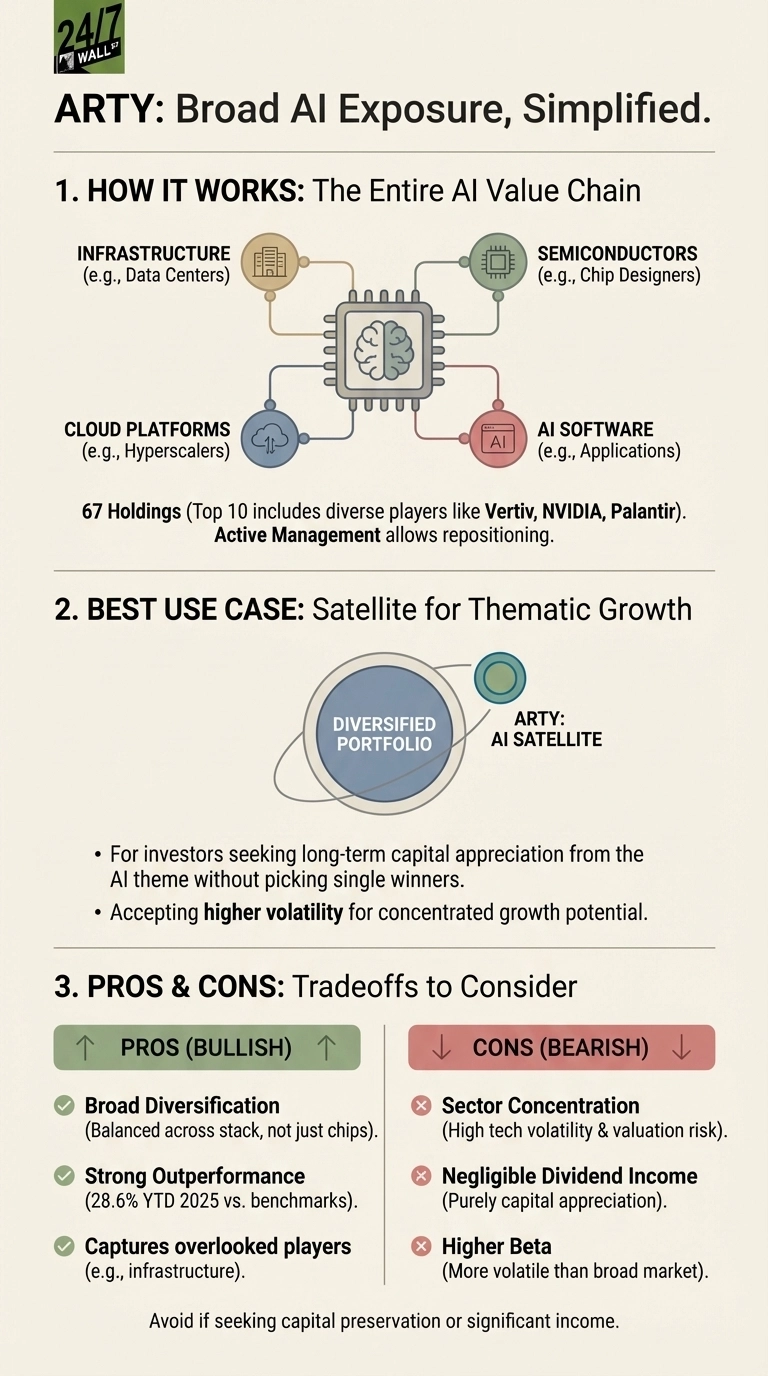
ARTY provides exposure to the entire AI value chain through a single ticker. With $1.9 billion in assets and a 0.47% expense ratio, the fund holds 67 companies spanning semiconductors, data center infrastructure, cloud platforms, and AI software. The portfolio tilts heavily toward technology at 66.4%, but captures less obvious AI plays. Vertiv Holdings (NYSE:VRT | VRT Price Prediction), a data center infrastructure company, is the fund’s largest holding at 5.95%—bigger than NVIDIA (NASDAQ:NVDA)’s 4.3%, revealing a sophisticated thesis: AI needs massive physical infrastructure most investors overlook.
The diversification is real. No single holding exceeds 6%, and the top 10 include chip designers (Advanced Micro Devices (NASDAQ:AMD), Broadcom (NASDAQ:AVGO), NVIDIA), networking equipment (Arista Networks (NYSE:ANET)), AI platforms (Palantir Technologies (NYSE:PLTR), MongoDB (NASDAQ:MDB)), and hyperscalers (Alphabet (NASDAQ:GOOGL), Microsoft (NASDAQ:MSFT), Amazon (NASDAQ:AMZN)). One Reddit user on r/ETFs discussed AI-focused ETFs, writing: “ARTY is a good choice if you want exposure to the entire AI stack – from infrastructure (data centers, chips) to software and applications. It’s more balanced than just buying NVIDIA or pure-play chip ETFs.” This observation highlights how ARTY balances infrastructure with software layers of the AI stack.
Performance That Justifies the Thesis
ARTY delivered a 28.6% return year-to-date through December 2025, crushing both the S&P 500’s 16.1% and the Nasdaq-100’s 20.7%. That’s over 12 percentage points of alpha versus the broad market and nearly 8 points versus a tech-heavy benchmark.
The fund’s 119% portfolio turnover reflects active management, allowing repositioning as the AI landscape evolves.
The Tradeoffs You’re Accepting
ARTY is a concentrated sector bet. With two-thirds in technology, you’re exposed to tech sector volatility and valuation risk. When AI enthusiasm cools or interest rates spike, this fund will feel it harder than a diversified portfolio. The 1.52 equity beta confirms higher volatility than the broader market.
You’re also accepting negligible dividend income. The fund’s yield is essentially zero, making this purely a capital appreciation play.
Who Should Skip This
Conservative investors nearing retirement should avoid ARTY. The volatility and lack of income make it unsuitable for capital preservation. Investors with significant direct holdings in NVIDIA, Microsoft, or other mega-cap tech names may find they’re doubling down on existing positions, negating the diversification benefit.
Consider BOTZ as an Alternative
Global X Robotics & Artificial Intelligence ETF (NASDAQ:BOTZ) offers a different angle with $3 billion in assets and broader sector exposure. While BOTZ charges a higher 0.68% expense ratio, it allocates only 26.5% to technology, spreading risk across healthcare robotics, industrial automation, and international companies. The tradeoff? BOTZ has significantly underperformed, gaining just 12.8% year-to-date versus ARTY’s 28.6%. If you want lower concentration risk and don’t mind sacrificing returns, BOTZ provides more defensive positioning.
ARTY works best as a satellite position for investors who believe AI infrastructure and software will drive the next decade of tech growth but don’t want to pick individual winners. Just understand you’re accepting higher volatility in exchange for concentrated exposure to one of the market’s most compelling themes.














 Top Gaining Stocks
 Top Losing Stocks