



When currency swings punish domestic investors and geopolitical headlines scream crisis, the stocks underneath often tell a different story. European equities have delivered that contrast in 2025, with quality blue chips outpacing both U.S. benchmarks and the AI darlings that dominated 2024.
What BBEU Actually Does in a Portfolio
JPMorgan BetaBuilders Europe ETF (NYSEARCA:BBEU | BBEU Price Prediction) provides low-cost exposure to developed European large caps. With a 0.09% expense ratio and $8.4 billion in assets, it tracks hundreds of European stocks weighted by market cap. The fund returned 36.9% year-to-date through late December 2025, more than doubling the S&P 500’s 17.8% gain.
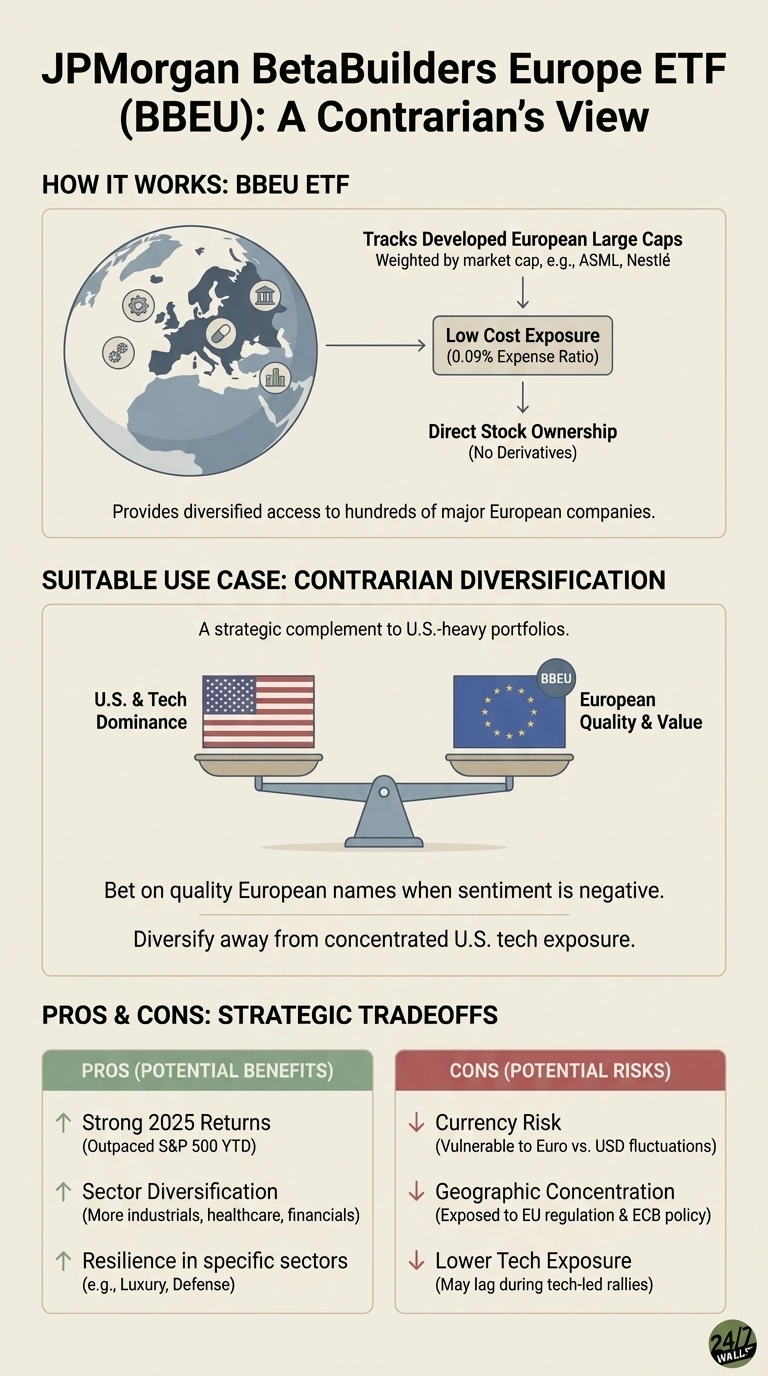
The return engine is straightforward appreciation of underlying positions. No derivatives, no leverage, no options overlay. You own pieces of ASML Holding (NASDAQ:ASML) (3.3% of assets), AstraZeneca (NASDAQ:AZN) (2.2%), Roche Holding (OTCMKTS:RHHBY) (2.2%), HSBC Holdings (NYSE:HSBC) (2.0%), and Nestlé (OTCMKTS:NSRGY) (2.0%). These are global leaders in semiconductors, pharmaceuticals, banking, and consumer staples domiciled in Europe.
Defense contractors like Rheinmetall and BAE Systems have benefited from European rearmament. Luxury names like LVMH and Hermès have proven resilient despite economic headwinds. The portfolio also includes SAP (NYSE:SAP), Siemens, and Airbus.
Performance That Contradicts the Narrative
While NVIDIA (NASDAQ:NVDA) posted strong gains in 2025, BBEU delivered 36.9%, outpacing the S&P 500’s 17.8%. Retail sentiment hasn’t caught up. In October, BBEU saw $678.7 million in inflows during a single week, a 16.4% surge in outstanding units that signaled institutional conviction even as retail investors stayed away.
The Tradeoffs You Accept
Currency risk cuts both ways. European investors holding U.S. stocks lost 14% to euro strength in 2025, but American investors in BBEU gained from dollar weakness. When the dollar rallies, those gains reverse.
Geographic concentration matters. You’re exposed to European regulatory environments, ECB monetary policy, and regional economic cycles. Polymarket prediction markets show just 1.3% odds of aggressive ECB rate cuts in February 2026, suggesting the market doesn’t expect crisis, but European growth has lagged the U.S. for years.
Sector composition differs from U.S. indexes. Europe has less tech exposure and more financials, healthcare, and industrials. That diversification helps when tech stumbles, but it caps upside when software and semiconductors dominate.
Who Should Skip This
If you’re building wealth through high-growth technology and can’t tolerate periods of underperformance when U.S. tech leads, BBEU will frustrate you. If you’re retired and prioritizing income, the 3.1% dividend yield is decent but not exceptional, and currency volatility adds uncertainty to distributions.
Consider VGK for Larger Scale
Vanguard FTSE Europe ETF (NYSEARCA:VGK) offers similar exposure with $24 billion in assets, triple BBEU’s size, and slightly better liquidity. The expense ratio is higher at 0.10%, but the one-basis-point difference is negligible. VGK’s larger asset base and longer track record (launched 2005 vs. 2018 for BBEU) provide more trading history and tighter spreads for larger positions.
BBEU works best as a contrarian bet on quality European names when sentiment is negative and valuations are reasonable, but currency risk and regional exposure make it a complement, not a core holding.












 Top Gaining Stocks
 Top Losing Stocks