



If you own U.S. stocks, you’ve likely questioned whether international diversification still makes sense. American equities have dominated for years, and many investors wonder if adding ex-U.S. exposure is worth it. Vanguard Total International Stock Index Fund ETF Shares (NYSEARCA:VXUS | VXUS Price Prediction) provides a single, low-cost way to own virtually every investable stock outside the United States.
The Core Role: Diversification Beyond U.S. Borders
VXUS complements U.S.-focused portfolios by offering exposure to developed and emerging markets across Europe, Asia, and Latin America. The fund’s scale matters: with $606.2 billion in net assets, it offers deep liquidity for investors entering and exiting positions. Its 0.05% expense ratio means costs won’t erode returns over decades of compounding, making it practical for long-term buy-and-hold strategies.
Geographic spread matters because different regions respond differently to economic cycles, currency movements, and policy shifts. When U.S. markets stall, international equities can provide ballast. The fund includes Canadian banks, European industrials, Japanese manufacturers, and emerging market growth stories. Reddit users frequently discuss VXUS as a hedge against U.S. dollar weakness and a way to capture growth in markets where valuations remain more attractive.
Has It Delivered on the Promise?
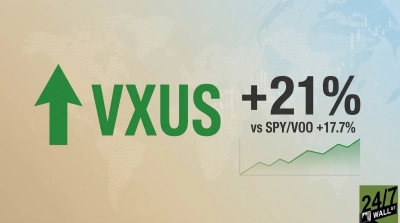
Recent performance tells an encouraging story for international diversification. VXUS returned 38.4% over the past year, significantly outpacing the 15.0% gain from Vanguard Total Stock Market ETF (NYSEARCA:VTI). This reversal suggests international markets may finally be catching up after a prolonged period of underperformance, driven by improving valuations in European and Asian markets.
The five-year view requires more patience. VXUS gained 51.8% compared to VTI’s 66.4% climb over that period. The gap reflects structural advantages U.S. markets enjoyed from technology sector dominance and stronger economic growth, but also highlights why diversification matters when leadership rotates.
The fund’s composition explains its different return profile. VXUS provides cost-effective access to sectors underrepresented in U.S. indexes, with significant exposure to financials and energy infrastructure through holdings like Royal Bank of Canada (NYSE:RY) and Enbridge (NYSE:ENB). These stable, cash-generating businesses offer dividends rather than explosive growth, creating a natural hedge against U.S. tech concentration risk.
The Tradeoffs You Accept
Owning VXUS means accepting three key tradeoffs. First, currency risk cuts both ways. A stronger dollar reduces returns for U.S. investors, while a weaker dollar boosts them. Second, you’re betting on mean reversion. If international markets continue lagging, your diversification comes at a performance cost. Third, broad diversification means exposure to slower-growing developed markets alongside higher-risk emerging economies.
VXUS works best for investors who believe U.S. outperformance won’t last forever and want protection against dollar depreciation, but it requires patience and a long time horizon.









 Top Gaining Stocks
 Top Losing Stocks