


Analysts anticipated weak fourth-quarter vehicle deliveries from Tesla (NASDAQ:TSLA | TSLA Price Prediction), with estimates indicating a 15% decline as consumer demand dried up due to the expiration of federal electric vehicle (EV) tax credits. Having pulled sales forward into the company’s third quarter, which saw record deliveries, even CEO Elon Musk admitted Tesla was facing a few difficult quarters.
The EV maker just reported the Q4 numbers this morning, and they were worse than what Wall Street thought as deliveries fell16% year over year. It marks the second consecutive year of falling sales. The disappointing results mean Chinese rival BYD surpassed Tesla to become the largest battery EV company in the world.
U.S. EV Demand Hits the Brakes
U.S. EV sales slowed sharply in 2025 after the $7,500 federal tax credit expired on Sept. 30. Tesla compiled Wall Street’s consensus estimates on its site last month showing analysts expected it to deliver 422,850 EVs in Q4, though some, like FactSet, were higher at 440,260 deliveries. The actual number, however, came in at 418,227, down from 490,570 in Q4 2024. Full-year deliveries totaled 1,636,129, an 8.5% decline from 2024.
U.S. sales spiked in September to give EVs an 11.6% market share, but they plunged 50% in October, dropping EVs to a 5.9% share. Automakers like Ford (NYSE:F) noted the potential for even further declines to 5% share without the benefit of incentives.
This could hit smaller players hard. Rivian Automotive (NASDAQ:RIVN) delivered 13,702 vehicles in Q3, but faces production swings and tariffs raising costs. Lucid Group (NASDAQ:LCID) set a Q3 record with 4,078 deliveries but cut its full-year production outlook to 18,000 to 20,000 units. Both burn cash rapidly, with Lucid posting a $978.4 million Q3 net loss. Without Tesla’s scale, these firms risk deeper struggles in a contracting market.
Musk’s DOGE Role Added Pressure
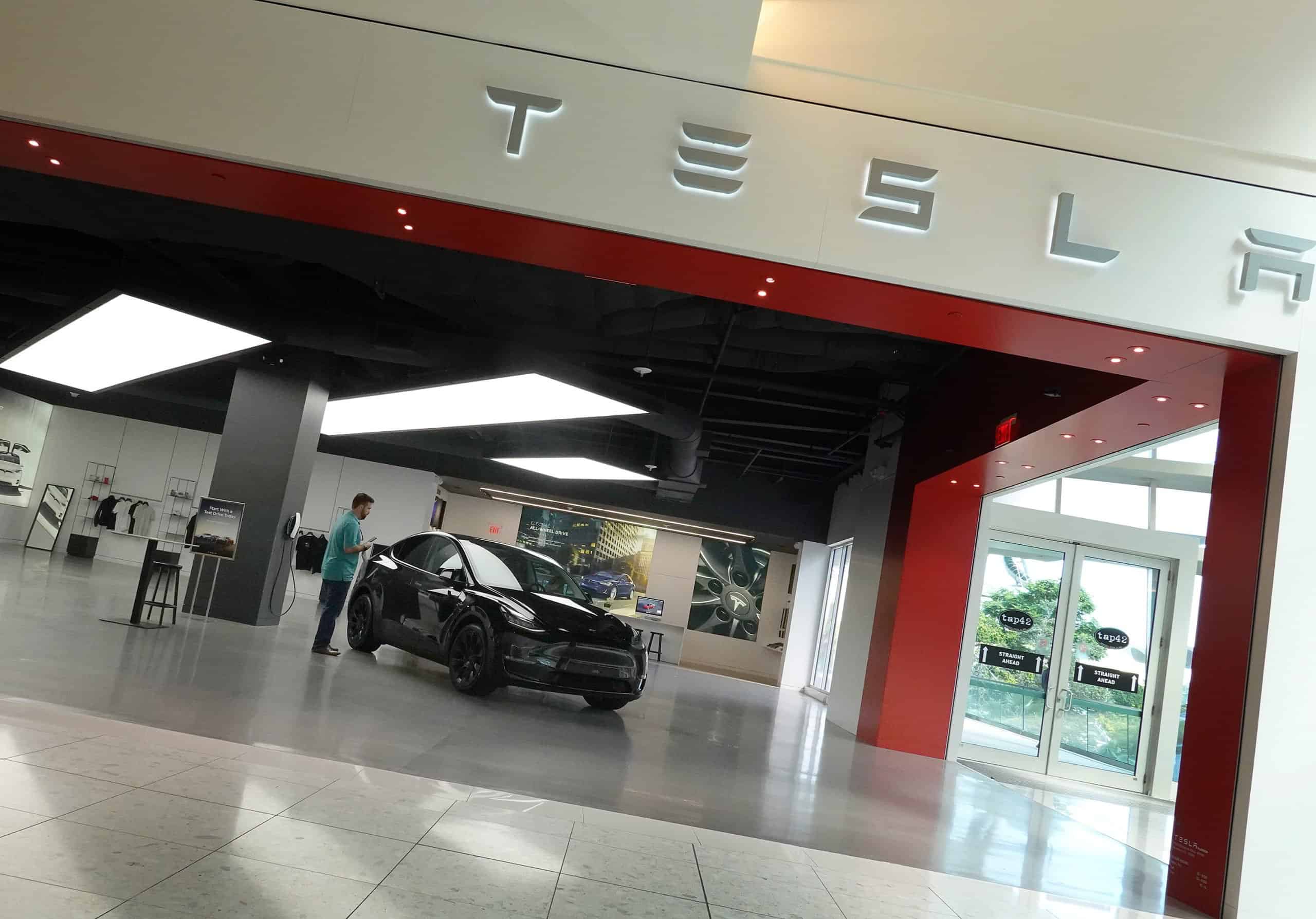
Elon Musk’s work leading the Department of Government Efficiency (DOGE) last year, identifying government waste, drew significant backlash from some quarters that amplified Tesla’s sales decline. Protests targeting Tesla showrooms resulted in vandalism, with incidents reported nationwide.
A Yale study estimated Musk’s politics cost Tesla over 1 million sales, and Musk left DOGE last April to refocus on his company again. Still, smaller EV makers like Rivian and Lucid, lacking the scale and volume advantage of their larger rival, face greater risks from the broader slowdown.
Global Sales Grow, But Unevenly
Global EV sales rose 21% to 18.5 million units in 2025, led by China’s 19% gain to 11.6 million and Europe’s 33% to 3.8 million. U.S. sales dipped 1% to 1.7 million as policy shifts disrupted the market.
Norway, though, stood out with 96%of all new vehicle registrations coming from EVs, and it reached 97.6% in December, driven by the government’s exemption on EVs from its 25% value-added tax (VAT) on car sales. In 2023, though, it introduced a 25% VAT on the amount of an EV’s price that exceeded 500,000 crowns, or $49,508. Even so, Tesla led the Norwegian market with a 19.1% market share, and its Model Y has been the best-selling EV for three straight years.
High taxes on gas-powered cars unsurprisingly boosted Norway’s EV adoption, but the VAT exemption threshold drops to 300,000 crowns in 2026, hitting Tesla’s Model Y. The VAT will be fully eliminated by 2027, which could raise Model Y costs by 75,000 crowns, potentially dampening Tesla’s sales.
While Norway is often hailed as a model to follow for EV adoption, it is not likely to be a workable solution. Norway has a land mass one-twenty-fifth the size of the U.S., and with 5.5 million people, it is akin to a city the size of Denver or Seattle.
Key Takeaway
Tesla stock opened higher this morning, along with stock market indexes, but ultimately closed down 2.6%. Part of the early resilience despite the worse-than-expected sales miss could be due in part to Tesla’s non-EV segments, such as energy storage, robotics, robotaxi, and AI, drawing greater focus.
Analysts at Morgan Stanley, for example, view 2026 as key for Tesla’s robotaxi commercialization, and energy storage saw a record 46.7 gigawatt hours deployed in the fourth quarter. With AI data centers’ insatiable demand for energy, this could be a particularly robust growth market.
Tesla may be an automobile stock, but its other businesses are likely to grow in size and importance, and those could determine its stock price going forward.







 Top Gaining Stocks
 Top Losing Stocks