



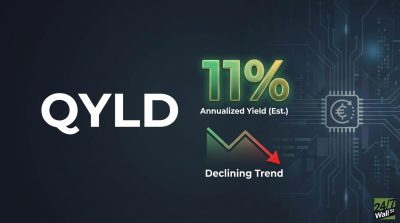
The Global X NASDAQ 100 Covered Call ETF (NYSEARCA:QYLD) has attracted income-seeking investors with its impressive 11% yield, but recent trends suggest retirees should approach this fund with caution. The sustainability of this income stream faces meaningful headwinds.
How QYLD Generates Its High Yield
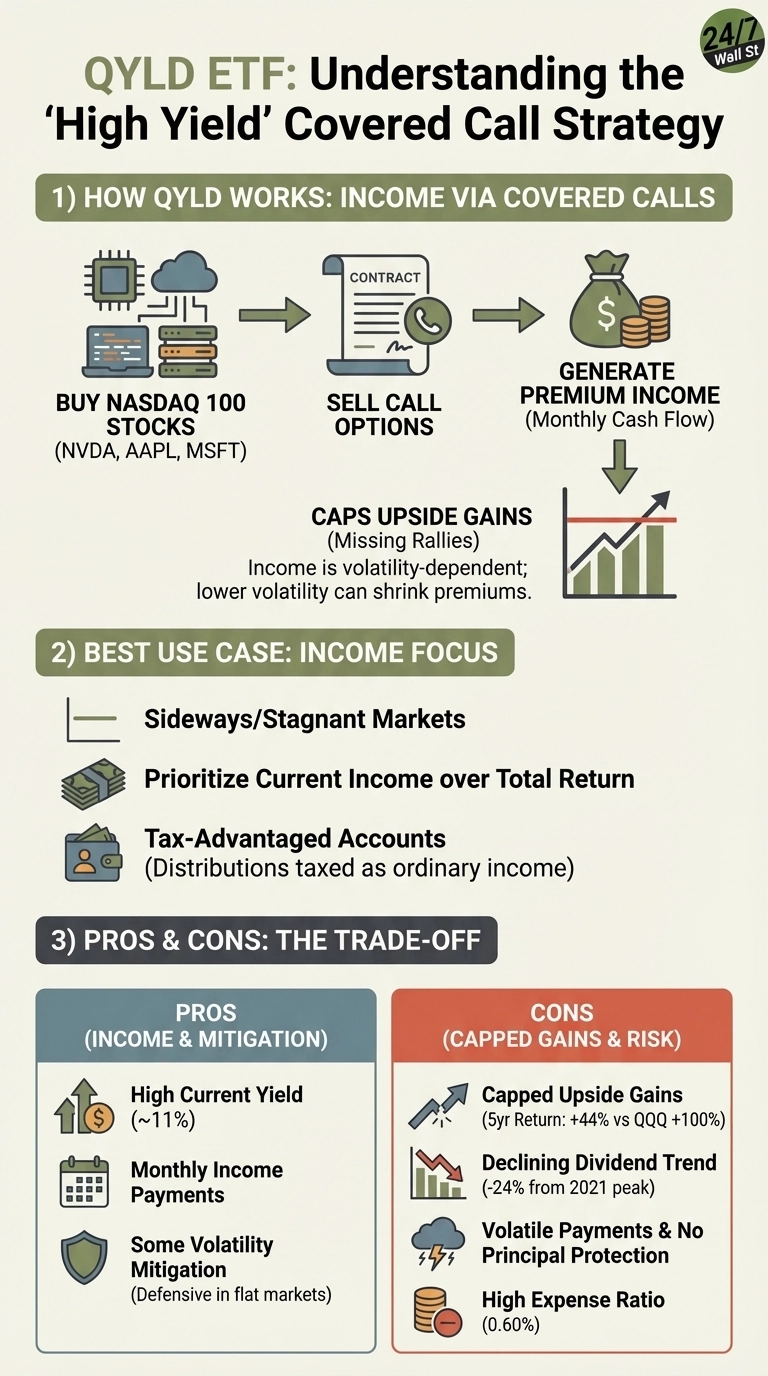
QYLD produces income through a covered call strategy on the NASDAQ 100 index. The fund holds the same tech-heavy stocks as the index—with top positions including NVIDIA (NASDAQ:NVDA | NVDA Price Prediction) (9.2%), Apple (NASDAQ:AAPL) (8.1%), and Microsoft (NASDAQ:MSFT) (7.3%)—but simultaneously sells call options on these holdings. When investors buy these call options, they pay premiums that become the fund’s primary income source. This generates consistent monthly cash flow but caps upside potential when markets rally.
The Declining Dividend Reality
QYLD’s distribution history reveals a troubling pattern. Annual payouts have declined 24% from their 2021 peak of $2.67 per share to approximately $2.04 in 2025. Monthly payments now fluctuate between $0.16 and $0.19, reflecting the volatility-dependent nature of option premium income. When market volatility drops—as it has during recent periods of steady gains—the premiums QYLD can collect shrink accordingly.
The mechanics are straightforward: covered call funds cannot grow dividends like traditional dividend stocks. They can only redistribute the option income they collect, which varies with market conditions. In low-volatility bull markets, QYLD’s income generation weakens.
The Total Return Trade-Off
More concerning for retirees is QYLD’s massive underperformance relative to simply holding the NASDAQ 100. Over the past five years, QYLD returned 44% while the Invesco QQQ Trust (NASDAQ:QQQ) delivered 100%—a 56 percentage point gap. Even accounting for QYLD’s distributions, investors sacrificed more than half the market’s gains. The 10-year comparison is starker: QYLD’s 131% total return versus QQQ’s 447%.
As Seeking Alpha analyst The Alpha Analyst noted in October 2025, “GPIQ’s active and flexible coverage is shown to outperform QYLD in various market conditions, offering better upside capture and reasonable downside protection.” Newer covered call strategies with dynamic approaches are now outpacing QYLD’s static methodology.
A More Flexible Alternative
The JPMorgan Nasdaq Equity Premium Income ETF (NASDAQ:JEPQ) employs an actively managed equity-linked notes strategy that provides similar income—currently yielding around 9%—while maintaining more flexibility to participate in market gains. The fund’s active approach allows managers to adjust option coverage based on market conditions rather than mechanically selling calls on 100% of holdings. With lower expenses and stronger total returns than QYLD, JEPQ represents an evolution in covered call strategies that addresses many of QYLD’s structural limitations. For income investors in 2026, JEPQ offers a more balanced approach to generating yield without completely sacrificing growth potential.











 Top Gaining Stocks
 Top Losing Stocks