


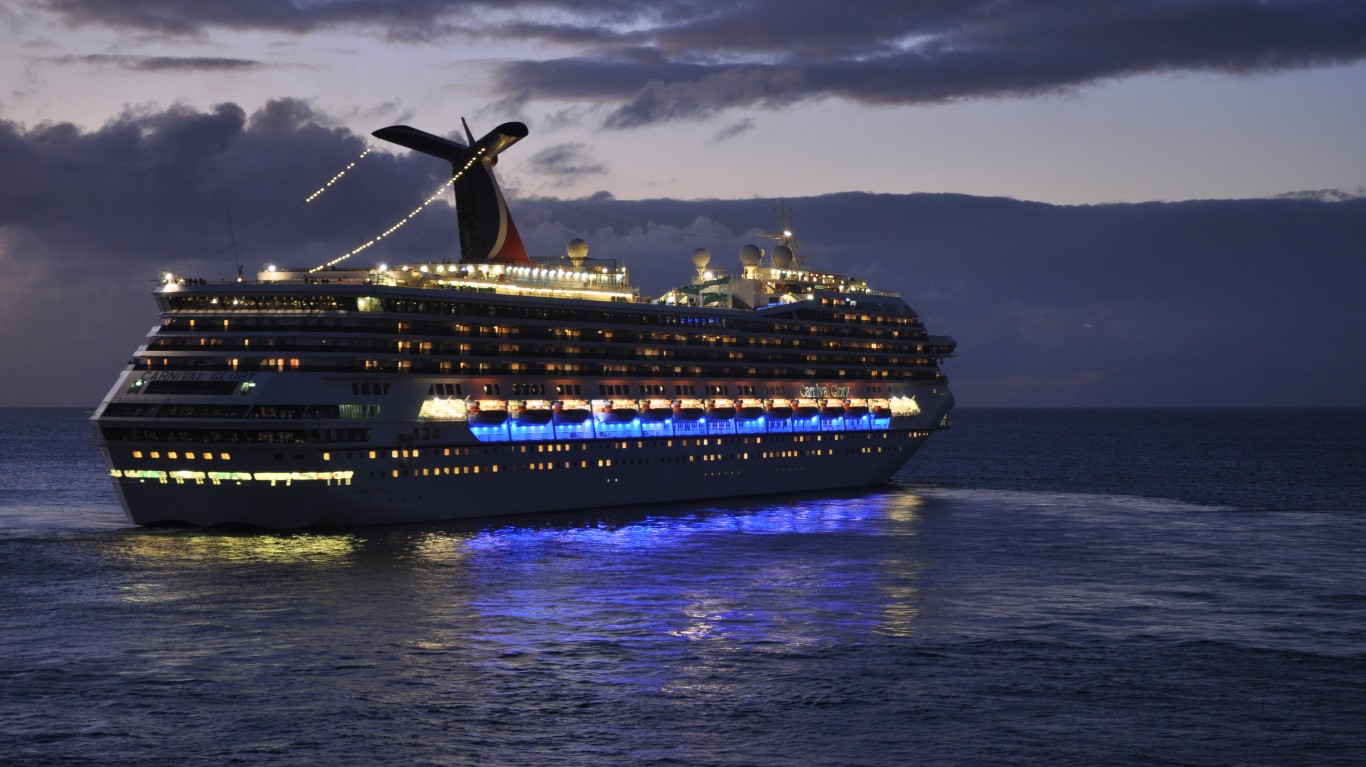
Carnival Corporation (NYSE:CCL | CCL Price Prediction) is delivering profitability metrics not seen since 2006. The company’s return on invested capital (ROIC) hit 13% in fiscal 2025, the highest level in 19 years, while generating $2.76 billion in net income on $26.62 billion in revenue. The 10.4% net margin represents a stunning recovery from the pandemic’s devastation, when the company hemorrhaged $10.24 billion in fiscal 2020 alone.
But here’s the uncomfortable question: Are we witnessing a structural transformation in cruise economics, or simply the top of a cyclical peak?
The Profitability Surge Is Real, But Context Matters
Carnival has transformed its operating leverage. EBITDA reached $6.91 billion in fiscal 2025, the highest in company history, eclipsing even the pre-pandemic peak of $5.43 billion in 2019. Operating margins expanded 250 basis points year-over-year, and the company delivered 5.5% yield improvement (revenue per passenger day) despite consumer sentiment readings hitting near-historic lows.
CEO Josh Weinstein framed this resilience during the recent earnings call:
The disconnect between consumer sentiment and actual booking behavior continues to reinforce what we’ve said for a long time. Demand for our cruise lines is proving far more resilient than traditional macro indicators would suggest.
The company is guiding toward $3.45 billion in net income for fiscal 2026, representing 12% growth on top of 2025’s 60% surge. Bookings for 2026 are two-thirds complete at “historical high prices,” and customer deposits hit an all-time high of $6.1 billion, up 7% year-over-year.
But the Balance Sheet Tells a Different Story
Strip away the income statement heroics and you find structural vulnerabilities. Carnival carries $26.8 billion in total debt, down from the $30.7 billion peak in November 2023 but still 2.3 times higher than the pre-pandemic $11.5 billion. The company’s current ratio sits at 0.32, meaning it has 32 cents in current assets for every dollar of short-term obligations. Working capital is negative $8.9 billion and worsening.
Interest expense consumed $1.35 billion in fiscal 2025, down from pandemic-era peaks but still six times the $206 million paid in 2019. The company reinstated its dividend at $0.15 quarterly after a five-year suspension, but retained earnings of $4.8 billion remain $21.8 billion below pre-pandemic levels.
Insider Actions Speak Louder Than Guidance
In late November 2025, as profitability reached 19-year highs, Chairman Micky Arison acquired 8.5 million shares. This wasn’t a sale but an acquisition, suggesting confidence at the board level. The company also repurchased 18 million shares after calling its last convertible debt.
The Cycle Question
Carnival’s competitor Royal Caribbean (NYSE:RCL) is posting even stronger metrics with a 46.7% return on equity versus Carnival’s 25.6%. The global cruise industry has 74 ships on order representing $76 billion in investment and 205,000 new beds by 2036. AAA projects a record 21.7 million American ocean cruisers in 2026.
The question isn’t whether Carnival is profitable. It demonstrably is. The question is whether pricing power and demand resilience can survive a consumer spending slowdown when the company still needs to service debt loads that would sink most businesses. Carnival has proven it can generate cash. Whether it can sustain margins if revenge travel normalizes remains the $37 billion market cap question.









 Top Gaining Stocks
 Top Losing Stocks